

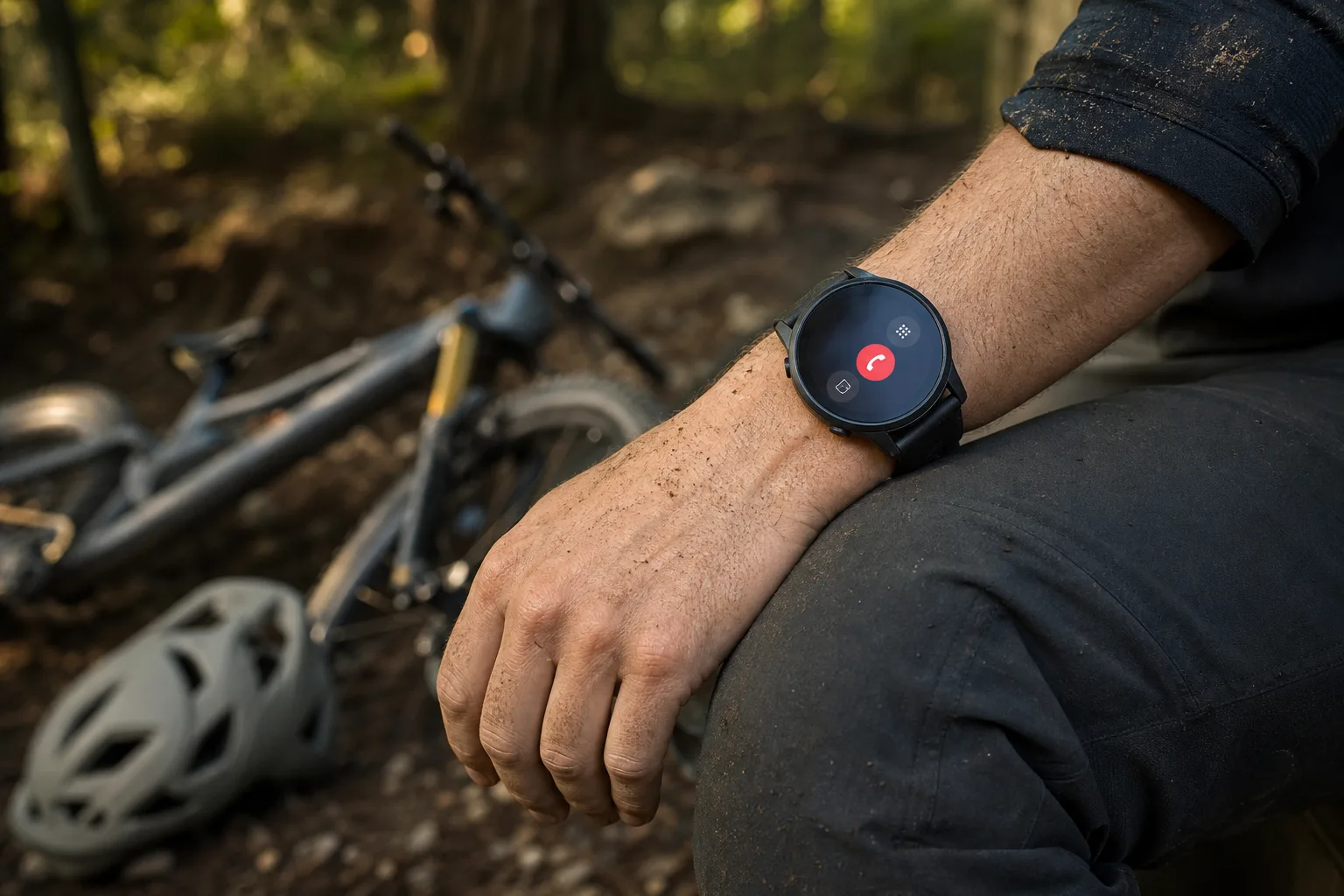
- Apple Watch safety features reportedly summoned emergency responders after cyclist Phil was knocked unconscious during a mountain biking crash.
- The Apple Watch safety story highlights Fall Detection and Emergency SOS, but neither feature should replace careful preparation outdoors.
- Phil says he broke a collarbone and seven ribs after misjudging a jump while riding with his children.
- Apple’s new video continues a marketing strategy built around genuine, high-stakes stories from wearable device users.
Table of Contents
Apple Watch safety in the moment that mattered
Apple Watch safety is easy to dismiss as a list of settings buried inside an iPhone companion app—until someone is too hurt to reach their phone. Apple’s latest customer-story video drives that home: a mountain biker named Phil was unconscious after a bad crash, and his watch reportedly called emergency services and sent responders his location.
Phil had been riding with his children when he misjudged a takeoff on a jump. The resulting fall left him with a broken collarbone and seven broken ribs, according to Apple’s account. More critically, the impact knocked him out. His Apple Watch detected the fall, placed an emergency call, and shared his position with dispatchers. Firefighters found him and brought him to hospital, where he spent a week recovering.
That sequence is the whole argument for a wearable emergency feature. Phones are usually close by, but ‘close by’ has a different meaning when you’ve landed in brush, are pinned awkwardly after a collision, or simply aren’t conscious enough to unlock a screen. A watch on the wrist is not magic, but it can be the one connected device still available when ordinary habits fail.
Apple’s video naturally presents the incident as a polished testimonial. The company commissioned it, after all. Still, the basic proposition is hard to argue with: an automated call can save precious minutes when someone cannot make one themselves. In an accident far from a trailhead or road, those minutes are not abstract.
What Apple Watch safety features actually do
The relevant Apple Watch safety tools are Fall Detection and Emergency SOS. Fall Detection looks for the motion pattern of a fall, then can call emergency services and share the wearer’s location.
Emergency SOS can also be triggered manually by holding the side button, though the exact calling flow depends on the model and regional setup. On cellular-capable models, the watch can place calls without the paired iPhone nearby if it has an active cellular service plan. GPS-only watches generally need a connected iPhone or Wi-Fi calling path. Those details matter more than glossy advertisements tend to suggest.
The company’s official safety feature guide provides more information about Apple Watch safety features.
Frankly, that caveat should be printed in large type anytime Apple Watch safety is discussed. Sensor systems make judgments from motion patterns; they cannot see a trail, assess an injury, or guarantee a cellular signal. A false alarm is possible. A serious fall may also fail to trigger detection. This is a backup system, not a substitute for telling somebody your route, bringing supplies, or riding within your limits.
But backups are exactly what people need during a messy real-world emergency. We install smoke alarms even though they occasionally complain about dinner. We wear seatbelts even though we hope they never become relevant. The watch belongs in that category.
Apple’s rescue-story marketing has become a familiar playbook
This is hardly the first time Apple has used an individual rescue to explain Apple Watch safety. At its October 2025 ‘Awe Dropping’ event, the company aired a longer segment featuring users who described medical episodes, vehicle crashes, and other emergencies in which an Apple Watch played a role. Earlier this year, Apple also ran its ‘Thankfully, I was wearing it’ campaign in China, featuring users who credited fall, crash, and heart-rate alerts with getting them help.
It is savvy marketing, and it works because it sidesteps the usual wearables sales pitch. Nobody needs another chart explaining accelerometers. A parent, cyclist, or older relative can immediately understand a story about someone who was unconscious and still got help. Apple has turned a difficult-to-demonstrate feature into an emotional product category of its own.
Other companies are chasing the same peace-of-mind market. Google’s Pixel Watch includes emergency features and fall detection in supported regions. Samsung offers SOS functions and health alerts through Galaxy Watch devices. Garmin has long pitched incident detection and assistance alerts to runners, cyclists, and backcountry athletes. The broader shift is clear: wristwear is increasingly sold not as a notification screen, but as an always-on safety companion.
The human limits behind the watch
Phil’s story does not show technology conquering a dangerous sport. It shows a small, mundane device doing one useful thing after the human part went wrong. Phil says he misjudged the jump. No software update can erase that judgment call, repair seven ribs, or make a mountain trail predictable.
Still, the Apple Watch safety pitch has gained credibility because it is rooted in a narrow promise: when a user cannot ask for help, the device may be able to ask on their behalf. That is a far more persuasive case for wearing a watch than another annual display-brightness bump.
My read is that these features will become table stakes across premium wearables, much like GPS and heart-rate monitoring did before them. The harder question is whether manufacturers can improve reliability without turning emergency services into a clearinghouse for false positives. If they can, the most valuable feature on your wrist may remain the one you never notice until everything goes wrong.

