

- Galaxy Ring sleep apnea risk monitoring is scheduled for fall 2026 after Samsung’s FDA-cleared Galaxy Watch rollout this summer.
- Samsung says Galaxy Ring sleep apnea monitoring will make it the first FDA-cleared over-the-counter ring for this specific risk assessment.
- The feature flags possible warning signs rather than diagnosing a medical condition, so concerning results still require a clinician’s evaluation.
- Oura and RingConn track related overnight breathing signals, but Samsung’s clearance gives its forthcoming feature a more defined regulatory position.
Table of Contents
Galaxy Ring sleep apnea monitoring is coming this fall
Smart rings have spent years promising better sleep insights, usually by turning a slightly anxious night of tossing and turning into a colorful chart. Galaxy Ring sleep apnea monitoring could be a more consequential use of that form factor. Samsung says it will bring FDA-cleared sleep apnea risk detection to the Galaxy Ring this fall, following an update for supported Galaxy Watch models due this summer.
The company slipped the news into its Galaxy Unpacked presentation in London, amid the far louder launches of the Galaxy Z Flip 8, Galaxy Z Fold 8, Galaxy Z Fold 8 Ultra, Galaxy Watch 9, and Galaxy Watch Ultra 2. Sharanya Desai, Samsung’s digital health lead, said the Ring would become the “first and only FDA-cleared over-the-counter ring device for sleep apnea risk detection.” That’s a notably specific claim, and the regulatory language is doing real work here.
Samsung hasn’t yet laid out the Ring’s precise compatibility requirements, regional availability, or the exact Samsung Health workflow users will see. But the timing matters. The Galaxy Ring launched as a premium wellness accessory with sleep tracking at its core; giving it a regulated screening feature is Samsung’s clearest attempt yet to make the device feel less like a sleek data collector and more like a health tool worth wearing every night.
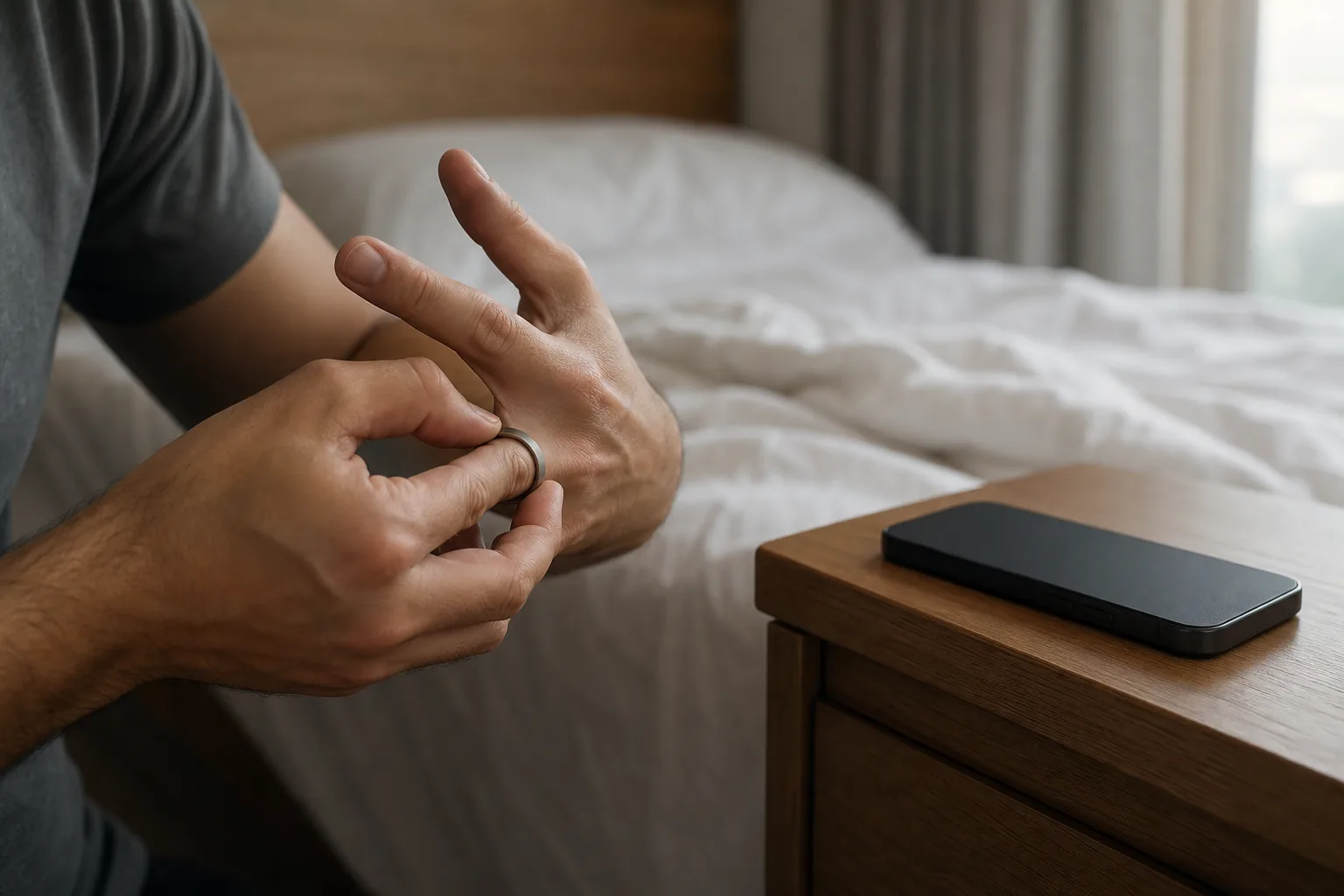
A person removes a smart ring after an overnight sleep-tracking session, illustrating the sort of passive wear Samsung is betting on.
What Galaxy Ring sleep apnea detection can and cannot do
First, the necessary reality check: Galaxy Ring sleep apnea detection will not tell someone they have sleep apnea. It is designed to identify a risk pattern, not deliver a diagnosis. That distinction may sound like regulatory fine print, but it’s the line between a useful early warning and a medical conclusion.
Sleep apnea involves repeated disruptions to breathing during sleep. Obstructive sleep apnea, the most common form, occurs when the upper airway becomes blocked or narrows. People may snore loudly, wake up gasping, feel exhausted despite spending enough hours in bed, or experience none of those obvious signals. Left untreated, the condition has been associated with risks including high blood pressure and cardiovascular problems.
A wearable cannot see the whole clinical picture from a finger. What it can do is watch for patterns that may warrant follow-up, such as changes in blood-oxygen saturation during the night alongside sleep and breathing data. Samsung’s approach is likely to draw on the same general category of signals used by watches and other rings, but FDA clearance means the company has supported a defined intended use rather than simply presenting a wellness metric.
That should make owners take an alert seriously, without treating it as a verdict. If Galaxy Ring sleep apnea monitoring flags risk, the sensible next move is a conversation with a doctor, who may recommend formal testing. Think of it as a smoke alarm, not a fire investigator.
Why the FDA wording gives Samsung an opening
Samsung is not the first company to put overnight blood-oxygen and breathing information on a finger. Oura, arguably the brand that made smart rings culturally legible, tracks blood oxygen and reports breathing disturbances during sleep. RingConn has offered a user-initiated sleep apnea monitoring function. Both products can be useful for spotting trends, particularly for people who dislike sleeping in a watch.
But Samsung’s Galaxy Ring sleep apnea feature is different in one practical respect: it is being positioned with FDA clearance specifically for sleep apnea risk detection. In health tech, that qualification matters. It affects what a company can claim, how it describes a feature to customers, and whether users and clinicians might view its alerts as more than a generic wellness score.
Samsung has been building toward this for a while. FDA-cleared monitoring is coming to Galaxy Watch wearables this summer. Now Samsung is moving that capability off the wrist and onto the finger, where a lighter device could be easier for some people to wear consistently overnight.
Consistency is the unglamorous part of wearable health. A sensor is only useful when it is actually on your body. Plenty of people charge their watches overnight or find them irritating in bed. A ring has its own fit and comfort problems, obviously, but it may be the less intrusive option for sleep-first tracking. That is the commercial logic behind Galaxy Ring sleep apnea support, and frankly it’s stronger than another incremental readiness score.
The fine print Samsung still needs to answer
There are limits to what Samsung has announced. The company did not provide details about which Ring sizes or markets will support the capability, whether an updated Galaxy phone is required, or whether the feature will arrive in every country where the Ring is sold. FDA clearance applies to the US regulatory framework; health features frequently roll out unevenly because each market has its own rules.
Samsung also needs to explain the user experience carefully. How many nights of data will be needed? What happens when a reading is inconclusive? How will it account for poor sensor contact, movement, alcohol use, illness, or a partner waking someone repeatedly at 3 a.m.? These systems are more useful when they communicate uncertainty rather than projecting the confidence of a hospital lab.
Readers should also pay attention to privacy terms. Sleep data can reveal routines, stress, illness, and lifestyle patterns with uncomfortable precision. Samsung directs users to its Samsung Health ecosystem, but the more health-sensitive its wearables become, the more clearly it should spell out where that data lives, who can access it, and how users can delete it.
A small ring with a bigger health-tech ambition
The near-term effect of Galaxy Ring sleep apnea monitoring may be modest: an alert that nudges some owners toward a doctor’s appointment they had been putting off. That is still meaningful. Sleep apnea is common, frequently underdiagnosed, and difficult to spot from daytime symptoms alone.
My read is that Samsung is also making a strategic play against Oura and Apple. Oura has credibility in sleep, Apple has the smartwatch scale, and Samsung wants the Ring to be more than an accessory for people already deep in the Galaxy ecosystem. Being first with an FDA-cleared ring-specific claim gives Samsung a clean marketing lane, at least until competitors answer.
Whether the feature earns trust will come down to accuracy, clarity, and restraint. A ring that catches a genuine risk without sending thousands of healthy sleepers into a panic would be valuable. The hardware is tiny. The responsibility attached to its alerts is not.

