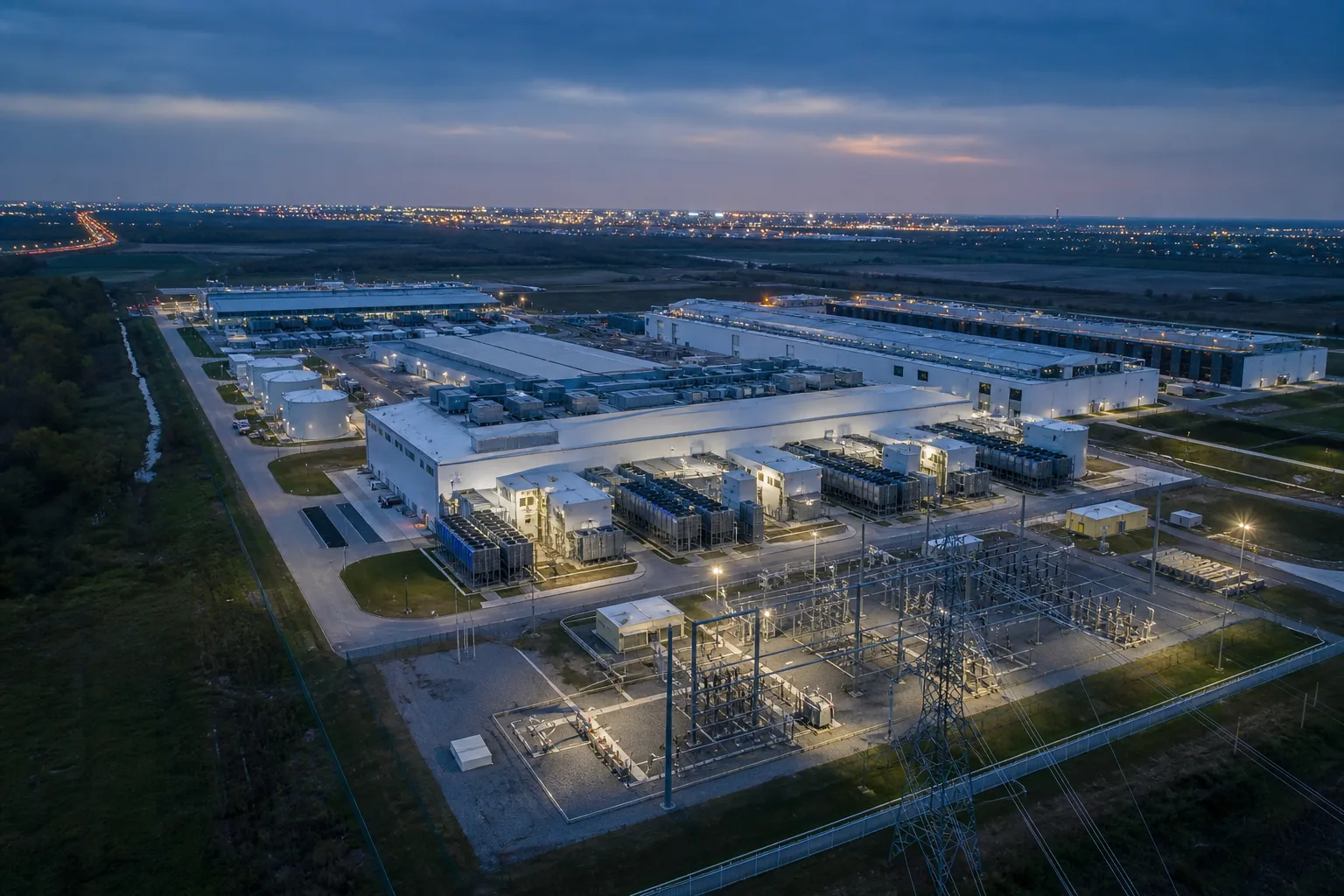
- The reported Meta BlackRock venture commits $14 billion to AI data-center infrastructure, pulling an asset manager directly into Meta’s push for more computing capacity.
- For Meta, the Meta BlackRock venture could open the door to outside capital. BlackRock, meanwhile, gets a stake in long-lived AI infrastructure assets.
- AI data centers now require far more than expensive GPUs: they need enormous amounts of power, land, networking equipment, and financing.
- The deal is another sign that hyperscalers increasingly view private infrastructure capital as part of the fight to secure AI capacity.
Table of Contents
The Meta BlackRock venture turns AI infrastructure into an asset class
AI has reached the point where the hard part is no longer only writing better models. It is finding enough electricity, land, fiber, cooling equipment and capital to run them at industrial scale. That is why the reported Meta BlackRock venture, a $14 billion data-center initiative, matters far more than another large corporate spending number.
Meta has spent years building its own enormous computing estate, first to serve Facebook and Instagram and now to train and operate its Llama family of AI models. BlackRock, meanwhile, manages money for institutions that want reliable long-term returns from real-world assets. Put those two impulses together and you get a straightforward proposition: AI infrastructure increasingly looks like the next big place for Wall Street to park patient capital.
The details that would determine the deal’s real significance are still thin. We do not yet know the precise ownership structure, where the facilities would be built, how much capacity is already contracted, or whether BlackRock is funding new construction versus taking an interest in existing assets. Those distinctions matter. A joint development platform is one thing; a financial arrangement that effectively helps Meta move infrastructure costs off its balance sheet is another.
Still, the reported $14 billion figure tells us the broad direction of travel. The era when a cloud provider could simply order another batch of servers and call it expansion is over. Today’s AI campuses resemble power stations crossed with logistics hubs. They take years to plan, face local opposition, and can consume enough electricity to become a regional political issue.
Why the Meta BlackRock venture fits the new AI spending race
Meta’s AI ambitions have been unusually aggressive. Meeting them will require vast quantities of compute, whether Meta is training frontier models, improving recommendations, generating advertising tools, or running consumer assistants at scale.
The company also has a different business model from Microsoft, Amazon and Google. Meta does not operate a conventional enterprise cloud that can directly rent excess computing capacity to corporate customers. Its infrastructure mostly exists to support Meta’s own services. That makes the Meta BlackRock venture especially interesting: bringing in a major financial partner could let Meta keep building without shouldering every brick, transformer and cooling loop alone.
BlackRock has been steadily expanding its infrastructure presence because pension funds, insurers and sovereign investors want assets with long operating lives and predictable contracts. Data centers have become a natural fit, particularly when a giant technology company is attached as an anchor customer. In ordinary terms, it is the difference between financing a speculative office block and financing a warehouse with a tenant already signed for decades.
There is plenty of risk here. AI demand is hot, but it is also unusually concentrated among a handful of richly funded companies. If the economics of AI services disappoint, or if model efficiency improves faster than expected, some of today’s capacity forecasts could look excessive. We have seen this movie before in telecom infrastructure, where exuberant projections produced plenty of fiber and not always enough customers.
Data centers are becoming a power problem before they become a chip problem
For readers following Nvidia earnings, the instinct is to treat GPUs as the scarce commodity. They remain central, but chips are only one component of the bill. A modern AI data center needs high-voltage connections, backup generation, specialized networking, liquid cooling in many cases, and a workforce capable of operating all of it. The constraints are often physical and local rather than purely technological.
The Meta BlackRock venture arrives as utilities and governments wrestle with a sharp rise in projected electricity demand. Northern Virginia, Ireland, Singapore and parts of the American Midwest have all faced versions of the same question: how many data centers can the grid support, and who pays for the upgrades?
Meta’s official newsroom is available here. A financing partnership could give that physical layer its own infrastructure business. Meta can focus on models and applications; a capital partner can help finance assets designed to generate returns over many years.
That division sounds tidy on paper. In practice, data-center projects live or die on power availability. A building without a timely grid connection is an expensive shell, no matter how many accelerators its owner planned to install. My read is that access to electricity, rather than access to dollars, will be the tougher bottleneck for projects of this size.
What the Meta BlackRock venture says about private capital
The financial architecture behind Big Tech is changing. For years, companies such as Meta, Microsoft, Alphabet and Amazon could use their own immense cash flows to fund nearly anything. They still can. But AI has made the spending requirements so large, and the useful life of some equipment so uncertain, that outside financing has started to look sensible rather than unnecessary.
The reported Meta BlackRock venture belongs to a wider trend in which private equity, infrastructure funds and credit investors want a piece of the AI buildout. They may not be writing the models, but they can own the land, buildings, power equipment and other expensive plumbing that makes model training possible. It is a familiar infrastructure play with a very fashionable tenant.
There is an accountability angle here too. When tech companies finance their own facilities, investors can look at capital expenditure in quarterly results and make a judgment. Joint ventures and other structured arrangements can make the economics harder to parse. That does not make them improper. It does mean investors should pay close attention to long-term commitments, guarantees and any obligations that sit outside the most obvious headline numbers.
The $14 billion question is whether demand will stay this intense
For Meta users, this arrangement will not mean a new button in Instagram tomorrow. The effects will show up indirectly: more capable assistants, stronger content-ranking systems, automated ad creation, and perhaps more ambitious consumer AI features. For everyone else, the deal is another marker that computing infrastructure is being rebuilt around AI workloads.
The Meta BlackRock venture also puts pressure on rivals. If outside capital can reliably fund AI campuses, companies that once relied only on their own balance sheets may have another way to expand quickly. That could accelerate construction, while also tying the AI boom more closely to the financial system.
Frankly, $14 billion is a huge sum even in a sector that has become numb to giant figures. Yet the decisive question is not whether Meta and BlackRock can raise or deploy the money. It is whether the applications built on all this compute will produce durable demand after the initial AI gold rush cools. The concrete will last decades. The current AI assumptions may not.