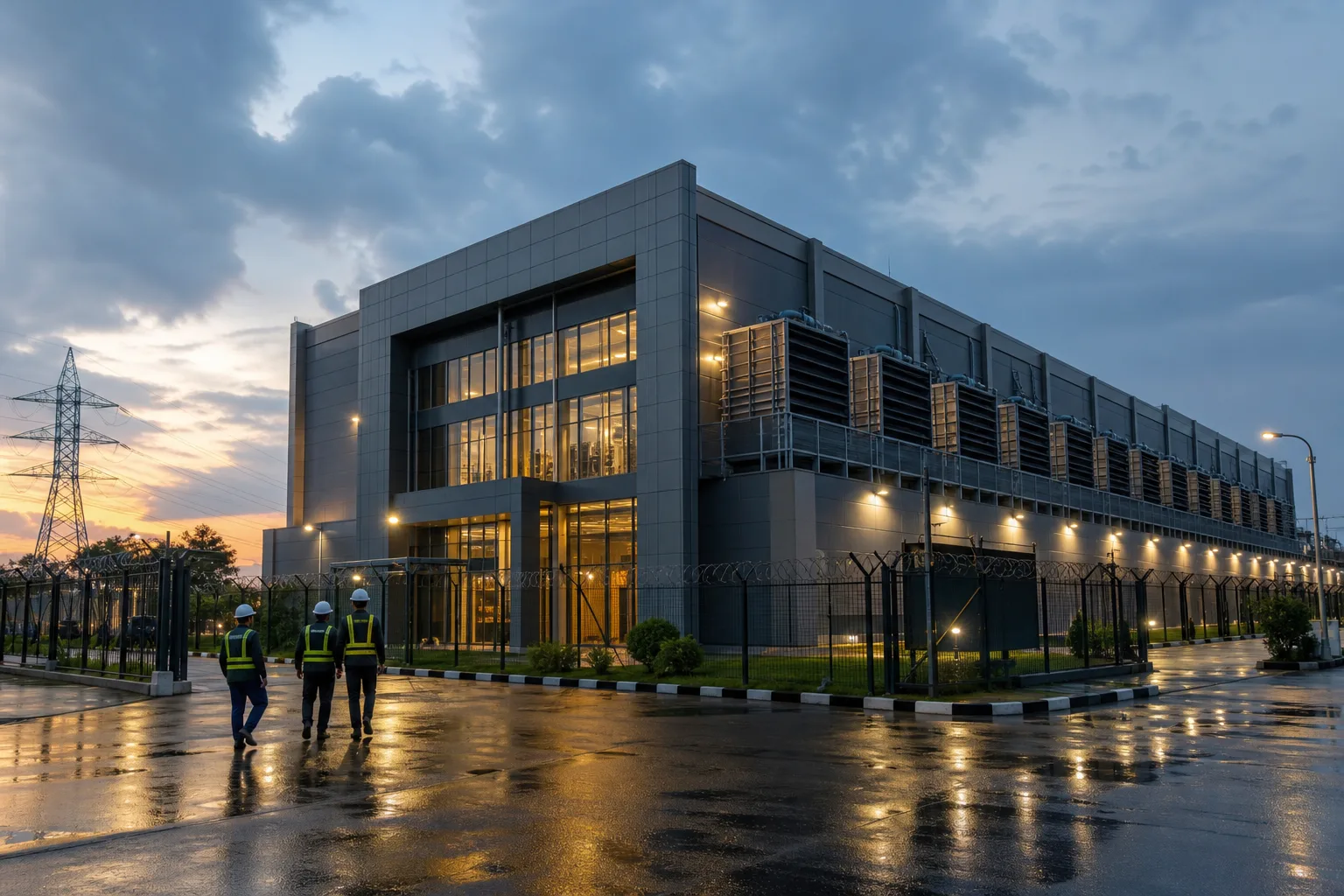
- USTDA support signals growing international interest in Nigeria data centers built for compute-intensive AI and cloud workloads.
- Nigeria data centers need dependable electricity and dense fiber links before AI capacity can become a durable competitive advantage.
- Local hosting could reduce latency and keep more enterprise technology spending within Nigeria’s fast-growing digital economy.
- The project’s real test will be whether infrastructure construction translates into affordable, reliable capacity for domestic customers.
Table of Contents
Nigeria data centers are becoming an AI infrastructure test
The announcement sounds straightforward: the U.S. Trade and Development Agency is backing work tied to AI-ready facilities in Nigeria. But Nigeria data centers are about far more than another construction announcement. They sit at the awkward, consequential intersection of Africa’s digital ambitions and the physical constraints that software companies usually prefer to ignore: power generation, transmission, cooling, fiber routes, financing and land.
AI has made data-center capacity a strategic commodity. Training large models requires huge clusters of expensive accelerators; running those models for customers requires reliable, low-latency infrastructure closer to where people and businesses actually live. That has sent governments and investors hunting for places where demand is rising but local computing capacity has not yet caught up.
Nigeria fits that description. It has Africa’s largest population, a large technology workforce, busy financial and telecoms sectors, and an internet economy that increasingly cannot afford to treat every serious workload as something that must travel to Europe or the United States. For Nigeria data centers, that creates a substantial domestic market to serve. The USTDA’s reported support is therefore meaningful, even if the early language around AI-ready sites should be treated carefully. A feasibility study, technical assistance package or development grant is not the same thing as a functioning hyperscale campus full of GPUs.
That distinction matters. The global AI infrastructure rush is full of polished renderings. The winners will be the operators that can keep the lights on.
Why Nigeria data centers matter to local users
For an ordinary Nigerian business, the value of more local capacity is not abstract. A bank processing transactions, a streaming service delivering video, a retailer running inventory systems, or a startup serving customers from Lagos all benefit when data does not need to make a long round trip to a server in another region. Lower latency improves responsiveness. Local availability can also help organizations meet internal security policies, customer expectations and data-residency requirements.
That is the practical case for Nigeria data centers: making cloud and AI services feel less like imported infrastructure and more like something companies can build on daily. The benefit is especially clear for real-time applications, from fraud detection to call-center automation and logistics software. A chatbot can tolerate a slight pause; a payment authorization system really cannot.
There is also an economic angle. When enterprises host abroad, much of the spending on compute, storage and network services leaves the country. More domestic facilities will not keep every naira at home—much of the equipment is imported, and global cloud platforms retain enormous market power—but they can create a deeper local supply chain around connectivity, operations, security, construction and managed services.
Still, local capacity does not automatically mean cheap capacity. Data-center operators pay for electricity, backup generation, imported hardware, specialist maintenance and international bandwidth. Those costs eventually show up in customer contracts. Anyone claiming that AI infrastructure alone will suddenly make cloud computing inexpensive in Nigeria is getting ahead of the evidence.
The power problem is the whole story
AI-ready is quickly becoming one of technology’s most overused labels. In plain English, it means a facility is designed to support racks that consume much more power and generate much more heat than conventional enterprise servers. Modern AI accelerators can concentrate astonishing energy demand into a small footprint, pushing operators toward liquid cooling, higher-capacity electrical systems and far more careful design.
That is where the conversation around Nigeria data centers becomes hard, and frankly more interesting. Nigeria has long dealt with grid reliability challenges, which has left many businesses dependent on diesel generators and other backup arrangements. Data centers cannot simply hope for the best. Their customers expect uptime, and an AI cluster sitting idle because power failed is a very expensive pile of metal.
Any credible AI facility plan will need to answer basic questions: Where will firm power come from? How much redundancy is built into the design? What is the role of gas, solar, batteries and utility supply? How will cooling operate during extreme weather? And what does all of that do to the price per kilowatt-hour?
The USTDA, an agency that supports U.S. private-sector participation in overseas infrastructure projects, has a track record of funding early-stage work rather than acting as a conventional project builder. Its involvement can help a project move from ambition to engineering and bankability. Readers can find the agency’s broader mandate at USTDA’s official website. But no development agency can wish away the fundamentals of power economics.
AI demand could finally sharpen the business case
Cloud services have been growing across Africa for years, with international providers and regional operators expanding points of presence, connectivity and data-center footprints. AI adds urgency because it increases the premium on available power and high-density capacity. The question is no longer only where companies store data; it is where they can process it at scale.
For Nigeria data centers, that may create a useful opening. A facility that can offer dependable power, carrier-neutral connectivity and modern cooling has a clearer pitch to banks, telecoms firms, government agencies, multinational companies and AI startups than a generic server warehouse. It may also give global cloud providers another reason to expand local partnerships rather than serving the market largely from afar.
But Africa is not one market, and Nigeria will face competition. South Africa remains the continent’s most developed data-center hub, supported by mature enterprise demand and substantial infrastructure. Kenya has become an East African connectivity and cloud focal point. Egypt is positioning itself around its geographic role linking Africa, Europe, Asia and the Middle East. Nigeria’s advantage is scale of demand; Nigeria data centers must convert that demand into infrastructure investors can trust.
My read is that AI could be the forcing function. For years, the pitch for domestic hosting has been compelling but gradual. The compute hunger surrounding generative AI gives decision-makers a more immediate reason to invest in the unglamorous parts: substations, fiber diversity, cooling plants and operations talent. Nobody gets excited about a redundant electrical feed until it is the thing preventing a major outage.
What to watch after the announcement
The next milestones will tell us whether this becomes a real inflection point or merely another promising infrastructure study. Watch for the identity of the local operator and technology partners, the proposed location, the planned power capacity, the energy strategy and a credible financing path. Those are the details that separate Nigeria data centers built for AI from facilities that simply borrow the language of the moment.
It will also be worth watching who signs up first. Enterprise commitments from financial institutions, telecom operators, public-sector agencies or cloud platforms would validate the commercial case. A project that depends solely on speculative AI demand is exposed; one anchored by existing workloads has a much firmer footing.
Nigeria has no shortage of digital demand. What it needs is infrastructure that can meet that demand on an ordinary Tuesday afternoon, through a grid disruption, during a heat wave, and at a price local companies can actually absorb. If this USTDA-backed effort helps solve that equation, it could matter far beyond one facility. If not, the AI boom will remain something Nigerian users access from somewhere else.