


- The Disney Hulu Black Friday deal offers eligible new or returning customers the ad-supported bundle for $4.99 monthly for one year.
- The Disney Hulu Black Friday deal excludes current Disney+, Hulu, ESPN, and bundle subscribers, limiting its value for existing customers.
- A $14.99 monthly Premium option removes advertising and includes downloads, though its discount is materially smaller than the ad-supported promotion.
- Subscribers should set a cancellation reminder because discounted plans revert to the prevailing regular monthly price after the first year.
Table of Contents
Disney Hulu Black Friday deal puts a familiar price war back on screen
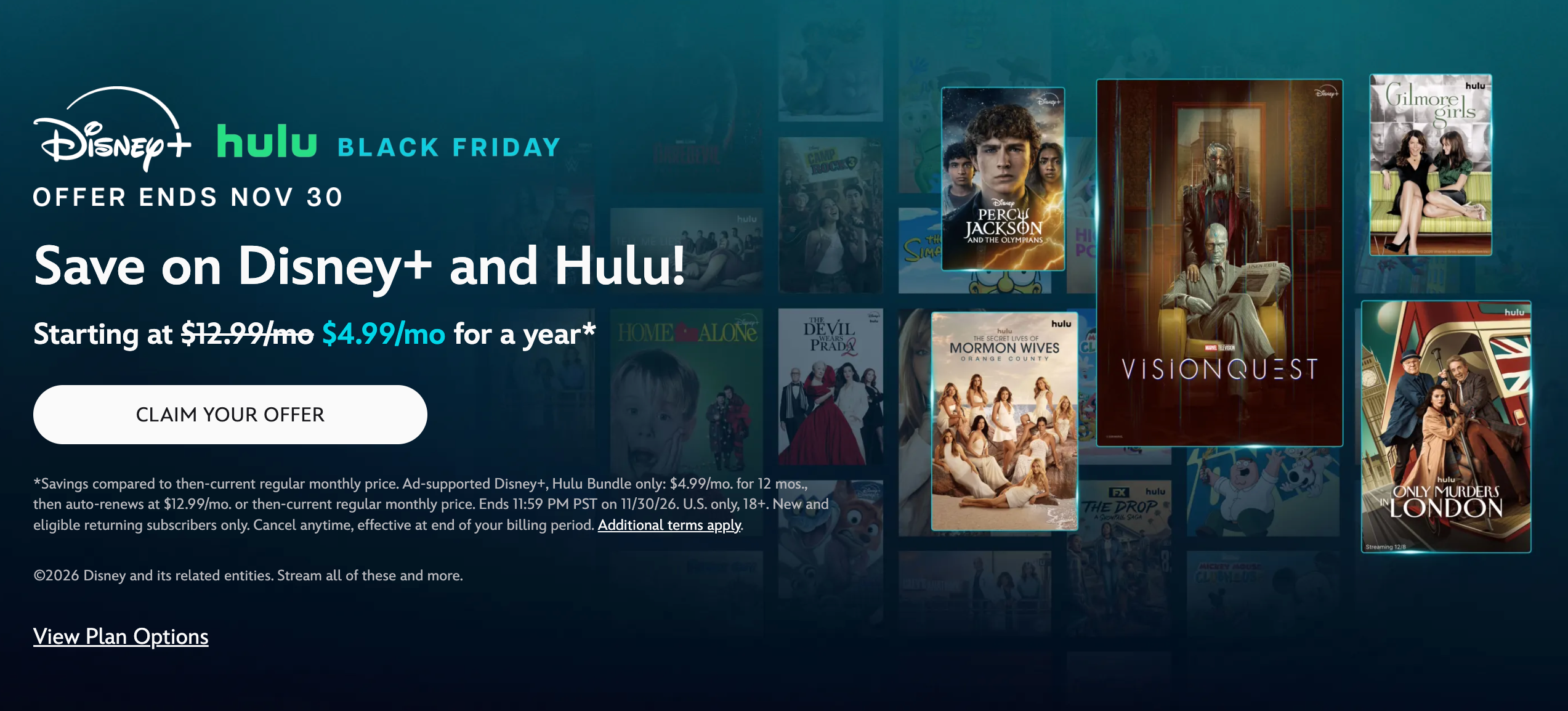
The Disney Hulu Black Friday deal is straightforward: eligible US customers can get the ad-supported Disney+ and Hulu bundle for $4.99 per month for 12 months. That is a sharp drop from the cited $12.99 monthly list price, and it gives Disney one of the more aggressive streaming promotions of the holiday shopping window.
According to ZDNET, the promotion runs from November 24 through November 30, 2026, and is available to new and eligible returning subscribers aged 18 or older. Disney is also discounting the no-ads Premium version to $14.99 per month for a year, down from $21.99.
At face value, this is a sale on two apps. In practice, it is Disney paying to get people back into its subscription funnel at precisely the time of year when households are comparing every recurring bill. Streaming has become a cupboard full of half-used subscriptions, and companies know a low introductory price can be enough to win a spot.

What the Disney Hulu Black Friday deal actually includes
The $4.99 tier combines Disney+ and Hulu with advertising. Subscribers can watch on up to two devices at once, based on the offer terms reported by ZDNET. The Premium bundle costs $14.99 monthly during the promotional year, removes ads, and adds downloads for offline viewing.
The difference matters more than the headline savings might suggest. A household that mostly watches one or two weekly shows may reasonably tolerate advertising and take the bigger discount. Someone who travels regularly, shares a home with viewers who hate interruption, or depends on downloaded episodes for flights may find the Premium plan more practical. Disney’s pricing is doing what modern streaming pricing does best: asking customers to put a dollar figure on annoyance.
Still, the ad-supported offer is the centerpiece. At $4.99 for both services, the bundle works out to just under $60 over 12 months before tax. Compared with paying the stated regular bundle price for the same period, that is roughly $96 in savings. The Premium promotion saves about $84 over a year against its cited standard rate.
The eligibility catch is the point
The Disney Hulu Black Friday deal is not for everyone. Current Disney+, Hulu, ESPN, or bundle subscribers are excluded. That restriction is frustrating if you already pay Disney every month, but it is hardly unusual. Subscription promotions are built to acquire customers, revive lapsed ones, and tempt people who have been sitting on the fence. They are rarely designed as a thank-you note to loyal users.
There are other constraints worth reading before clicking through. The offer cannot be combined with other promotions or bundle pricing. It cannot be purchased with a gift card. And if a subscriber changes plans after redeeming the offer, the discounted price disappears. That last condition is easy to miss and could matter if Disney adjusts its packages midway through the year.
Disney’s subscription help pages are the sensible place to verify current plan terms before purchase. Streaming companies change prices, bundle structures, and eligibility rules often enough that a promotional landing page should never be treated as permanent policy.
For people who canceled Hulu or Disney+ some time ago, the Disney Hulu Black Friday deal could be a clean way back in. For existing customers, it is a reminder of the increasingly awkward economics of loyalty. Canceling, waiting, and returning has become a rational way to buy streaming, which is not exactly the durable customer relationship these platforms claim to want.
Why Disney is willing to discount so heavily
Disney is no longer selling streaming as a simple replacement for cable. It is selling an ecosystem: blockbuster franchises, Hulu’s general-entertainment catalog, advertising inventory, and eventually the possibility that a low-cost subscriber upgrades, stays longer than planned, or adds another Disney service.
The Disney Hulu Black Friday deal also arrives after years in which streamers trained audiences to expect price increases. Netflix, Max, Peacock, Paramount+, and Disney have all experimented with ad tiers, bundles, restrictions, and shifting content libraries. The industry has discovered that streaming is less like buying a DVD and more like signing up for a gym: the monthly fee needs to stay psychologically manageable, while the business quietly hopes you do not reconsider it every billing cycle.
Advertising is what makes $4.99 plausible. An ad-supported subscriber brings in subscription revenue and can also generate ad revenue, assuming they keep watching. Disney has a particularly valuable catalog for that model, from family programming to Hulu’s current-season TV and broader adult audience. The company does not need every discounted user to become a Premium customer. It needs enough viewers, engagement, and eventual retention to make the math work.
This is not generosity. It is disciplined customer acquisition. But customers do not need to apologize for taking a good price when the deal is honest about what it is.
How to use the offer without paying for it by accident
If the Disney Hulu Black Friday deal fits your viewing habits, sign up during the November 24–30 window and immediately add a calendar reminder for several days before the 12-month promotional period ends. The bundle will renew at the then-current regular monthly price unless canceled. The source cites $12.99 as today’s regular ad-supported bundle price, but that figure could change before renewal.
Also resist the urge to optimize yourself into a worse deal. Switching plans voids the promotional rate, so decide upfront whether ads and the lack of downloads are tolerable. For many households, the cheaper tier is the rational pick. For others, paying more to avoid ads will be worth it. The useful comparison is not whether Premium is discounted; it is whether you will actually use its two meaningful extras.
Streaming is moving toward an annual ritual of subscribe, watch, reassess, cancel, and repeat. Consumers who treat these services as permanent utilities will usually pay more than those who rotate them around the shows they want. Disney’s offer is attractive because it acknowledges that reality, even as it tries to persuade people to stay once the bargain ends.
Whether that bet pays off will depend less on a $4.99 headline than on what Disney gives viewers to watch in month 13.