

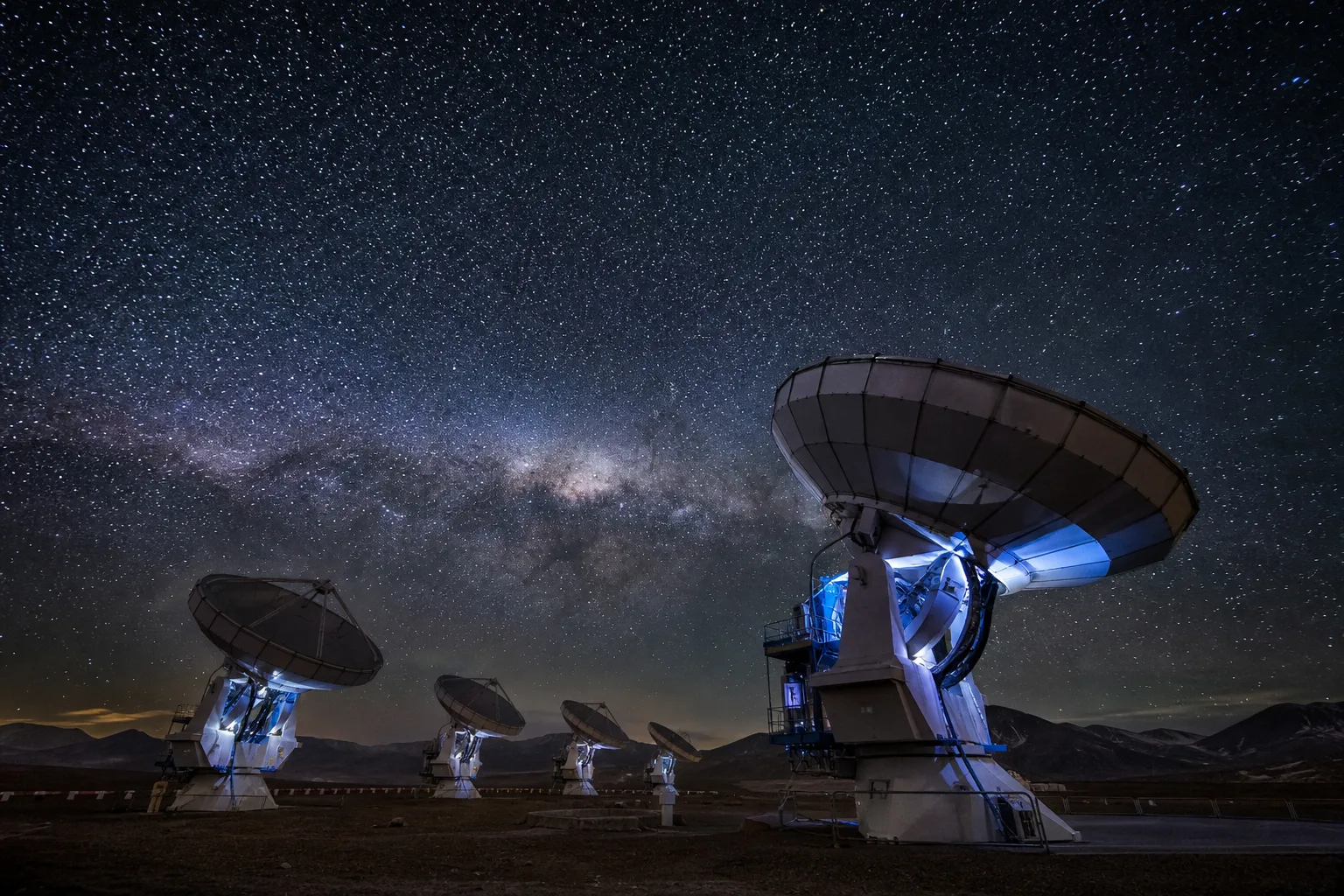
- Black hole jet images from the Event Horizon Telescope track structures near supermassive black holes at previously unreachable resolution.
- New black hole jet images of M87 and 3C 84 could help test how magnetic fields launch near-light-speed outflows.
- The work takes the EHT beyond famous black hole silhouettes, turning it into a long-term observatory for changing cosmic environments.
- Radio observatories across Earth effectively form one planet-sized instrument, though sparse data still requires careful interpretation.
Table of Contents
Black hole jet images move beyond the famous ring
The Event Horizon Telescope’s first black-hole image became an instant scientific icon: a hazy orange ring around M87*, the giant black hole at the center of the Messier 87 galaxy. But the more consequential phase of the project may be arriving now. New black hole jet images are pushing attention away from the silhouette itself and toward the violent outflows that can reshape an entire galaxy.
According to Phys.org, the EHT collaboration has produced detailed observations between 2024 and 2026 of jets associated with 3C 84 and M87*. That broadens the project in an important way. A still image of an event-horizon-scale shadow proved that the instrument could do something extraordinary; mapping a jet’s geometry and evolution begins to address the harder physics question of what black holes actually do to their surroundings.
M87* remains the obvious celebrity. It is a supermassive black hole, and its jet extends beyond its host galaxy’s core. 3C 84, meanwhile, is the bright compact radio source in the galaxy NGC 1275, at the center of the Perseus galaxy cluster. Both targets provide unusually clear laboratories for observing jets close to their launch regions.
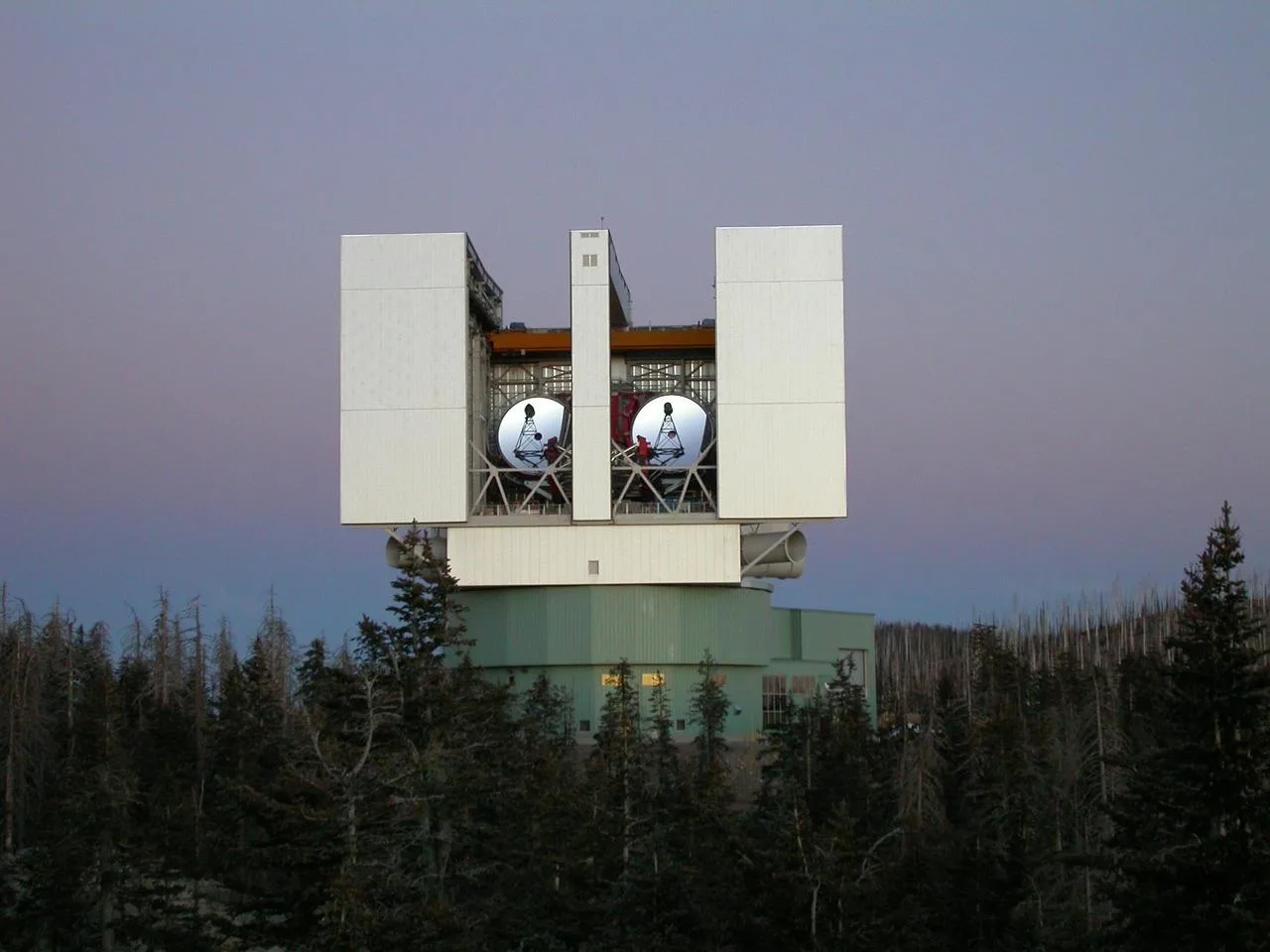
The image above, of the Large Binocular Telescope Interferometer, is a useful reminder that astronomy’s sharpest views often come from combining instruments rather than building one impossibly large camera. The EHT takes that principle to a global scale.
Why black hole jet images are such a hard-won result
A jet is not material somehow escaping from inside a black hole. Nothing crosses the event horizon outward. Instead, the leading picture is that gas spiraling toward the black hole drags and twists magnetic fields in the surrounding accretion flow. Those fields may channel a fraction of the infalling material into tightly collimated beams moving at speeds close to light.
That explanation sounds neat on a whiteboard. Nature is less cooperative. Researchers still need to pin down where the jet is anchored, how magnetic fields are arranged, why some black holes create such prominent jets while others do not, and how those streams remain narrow across enormous distances. Black hole jet images at EHT-scale resolution give scientists a way to compare those theoretical models with structures much closer to the engine.
The technical trick is very-long-baseline interferometry, or VLBI. Radio dishes separated by continents observe the same target and record data with exquisitely accurate timing. Once the recordings are correlated, the network behaves like a telescope whose effective diameter approaches Earth’s size. That is what lets the EHT resolve features that would otherwise be hopelessly blurred together.
There is an unavoidable caveat, though. Interferometers do not collect every possible spatial detail, and the final visualizations rely on reconstruction methods constrained by real data and physical assumptions. That does not make the results suspect; it means the honest story is more sophisticated than the viral 2019 image suggested. These are rigorously derived radio maps, not snapshots taken with a conventional camera.
From a black hole portrait to a changing system
The key word in the latest work is dynamics. A jet is not a static exhaust pipe. Bright knots can shift, plasma can brighten or fade, and the apparent shape can change as magnetic conditions and material flow evolve. Repeated black hole jet images could reveal which features persist and which are temporary disturbances moving through the flow.
That time dimension matters especially for Sagittarius A*, the Milky Way’s central black hole. The EHT published the first image of Sagittarius A* in 2022, but its environment changes much more quickly than M87*’s because Sgr A* is far less massive. Imaging it required accounting for rapid variation during an observing run. M87* has its own complications, but its slower characteristic timescales make it a particularly useful subject for tracking jet behavior across years.
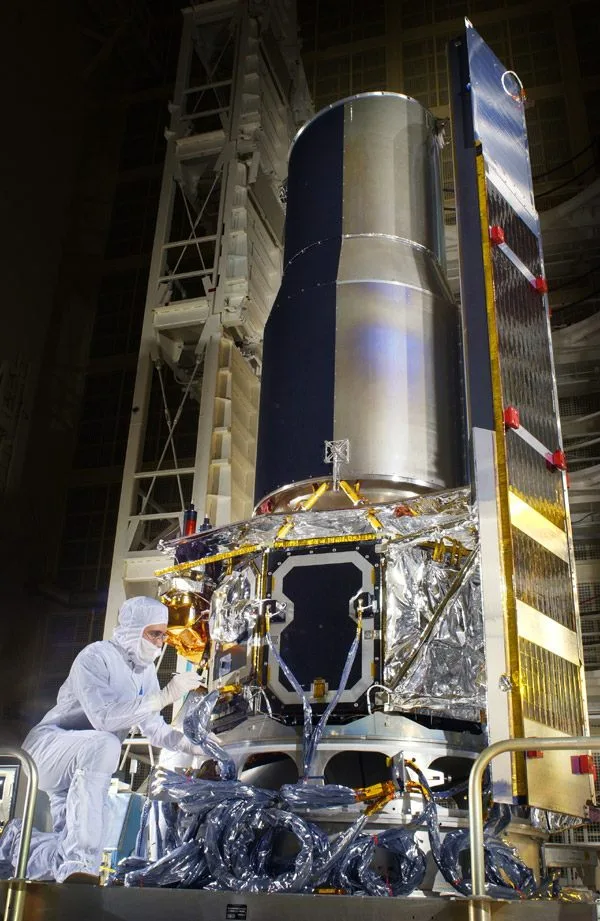
The Space Infrared Telescope Facility shown above predates the EHT and observes a different part of the spectrum, yet it points to a broader truth: major astronomy advances increasingly come from observatories designed around complementary wavelengths. Infrared instruments trace warm dust and stars; X-ray telescopes trace extremely hot gas; radio arrays like the EHT can probe plasma and magnetic structures near black holes.
The implications reach well beyond visual spectacle. Jets may regulate the gas available to form stars in and around massive galaxies. In galaxy clusters, energy released by an active central black hole can help prevent gas from cooling too quickly. The feedback process is a central ingredient in modern galaxy-formation models, but its smallest-scale starting point has remained frustratingly opaque. If black hole jet images can connect conditions near the event horizon to consequences on galactic scales, they will close a major observational gap.
What the EHT still needs to prove
It would be premature to declare the jet-launching problem solved. Detailed observations of two systems are not a universal theory, and M87* is an unusually favorable target. Its jet is bright, its orientation helps astronomers separate structures, and it has been studied across the electromagnetic spectrum for decades. The universe is full of less accommodating black holes.
Even so, the direction is hard to miss. The Event Horizon Telescope collaboration has shown that its network can do more than produce a historic first image. It can investigate the machinery outside the shadow. Future improvements in frequency coverage, participating stations, calibration and imaging methods should make black hole jet images more informative and more routine.
Frankly, that is the story worth watching. The original M87* ring answered a question people could grasp immediately: can humanity image a black hole? The next set of results is aimed at questions that are less tidy but far more revealing. How does a black hole turn a small region of magnetized gas into a beam capable of influencing a galaxy? If the EHT can keep narrowing that gap, its most famous picture may eventually look like the opening act.
Frequently Asked Questions
What are black hole jet images?
Black hole jet images are radio observations of narrow, powerful streams of plasma emerging from regions close to a black hole. They do not photograph a black hole directly in the ordinary sense; they reconstruct radio emission captured by widely separated telescopes working together.
How does the Event Horizon Telescope make black hole jet images?
The Event Horizon Telescope links radio observatories around the world using very-long-baseline interferometry. By precisely timing signals recorded at each location, researchers combine the data as if it came from an Earth-sized radio telescope, allowing extraordinarily fine angular resolution.
Why do black hole jets matter to galaxies?
Jets can carry energy far beyond a galaxy’s central black hole, heating surrounding gas and potentially affecting star formation. Understanding how they begin is therefore tied to a larger question: how actively growing black holes influence the galaxies that host them.