

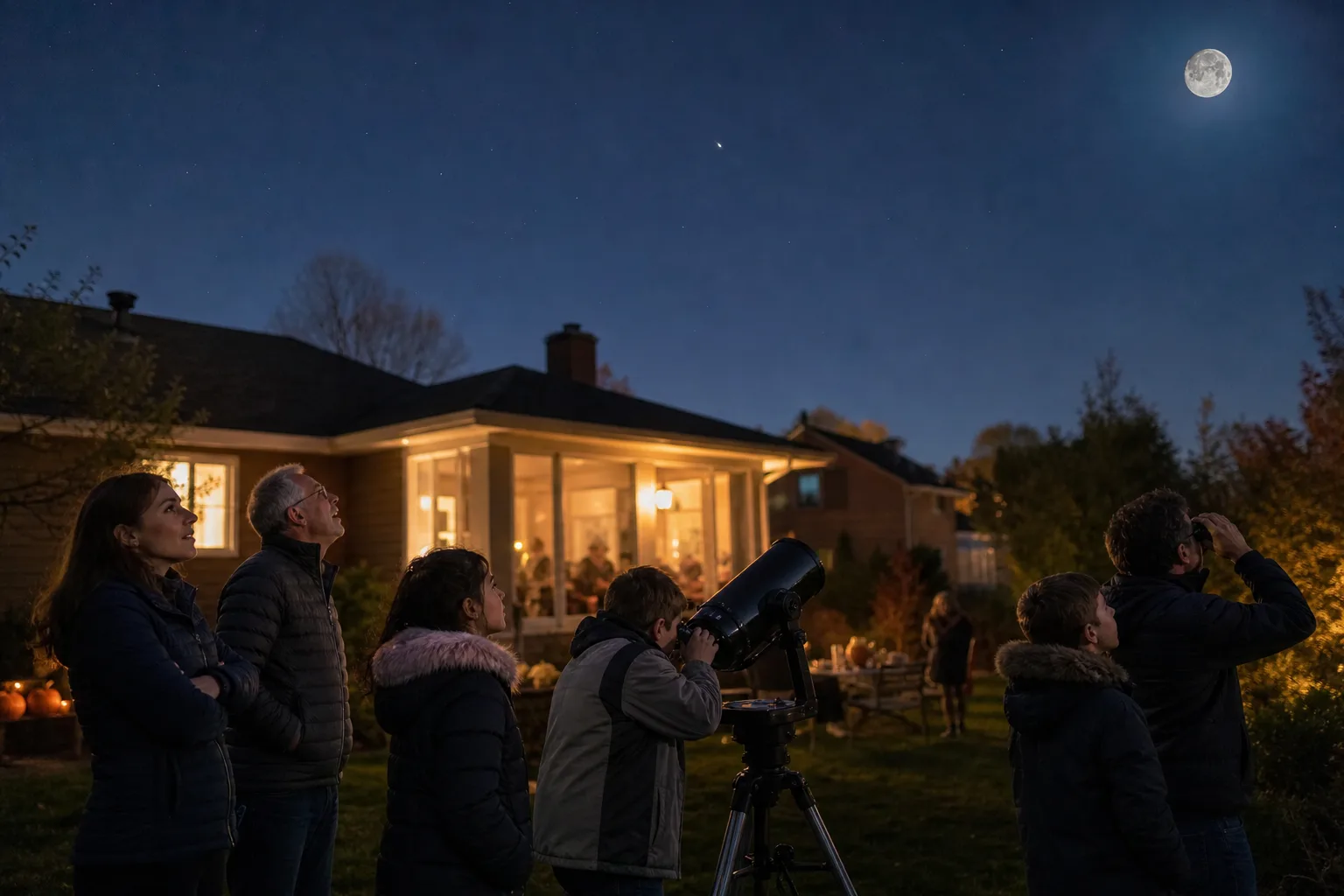
- The Thanksgiving night sky offers an unusually easy family viewing lineup: Saturn at dusk, a bright moon later and possible ISS passes.
- For the Thanksgiving night sky, binoculars can reveal lunar detail while a small telescope may show Saturn’s thinly tilted rings.
- The International Space Station may cross much of the US after dinner, though exact visibility depends on location and local conditions.
- NASA and satellite-tracking services provide reliable pass predictions, making a spontaneous backyard viewing session far easier to plan.
Table of Contents
Thanksgiving night sky viewing starts with a simple reason to step outside
The Thanksgiving night sky has a better post-dinner lineup than another hour of football highlights. On Thanksgiving evening, Saturn will be up after dusk, the moon will rise soon afterward, and much of the United States may get an International Space Station flyover. None of that requires an observatory, a subscription, or the sort of planning that turns a family holiday into a project.
That’s the useful appeal here: astronomy works remarkably well as a shared, low-friction activity. You can ask relatives to walk outside for five minutes, point at a bright object, and give them something genuinely distant to think about before the pie coma begins. Space first laid out the evening’s three-part celestial schedule, including the local timing caveats that matter far more than any universal skywatching promise.
Clear weather remains the uncooperative hardware dependency, naturally. But even suburban light pollution won’t erase the main targets. The moon thrives in city skies, Saturn is bright enough to find with a little patience, and the ISS is often visible to the naked eye when it catches sunlight at the right moment.
Saturn is the Thanksgiving night sky headline act
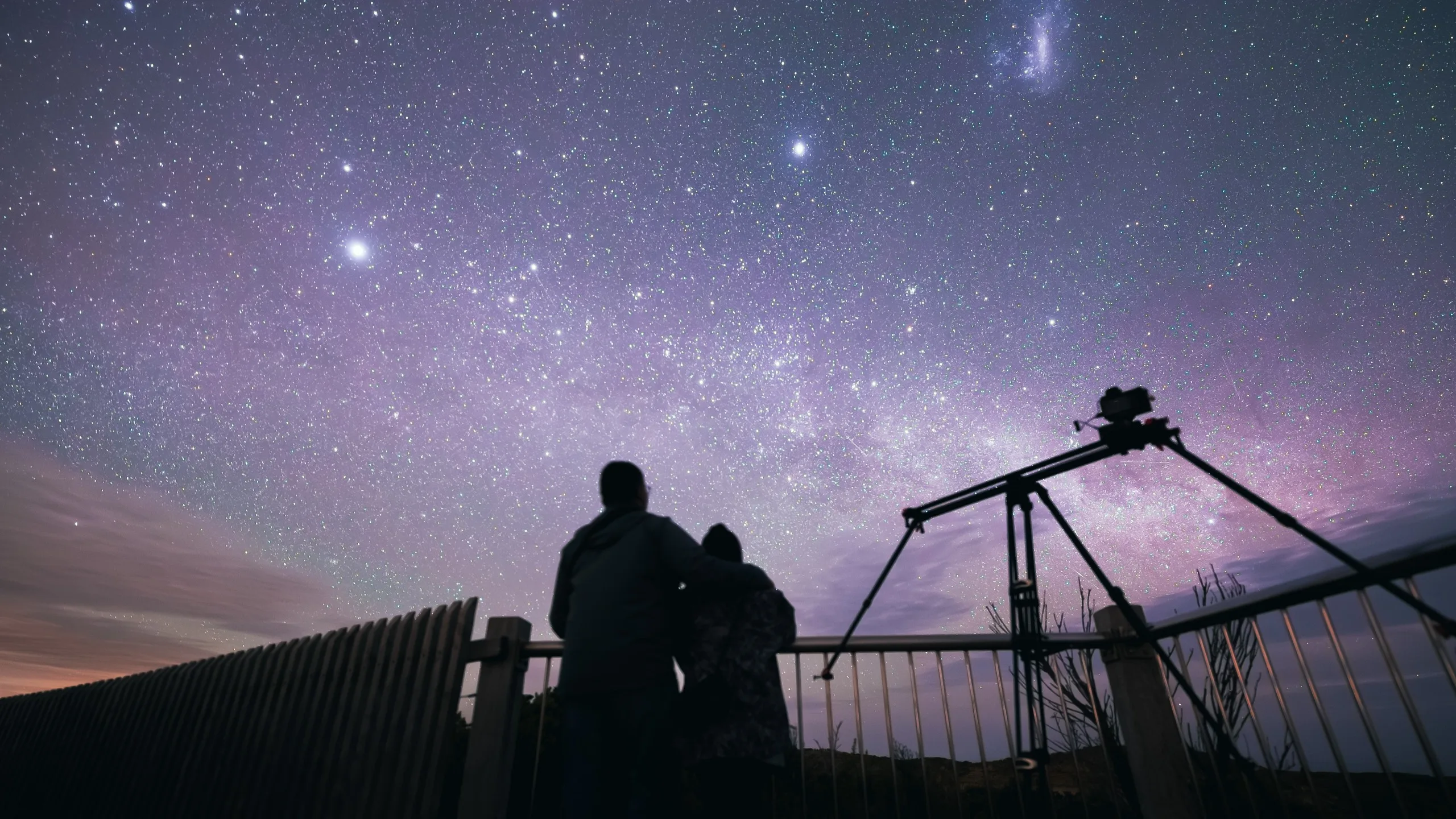
At dusk, look broadly south for Saturn, glowing at first magnitude with a restrained yellow-white color. It should outshine Fomalhaut, the conspicuous star positioned lower and to Saturn’s right, by a meaningful margin. The old trick applies: hold a clenched fist at arm’s length and you have a rough ten-degree measuring tool; four fists span about 40 degrees. It’s imprecise, but perfectly adequate for a backyard search.
Saturn is especially compelling because it asks very little of beginners while rewarding better equipment. Naked-eye observers can identify a planet rather than another anonymous star. Binocular users may get a hint of the planet’s famous geometry. A telescope with at least 30-power is the more realistic route to seeing the ring system as a distinct structure.
Here’s the wrinkle: Saturn’s rings are tilted only around six degrees toward Earth at this point, so they appear unusually narrow rather than wide open. That makes this a less dramatic ring presentation than some future seasons will offer. Still, the thin angle gives the view its own value: it is a reminder that planets aren’t static textbook illustrations. Their apparent shape changes because Earth and Saturn keep moving through their very large, very different orbits.
The moon supplies the easiest close-up view
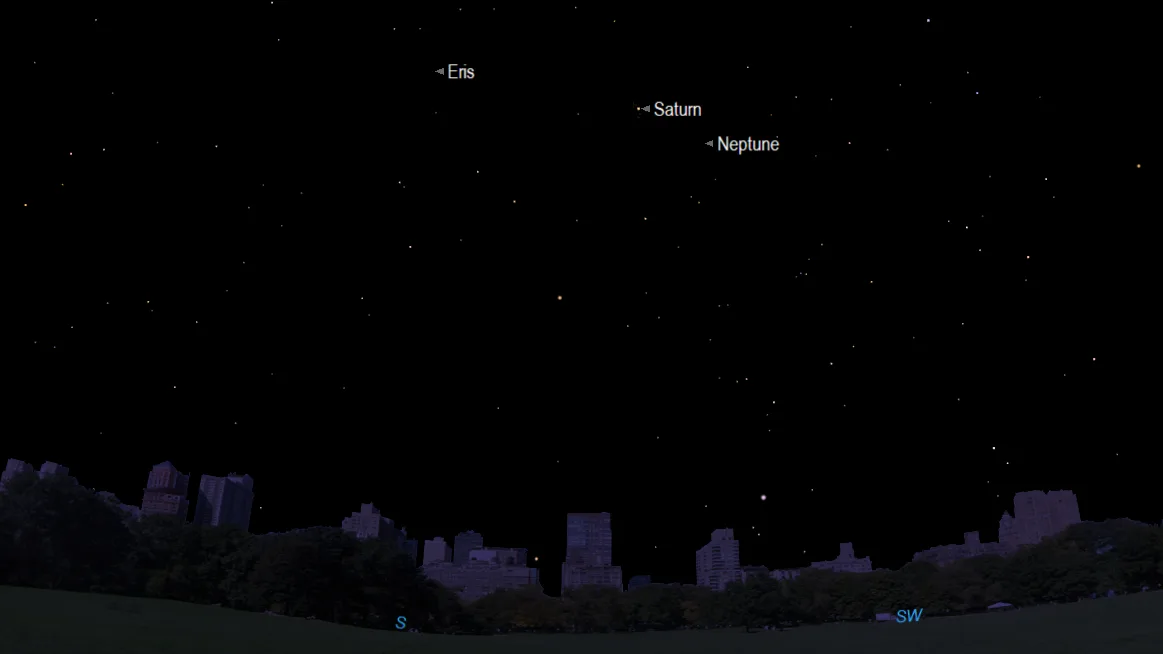
The Thanksgiving night sky gets brighter around 6:25 p.m. local time, when a waning gibbous moon, roughly two and a half days past full, begins rising in the east-northeast. It will be about 91% illuminated. Give it an hour before making it the main event; low horizon haze, trees and houses can make moonrise more frustrating than romantic.
Once the moon is higher, binoculars are enough to make the exercise worthwhile. The key feature to watch is the terminator, the shifting boundary between lunar day and night. Craters and mountain rims near that line cast longer shadows, which makes their relief more obvious than it is under direct overhead sunlight. It’s the same reason a low afternoon sun makes potholes look worse in a parking lot.
Mare Crisium, or the Sea of Crises, is a useful target this evening: a dark, circular plain toward the moon’s northeastern edge. Nearby terrain includes an approximately 80-kilometer-wide mountainous ring with peaks reaching about 4,389 meters. The naming is pure historical theater — lunar maria are ancient basalt plains, not seas — but it remains one of astronomy’s more charming bits of inherited vocabulary.
Use software for the ISS, not guesswork
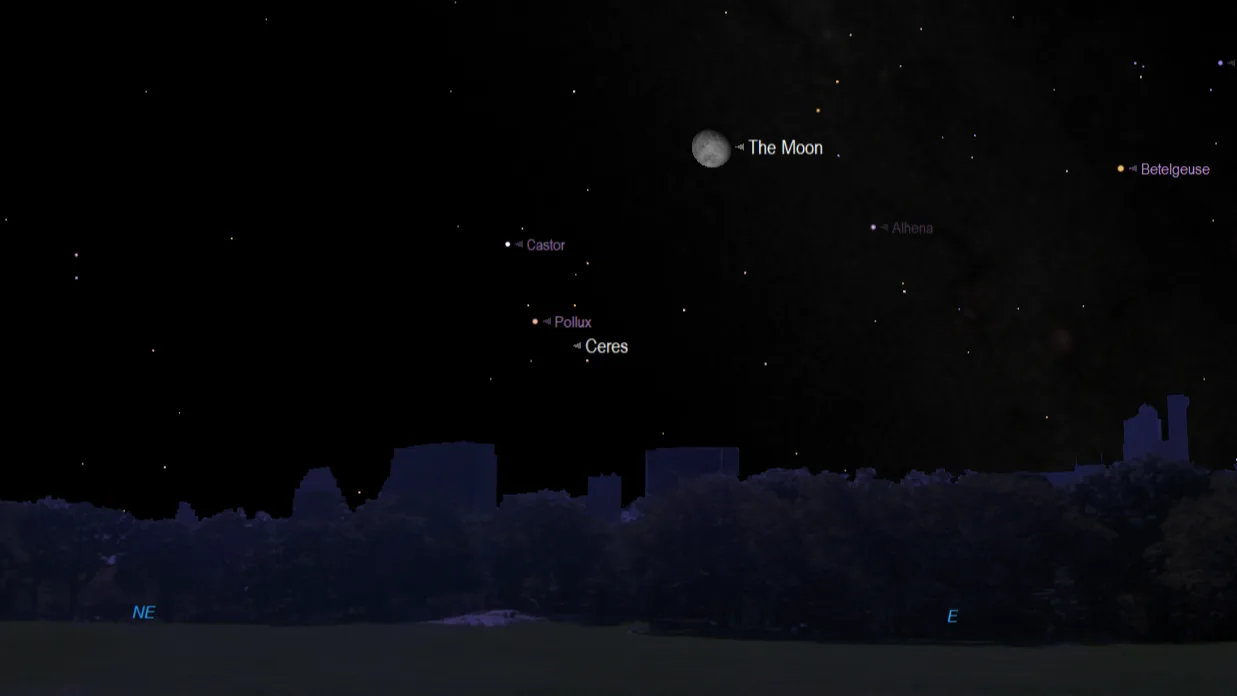
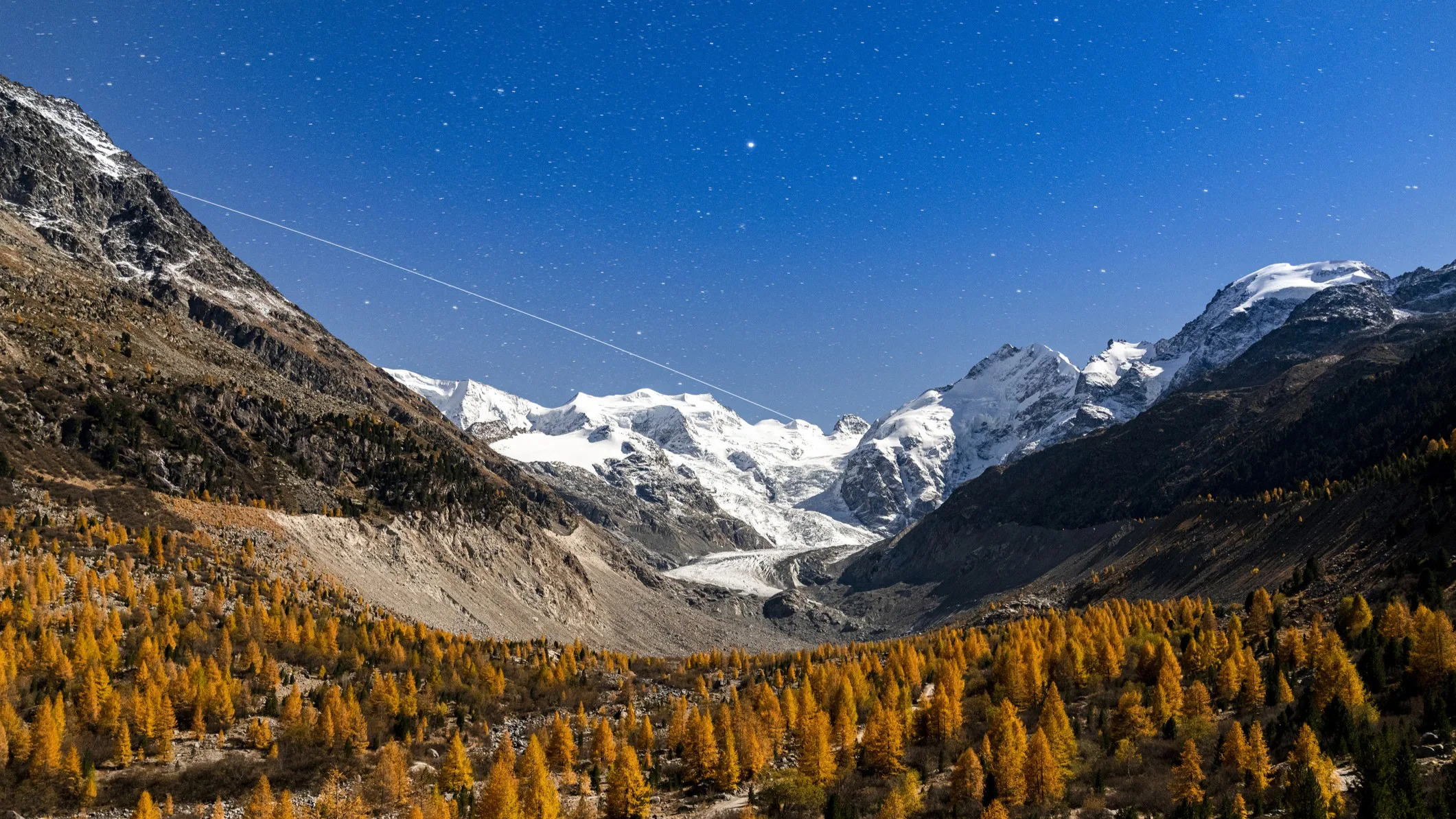
The possible ISS appearance is the most time-sensitive portion of the Thanksgiving night sky. The station travels roughly 420 kilometers above Earth at around 28,200 kilometers per hour. When it passes over a dark enough location while still lit by the sun, it can look like a bright, steady moving star crossing the sky over several minutes. It does not blink like a typical aircraft, although airline traffic is still the most common source of confusion.
Visibility is not uniform. The reported holiday forecast excludes parts of the southern US from the broad expectation of evening passes, and every observer needs a city-specific prediction. NASA’s Spot the Station tool is the cleanest starting point. It lists when to look and where the station will appear. Heavens-Above and N2YO offer similar tracking data, though their interfaces can be more intimidating than the task deserves.
The technology angle is hard to ignore. A thing circling Earth at orbital velocity has become a calendar notification on a phone. The underlying mechanics are extraordinary; the user experience is basically, ‘Go outside at 7:14 and look northwest.’ That translation from complicated system to accessible moment is one of the better uses of consumer-facing space data.
Make the Thanksgiving night sky a repeatable ritual
The best way to approach the Thanksgiving night sky is not to turn everyone into amateur astronomers. Put a pair of binoculars near the door. Check the ISS forecast earlier in the day. Let eyes adjust for a few minutes, and avoid blasting the group with a phone flashlight. If someone has a telescope, set it up before guests arrive; alignment and eyepiece swapping are not where you want to spend the evening.
There is also no shame in keeping expectations modest. Clouds may wipe out the entire program. A bright moon will wash out faint stars. Saturn’s rings may look smaller than a guest imagined after decades of NASA imagery. But those constraints are part of the point. Unlike an endlessly refreshable feed, the sky imposes its own schedule, its own weather and a small amount of patience.
For families who make it outside, the Thanksgiving night sky could become a more durable tradition than the annual argument over who gets the remote. And as satellites, launch providers and lunar missions increasingly turn space into an industrial story, the simplest counterweight may be this: going outside and remembering what all that infrastructure is orbiting around.
Frequently Asked Questions
What can I see in the Thanksgiving night sky without a telescope?
Saturn should be visible as a steady yellow-white point after dusk, while the waning gibbous moon will be obvious once it rises in the east-northeast. In many locations, the International Space Station may also make a visible pass. Binoculars improve the moon substantially.
When will the moon rise on Thanksgiving 2026?
The source places moonrise at roughly 6:25 p.m. local time. About an hour later, the moon should be about one fist-width above the horizon, offering a better position for viewing.
How do I know when the International Space Station will pass overhead?
Use an ISS tracking website to enter your city, town, or custom location and generate a sighting schedule. These services provide information on when and where to look for visible ISS passes.
Can binoculars show Saturn’s rings?
Possibly, but conditions matter. Saturn’s rings are presented at a narrow angle from Earth, so steady, high-power or image-stabilized binoculars offer the best chance. They may also be visible through a telescope magnifying more than 30-power.