
- Hermes Agent writes reusable skill files across sessions, making repeated tasks progressively cheaper to execute over time.
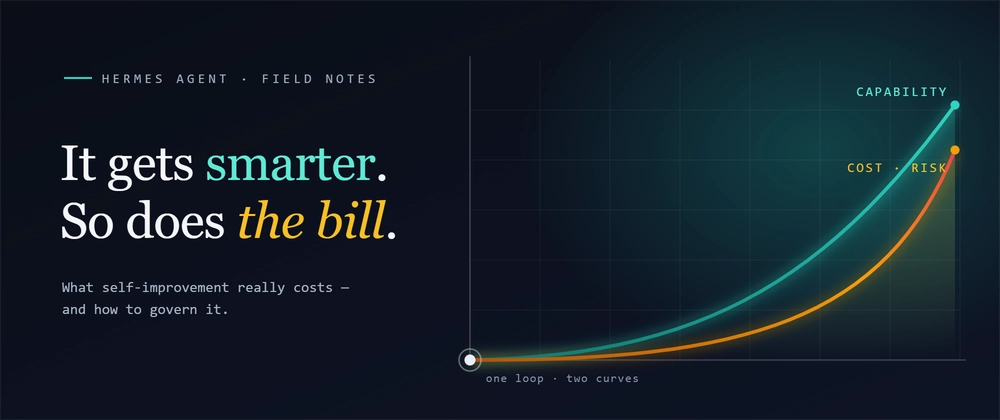
- Hermes Agent compounds capability and cost simultaneously — most write-ups only celebrate the first half of that equation.
- Because skills are stored as plain markdown files, the agent’s learning is readable and auditable — unlike fine-tuned models.
- Compounding autonomy extends your trust surface every day, creating governance risks that grow silently in the background.
Table of Contents
The Agent That Never Forgets — and Never Stops Charging
Hermes Agent has been getting a lot of attention lately, and most of that coverage tells the same flattering story: it’s a self-hosted, self-improving AI agent that gets sharper session by session, building up a library of reusable skills so it never has to re-solve the same problem twice. That story is accurate. It’s also about half the picture. The half that almost nobody covers is the one that matters most once you’ve actually deployed the thing.
The core promise of Hermes Agent is what you might call compounding autonomy. Unlike a standard LLM API call — which is stateless, amnesiac, and charges you full price to rediscover what it figured out an hour ago — Hermes runs as a persistent process on infrastructure you control. A VPS, a Docker container, an SSH host. It remembers. And more importantly, it learns.
That distinction is bigger than it sounds. Stateless agents are burning tokens constantly just re-establishing context, re-deriving solutions, re-inventing procedures they’ve already worked out. A huge fraction of what you’re paying for with a typical agent setup is redundant reasoning. Hermes attacks that problem directly.
How Hermes Agent Actually Builds Skills
The mechanism behind Hermes Agent’s self-improvement is deliberately unglamorous, and that’s a strength. When the agent works through a task, it can write the resulting procedure down as a plain markdown file — a skill — in a local directory. Next time that task appears, it loads the file instead of reasoning from scratch. No vector database required. No fine-tuning run. Just a readable text file that the agent wrote for its future self.
A conceptual example: a skill for a weekly revenue brief might look something like this — pull the last seven days of orders, compare against the prior period, flag anything moving more than 15%, summarize in five bullets, and post to the leadership channel before 9am. The first time, the agent reasons its way to that procedure from scratch. Every subsequent time, it loads four lines of markdown and executes. The re-derivation cost trends toward zero.
Alongside skills, Hermes maintains a memory layer — a searchable record of past sessions built on SQLite full-text search combined with LLM summarization to keep it from bloating. It knows what happened last Tuesday. It can recall prior decisions and their outcomes. The agent is also designed to curate and refine both memory and skills continuously as it works, not in some separate offline process.
The practical upshot is that Hermes can also spawn isolated subagents with their own execution contexts, fanning out on long tasks and folding results back in. Combined with natural-language scheduling — tell it to brief you every morning on yesterday’s numbers — and you’re no longer operating a tool. You’re running a process.
There’s also the ownership angle, which matters more than it might seem right now. Hermes is MIT-licensed, model-agnostic, and runs entirely on your hardware. You can swap underlying model providers when one has an outage, a price hike, or a better capability profile. No vendor can deprecate your agent out from under you — a scenario that’s become increasingly relevant as the major AI labs regularly sunset, reprice, and restructure their API offerings.
Hermes Agent’s Real Liability: Compounding Runs Both Ways
Here’s where the conversation needs to get honest. Compounding is not a feature — it’s a property of the system. And properties don’t take sides.
The same loop that makes Hermes Agent progressively cheaper and more capable also compounds everything else: token costs, skill drift, and the size of the trust surface you’ve extended to an autonomous process running on your server. Each of those deserves a serious look before you deploy.
Cost drift is the sneaky one. When Hermes is working well, per-task token costs fall over time as skills get reused. But the system’s overall activity tends to grow too. More skills mean more skill-loading overhead. Subagent spawning multiplies API calls. Scheduled tasks accumulate. What starts as a lean setup can quietly become a significant monthly line item if you’re not tracking usage at the task level. The per-task cost goes down; the total bill doesn’t necessarily follow.
Skill rot is less obvious but arguably more dangerous. Skills are written by the agent based on what worked at a particular point in time, against a particular data environment. APIs change. Business logic evolves. A skill that was accurate in January can be subtly wrong by April — and because the agent trusts its own prior work, it may execute that stale procedure with full confidence. You need a review cadence for skills, just like you’d review any other piece of code in production. The fact that the agent wrote it doesn’t make it exempt from change management.
Trust surface expansion is the existential one. Every skill the agent writes is code — or at least executable logic — that you didn’t author or review. Every memory record it creates shapes future decisions. If you started Hermes with access to your data sources, your internal APIs, your communication channels, the scope of what it can affect grows every time it acquires a new skill. That’s the loan the original framing describes: you’re drawing down capability now and the bill arrives later in the form of autonomous actions you didn’t explicitly authorize.
The Governance Case: Why Legibility Is Hermes Agent’s Best Feature
The good news — and it’s genuinely good news — is that Hermes Agent’s architecture makes it more governable than almost any comparable system. Because skills are plain markdown files and memory is a queryable store, you can actually read what your agent has learned. You can diff the skills directory the way you’d review a pull request. You can query memory to understand what context is shaping current decisions.
Compare that to a fine-tuned model, where “what the model learned” is diffused across billions of weights that no human can audit. Or to a RAG setup where retrieval logic can quietly change what the model sees without any visible artifact. Hermes’s learning is legible. That’s not a minor point — it’s the entire basis on which you can build a governance practice around an autonomous agent.
Practical governance for a Hermes deployment doesn’t have to be elaborate. A skills review process — treating new and modified skill files as merge requests before they’re promoted to active use — addresses both drift and trust surface concerns at once. Tagging skill files with creation date, last-validated date, and the task context that generated them gives you an audit trail. Setting hard token budgets per task type and alerting on deviations catches cost drift early. None of this requires exotic tooling; it requires treating your agent’s learned artifacts as production assets, not background noise.
What Hermes Agent Tells Us About the Broader Agent Landscape
Hermes isn’t an outlier — it’s an early, honest look at where the entire agentic AI space is heading. The industry is moving fast toward persistent, long-running agents that accumulate context and capability over time. Microsoft’s Copilot agents, Anthropic’s Claude with tool use, and the emerging crop of AutoGPT successors are all, to varying degrees, trying to solve the same statelessness problem that Hermes tackles head-on.
What makes Hermes worth studying isn’t just the implementation — it’s the intellectual honesty of the design. By making learning artifacts readable and local, it forces the question that every enterprise deploying autonomous agents will eventually have to answer: what does your agent know, how did it learn it, and who’s responsible for what it does next? Those questions aren’t going away as agents get more capable. If anything, they get harder to dodge.
The teams that build governance into their agent infrastructure now — treating skills as code, memory as data, and autonomy as a surface to manage — are the ones that won’t be scrambling when something unexpected runs in production at 3am. Hermes makes that discipline possible. Whether you exercise it is still up to you.