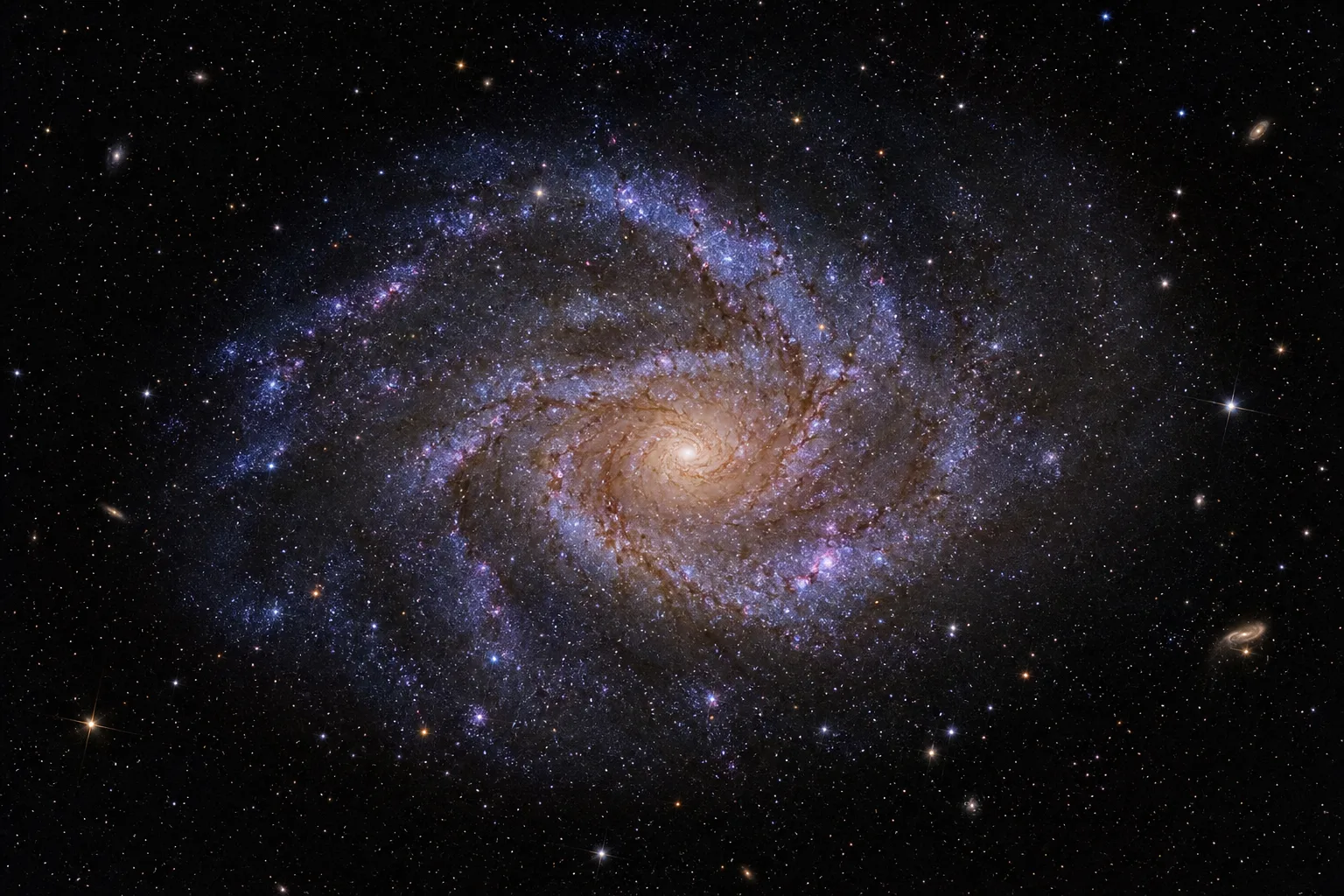
- The Hubble Space Telescope captured a new image of M88, a spiral galaxy 63 million light-years from Earth.
- M88 is an active galaxy with a supermassive black hole at its center, part of the 1,000-galaxy Virgo Cluster.
- Hubble’s Wide Field Camera 3 was used to study how spiral galaxies behave across different cosmic environments.
- The Hubble Space Telescope has been observing the cosmos for over 36 years and remains a key scientific instrument.
Table of Contents
The Hubble Space Telescope’s Latest Striking View
The Hubble Space Telescope has delivered another one of those images that makes you stop scrolling. Its newest target: Messier 88, better known as M88 or NGC 4501, a spiral galaxy located approximately 63 million light-years away in the constellation Coma Berenices — poetically named ‘Berenice’s Hair’ after an Egyptian queen whose locks were said to have been transformed into stars. The result is a sweeping, hypnotic portrait of a galaxy mid-spin, its arms trailing outward from a blazing core in a way that feels almost too elegant to be real.
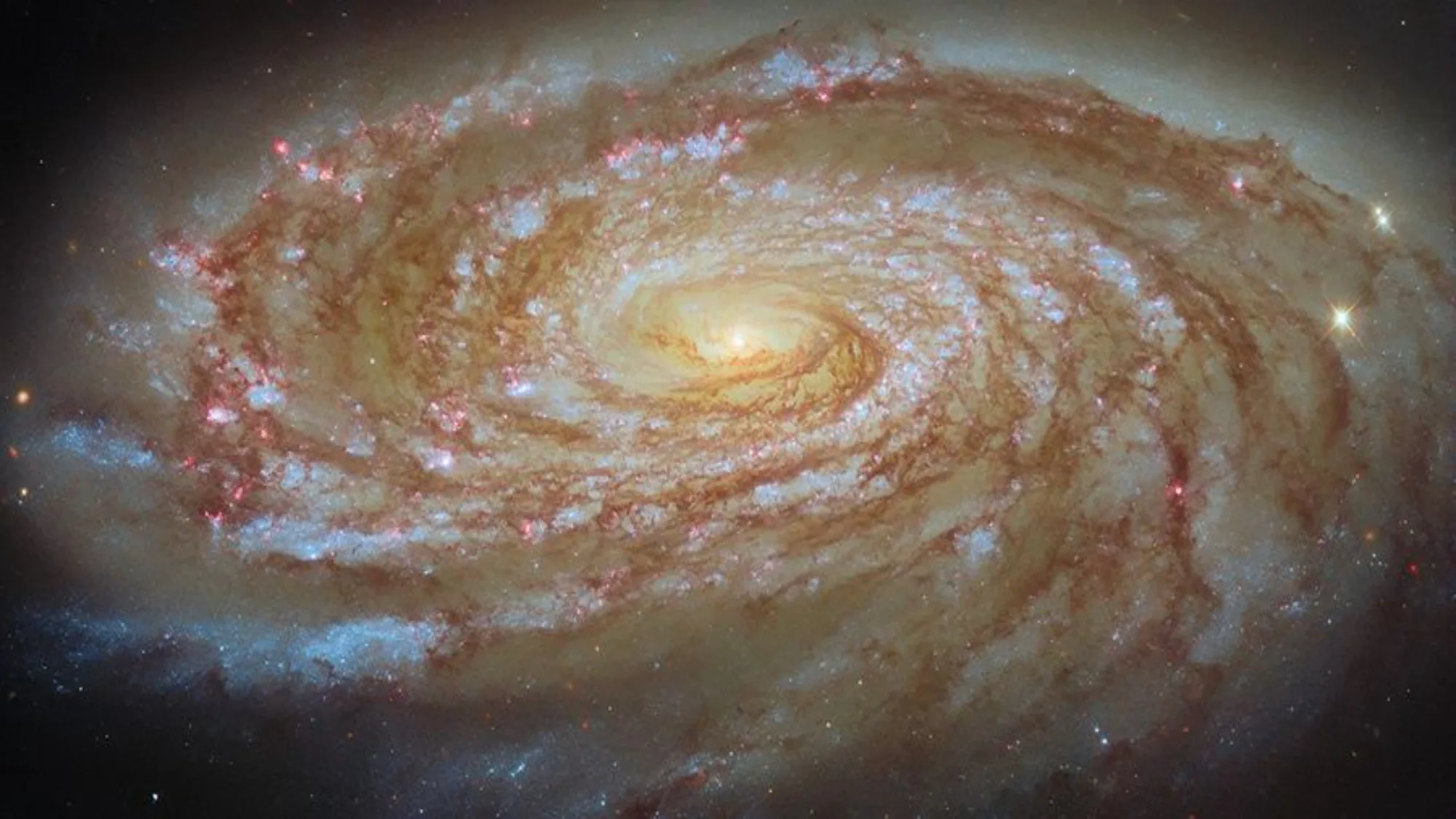
What you’re looking at isn’t just pretty imagery. M88 is what astronomers call an active galaxy — a classification that means its central supermassive black hole is actively pulling in surrounding gas and dust, generating enormous amounts of energy in the process. That core is essentially a cosmic furnace, and the spiral arms wrapping around it contain the raw material — stars, gas clouds, interstellar dust — that makes galaxies like this so scientifically interesting. It’s a reminder that what looks like a serene swirl from 63 million light-years away is actually a scene of continuous, violent transformation.
Why M88 and Why Now
This image wasn’t taken for the sake of producing wallpaper, though it certainly qualifies. Astronomers used the Hubble Space Telescope to observe M88 as part of a broader study into how spiral galaxies operate across different environments. The Virgo Cluster, of which M88 is a member, provides a useful natural laboratory for that kind of work. With over 1,000 galaxies packed into a relatively small region of space, the cluster creates conditions — gravitational interactions, stripped gas, pressure from the intracluster medium — that can dramatically alter how individual galaxies evolve. Studying M88 in that context tells astronomers something about what environment does to a galaxy’s structure and star-forming activity over time.
The tool doing the heavy lifting here is Hubble’s Wide Field Camera 3, an instrument that remains one of the most capable imaging systems in orbit. It operates across ultraviolet, visible, and near-infrared wavelengths, giving researchers a wide spectral window onto objects like M88. At a distance of 63 million light-years, that level of detail is genuinely hard to achieve — the fact that individual structural features of the galaxy are visible at all speaks to how formidable this instrument remains.
Hubble Space Telescope at 36 — Still Punching Hard
It’s easy to treat the Hubble Space Telescope as a legacy instrument in the era of James Webb, but that framing undersells what Hubble is still doing. Since its launch in April 1990, Hubble has produced an enormous body of observations and contributed to a vast number of peer-reviewed papers. The M88 image is a small but concrete reminder that the telescope isn’t coasting — it’s still actively participating in frontier science.

Webb and Hubble aren’t really competitors. They’re more like two instruments in the same orchestra, each covering a different register. Webb operates primarily in the infrared, which makes it extraordinary for peering through dust-obscured star-forming regions and looking back at the earliest epochs of the universe. Hubble’s strength is optical and ultraviolet imaging — the kind of crisp, detailed visible-light portraits that remain scientifically irreplaceable for studying galaxy morphology, stellar populations, and objects like M88. The two telescopes are, in practice, used together as complementary tools on the same questions.
The forthcoming Nancy Grace Roman Space Telescope, NASA’s next flagship observatory, will add yet another layer when it eventually launches. Roman is designed for wide-field surveys — think Hubble’s depth but applied across a significantly larger field of view. Where Hubble excels at staring hard at individual targets, Roman will be built to map the sky at scale. That’s not a replacement for what Hubble does; it’s a different kind of vision entirely.
What M88 Actually Tells Us
Zoom out from the aesthetics for a moment and the science here gets genuinely interesting. Spiral galaxies aren’t uniformly distributed across the universe — they tend to be found more often in lower-density environments, away from the crowded centres of clusters like Virgo. The fact that M88 is a spiral galaxy inside the Virgo Cluster makes it something of an outlier, and that makes it a useful test case. Is its spiral structure being slowly eroded by the cluster environment? Is the rate of star formation in its arms being suppressed by ram pressure stripping — the process by which a galaxy moving through the cluster’s hot gas gets its own gas peeled away like paint from a car in a wind tunnel? These are the kinds of questions the broader study that produced this image is trying to answer.
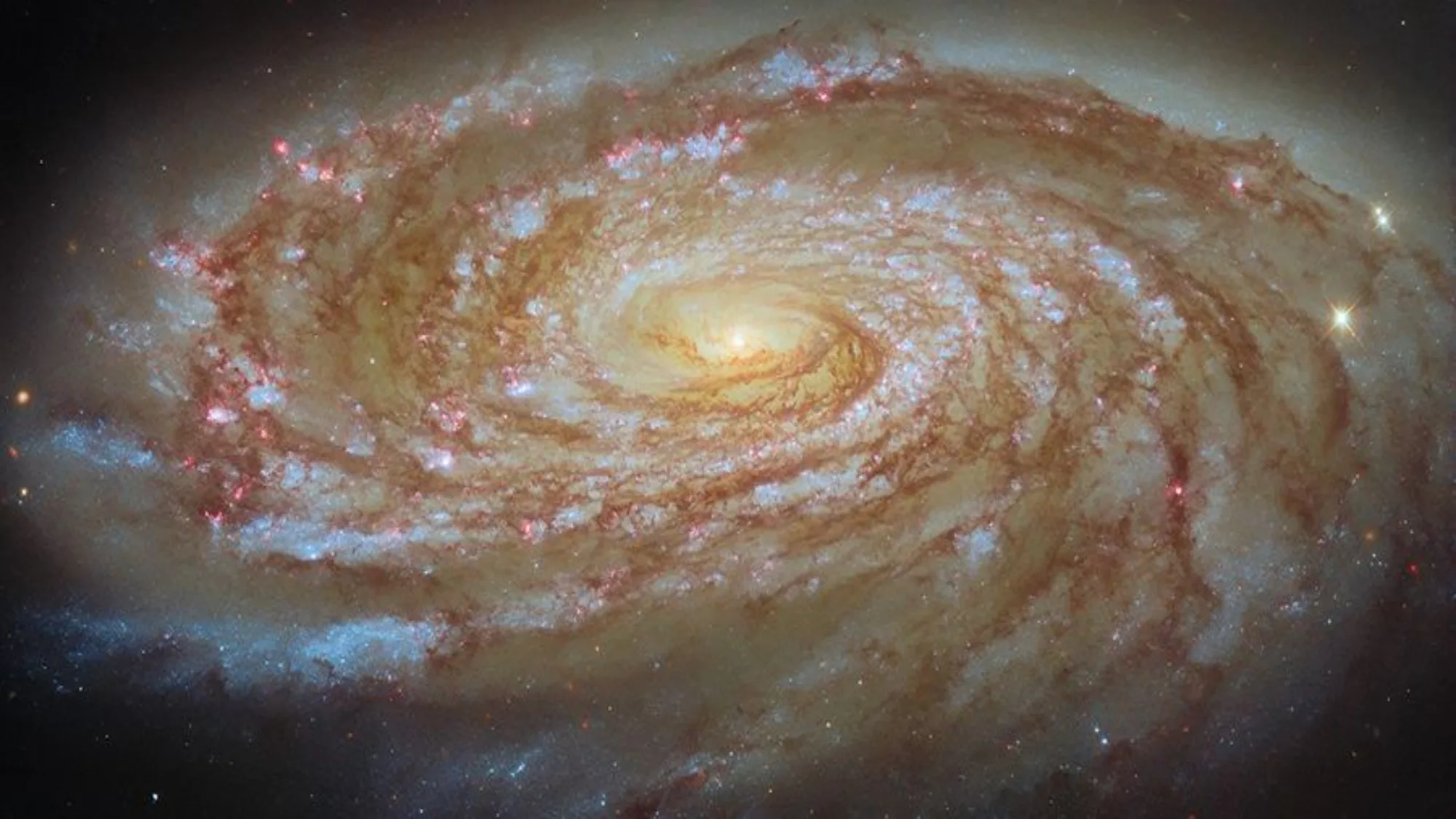
The Hubble Space Telescope is uniquely positioned to contribute to this work because it can resolve the fine structural details — star clusters, dust lanes, HII regions — that tell the story of where a galaxy has been and where it’s heading. A lower-resolution instrument would see the same broad shape but miss the tell-tale signs written into the finer textures of the arms and core.
The Longer Arc of Deep-Space Imaging
Images like this M88 portrait have a dual life: they’re scientific data, but they’re also a form of public communication that has proven consistently powerful over three and a half decades. When NASA released the original Hubble Deep Field in 1995 — a long exposure of a tiny, seemingly empty patch of sky that turned out to be teeming with thousands of galaxies — it rewired how the general public thought about the scale of the universe. Subsequent images, from the Pillars of Creation to the eXtreme Deep Field, built on that tradition. M88 isn’t at that tier of cultural impact, but the impulse is the same: take something abstract and make it visceral.
That’s still worth doing. As the Hubble Space Telescope enters what is likely the final decade or so of its operational life — there’s no active servicing mission planned, and the telescope’s gyroscopes have been a recurring concern — images like this one carry a certain weight. Each new observation is a reminder of what the instrument has made possible, and what the field will need to sustain once it’s gone. Webb is already doing extraordinary work, and Roman will eventually broaden the aperture further. But Hubble’s specific voice in the conversation — that sharp, optically precise, colour-rich portrait of the nearby universe — isn’t something that gets automatically replaced the moment a newer telescope goes online.
Source: Space.com
Frequently Asked Questions
What is the Hubble Space Telescope currently used for?
The Hubble Space Telescope continues to study galaxies and deep-space structures. Its Wide Field Camera 3 can image objects tens of millions of light-years away in exceptional detail, contributing to ongoing research like the current investigation into spiral galaxy behaviour in different environments.
What makes M88 an active galaxy?
M88 is classified as an active galaxy because it harbours a supermassive black hole at its core. That black hole continuously draws in vast quantities of gas and dust from the surrounding space, generating significant energy output from the galactic centre.
How far away is the M88 galaxy from Earth?
M88, also catalogued as NGC 4501, sits roughly 63 million light-years from Earth in the constellation Coma Berenices — sometimes called ‘Berenice’s Hair.’ It is one of the brighter members of the Virgo Cluster, a grouping of over 1,000 galaxies.
How does Hubble compare to the James Webb Space Telescope?
Hubble and James Webb serve complementary roles, each with unique purposes to expand our understanding of the universe. Hubble remains an incredibly powerful tool for exploring the cosmos, while James Webb and the upcoming Nancy Grace Roman Space Telescope also contribute to broadening our knowledge.