

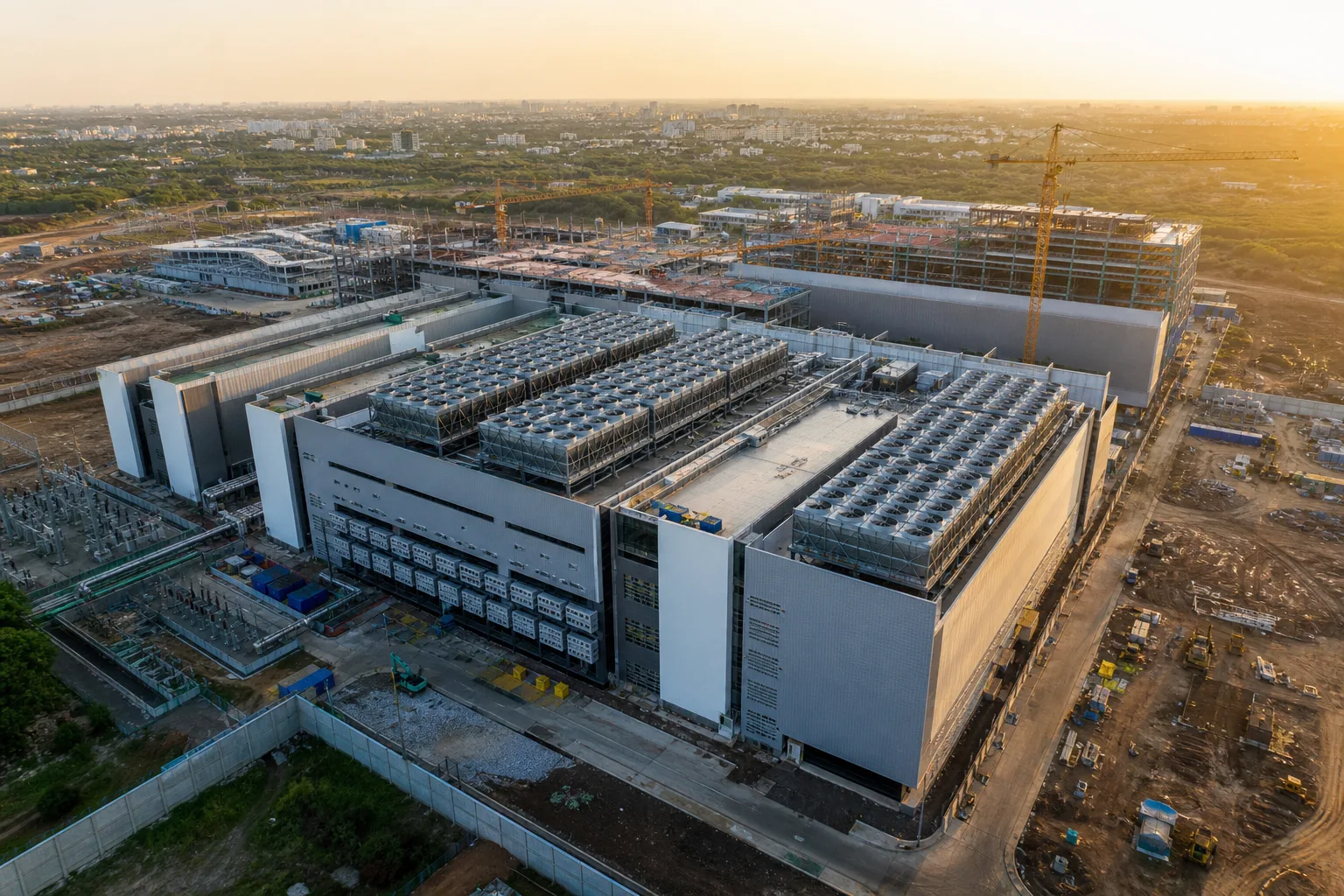
- India generates nearly 20% of the world’s data yet accounts for only 3% of global India data centre capacity.
- The India data centre market is drawing massive investment from hyperscalers including Google, Microsoft, and Amazon.
- Government policy on data localisation is accelerating demand for domestic data infrastructure at scale.
- Analysts expect India’s installed data centre capacity to more than double within the next five years.
Table of Contents
The India Data Centre Gap Nobody Can Ignore
The India data centre story starts with a single, uncomfortable statistic: India produces roughly one-fifth of all the data generated on earth, yet the physical infrastructure needed to store, process, and serve that data — the actual servers, cooling systems, and network fabric of a modern India data centre — accounts for barely 3% of global capacity. That’s not a gap. That’s a chasm. And right now, it’s arguably the single biggest infrastructure investment opportunity in the entire Asia-Pacific region.
To put it in perspective, a country of 1.4 billion people with over 800 million internet users and one of the fastest-growing digital economies on the planet has been quietly offshoring the backbone of its own data ecosystem. For years, the data that Indian users generated — payments, messages, health records, government interactions — was routinely processed and stored in server farms in Singapore, the US, or elsewhere in the Asia-Pacific. The economics made sense at the time. Building large-scale India data centre capacity was expensive, power was unreliable, and land in urban centres was difficult to acquire.
Those conditions haven’t entirely disappeared. But the calculus has shifted dramatically.
Why Hyperscalers Are Betting Big on India Now
Google, Microsoft, and Amazon Web Services have each made substantial, publicly announced commitments to expanding their Indian cloud footprint. Google has reportedly pledged significant investment into its Indian cloud region, while Microsoft has reportedly committed substantial funding to cloud and AI infrastructure across the country. AWS, not to be outdone, reportedly has its own expansion plan targeting Indian enterprise customers. These aren’t exploratory bets — they’re structural commitments from companies that do serious modelling before they pour concrete.
What changed? A few things converged at once. India’s smartphone penetration kept climbing. Jio’s arrival in 2016 effectively collapsed mobile data prices overnight and brought hundreds of millions of new users online. The UPI payments network became one of the most-used digital payment systems anywhere in the world, processing a vast number of transactions every month, according to the National Payments Corporation of India. Every one of those transactions generates data. Every streaming session on JioCinema or Hotstar generates data. Every interaction with a government digital service generates data. India’s data exhaust is enormous, and it’s growing fast.
Then there’s AI. The global scramble for AI infrastructure has forced every major cloud provider to reassess where they need compute capacity and when. India, with its large developer base, growing number of AI startups, and appetite for AI-powered services, sits near the top of every hyperscaler’s priority list for the next wave of GPU-dense India data centre buildout.
Domestic Players Are Moving Too
It isn’t just the American giants. Indian conglomerates have identified the India data centre opportunity just as clearly. Adani Enterprises has been building out a significant data centre portfolio, targeting hyperscale customers. Reliance Industries, through its Jio Platforms arm, has its own infrastructure ambitions that include India data centre capacity to support its sprawling digital ecosystem.
The geography of Indian data centres is itself telling. Mumbai remains the dominant hub — it has the submarine cable landings, the financial services concentration, and the legacy infrastructure that makes it the natural anchor. But Hyderabad, Chennai, Pune, and Delhi-NCR are all emerging as serious secondary markets. Hyderabad in particular has attracted attention because of its relatively lower land costs, state government incentives, and an established base of IT industry tenants who’d happily co-locate workloads closer to their own offices.
The Policy Tailwind: Data Localisation
Government policy is doing a lot of the heavy lifting here too. India has been moving — slowly, but deliberately — toward data localisation requirements that mandate certain categories of sensitive data be stored on Indian soil. The Personal Data Protection landscape has evolved considerably over the past few years, and while the full regulatory picture is still taking shape, the direction of travel is unmistakable. Foreign companies operating in India increasingly need India data centre capacity not just for performance reasons, but for compliance ones.
That’s a structural demand driver that doesn’t go away. It means that even multinationals with no particular attachment to India’s market dynamics are essentially compelled to stand up Indian infrastructure or find a local partner who has.
The Real Challenges Ahead
None of this is frictionless. The India data centre build-out faces real constraints that don’t vanish just because the demand is compelling. Power is still the biggest one. Data centres are voracious electricity consumers, and India’s grid — while improving — isn’t uniformly reliable at the scale that hyperscale operators require. Many large facilities are investing heavily in diesel backup and, increasingly, renewable energy tie-ups, but the operational complexity is real.
Water is another concern that tends to get less attention than it deserves. Traditional data centre cooling is water-intensive, and in a country with significant water stress in many regions, that’s a genuine long-term planning issue. A handful of operators are already looking at air-cooled and liquid-cooled alternatives specifically with Indian conditions in mind.
Land acquisition in and around major metros remains difficult and expensive. Mumbai, in particular, has a well-documented problem with available industrial-zoned land close enough to fibre networks to be practical. Some developers are deliberately looking further from city centres and investing in the connectivity infrastructure needed to make those sites viable.
What the Build-Out Actually Means
If the projections hold — and multiple analysts are forecasting India data centre capacity roughly doubling or more within the coming years — this is more than just a real estate story. It’s a reconfiguration of where India’s digital economy actually runs.
Faster processing closer to end users means lower latency for applications that require it — financial trading, real-time AI inference, gaming, telemedicine. It means Indian startups building AI-native products will increasingly have access to the kind of GPU compute that used to require routing workloads through Singapore or Virginia. It means India’s sovereign data ambitions — the idea that critical national data should sit on Indian infrastructure — become genuinely feasible rather than aspirational.
The 20%-versus-3% imbalance won’t close overnight. India data centre construction at hyperscale takes years from site selection to going live. But the capital commitments are in place, the policy signals are consistent, and the demand is only going one direction. India’s infrastructure gap is, right now, also its biggest investment story.
Frequently Asked Questions
Why is India data centre capacity so low compared to data generation?
India’s digital economy expanded far faster than its physical infrastructure. Historically, multinational companies routed Indian data through Singapore or US-based facilities. The combination of underinvestment, land constraints, and unreliable power supply held domestic capacity back for years.
Which companies are investing in India’s data centre market?
Global tech giants and hyperscalers have announced or expanded their presence in India. Domestic players are also scaling aggressively to meet surging enterprise and government demand.
How does India’s data localisation policy affect data centre growth?
India’s push toward data localisation rules — requiring certain categories of sensitive data to be stored on Indian soil — directly creates demand for domestic data centre capacity. It gives both foreign and local operators a regulatory incentive to build on Indian ground rather than route data offshore.
What is driving India’s data consumption growth?
India has a large and growing internet user base, some of the world’s cheapest mobile data rates, and a rapidly expanding digital payments and e-commerce ecosystem. The explosion of AI applications and government digital services is layering additional demand on top of that already massive base.

