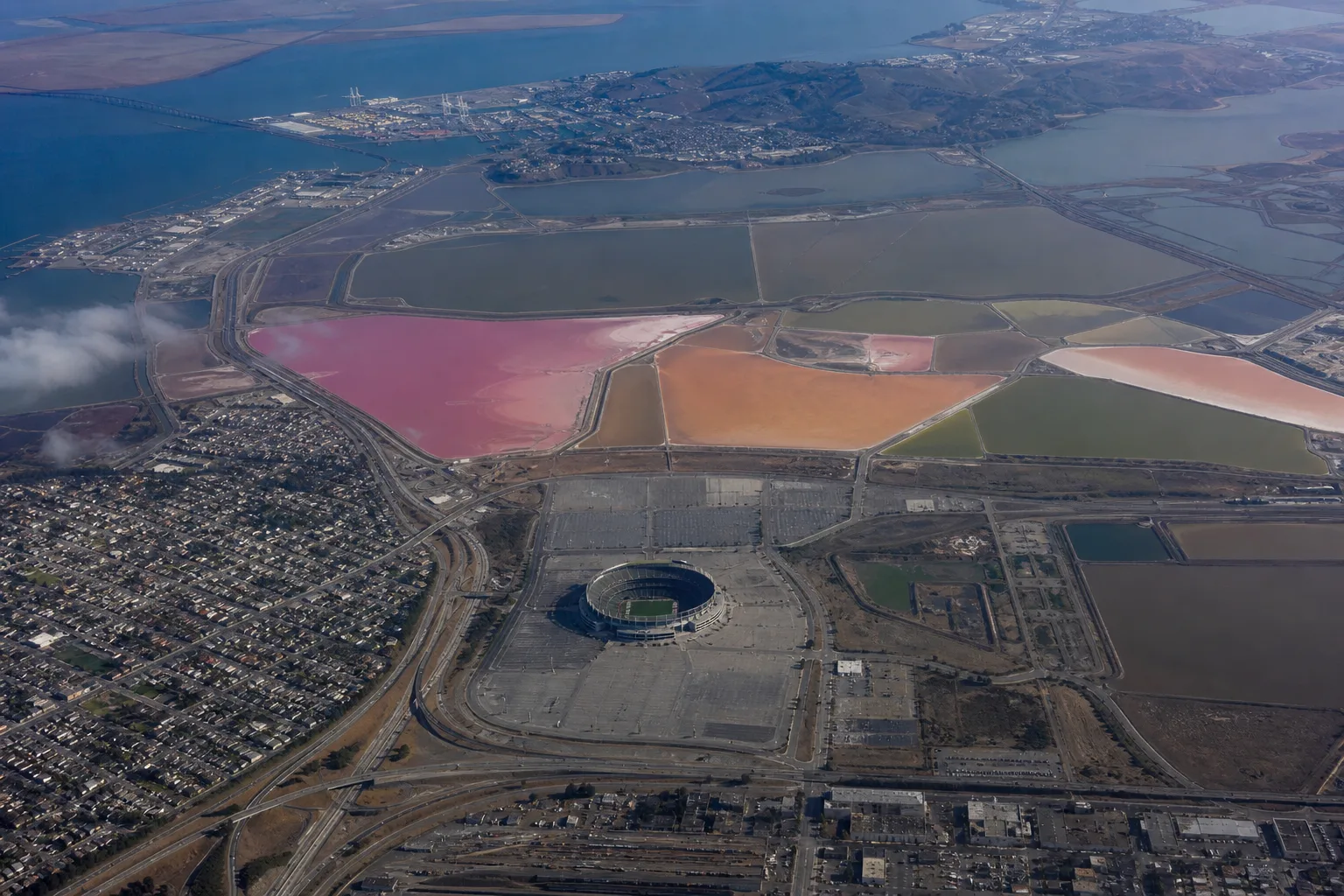
There’s a specific kind of perspective shift that only happens when you see something familiar from an impossible angle. The ISS World Cup photos released by NASA do exactly that — pulling back 250 miles above North America to reframe some of the most-watched sporting venues on the planet as tiny geometric shapes embedded in sprawling, complicated landscapes. What makes these images more than novelty is what they reveal about the ground beneath the grandstands: century-old environmental scars, active restoration efforts, and the strange collision of stadium infrastructure with the natural world.
- ISS World Cup photos captured by Expedition 67 astronauts reveal stunning aerial detail of host venues across North America.
- The ISS World Cup photos expose dramatic environmental histories — from toxic dumping grounds to active wetland restoration projects.
- NASA’s Earth-observing program uses Nikon D5 cameras with focal lengths up to 1150mm to capture precise ground-level detail from orbit.
- The 2026 FIFA World Cup final is scheduled for July 19 at MetLife Stadium in East Rutherford, New Jersey.
Table of Contents
ISS World Cup Photos: A View No Camera Crew Can Get
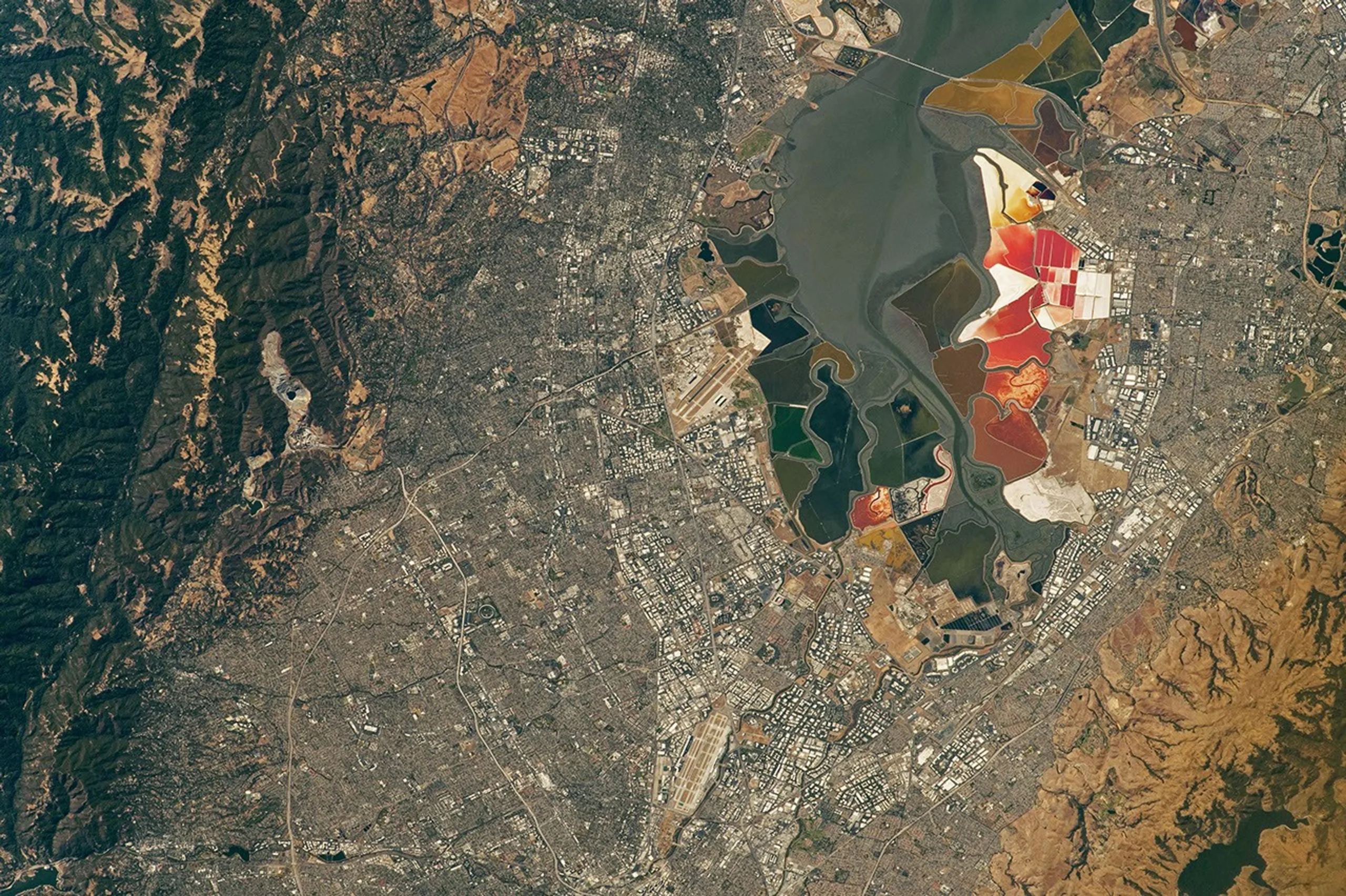
The ISS World Cup photos were captured by members of NASA’s Expedition 67 crew using Nikon D5 digital cameras — the same workhorse body trusted by professional sports photographers on the ground, but in this case mounted in the cupola of a space station moving at roughly 17,500 miles per hour. Two key images stand out. The first, taken on July 26, 2022, shows Levi’s Stadium in Santa Clara, California, using a 400mm focal lens. The second, acquired on April 17, 2022, captures MetLife Stadium in East Rutherford, New Jersey, shot with a 1150mm focal length — a reminder of just how much optical reach you need to resolve meaningful ground detail from low Earth orbit.
Both images were processed by the ISS Crew Earth Observations Facility and the Earth Science and Remote Sensing Unit at NASA’s Johnson Space Center, with cropping, contrast enhancement, and lens artifact removal applied before public release. The program exists specifically to maximise the scientific and public value of astronaut photography — and the World Cup offered a compelling hook to surface images that had been sitting in the archive for years.
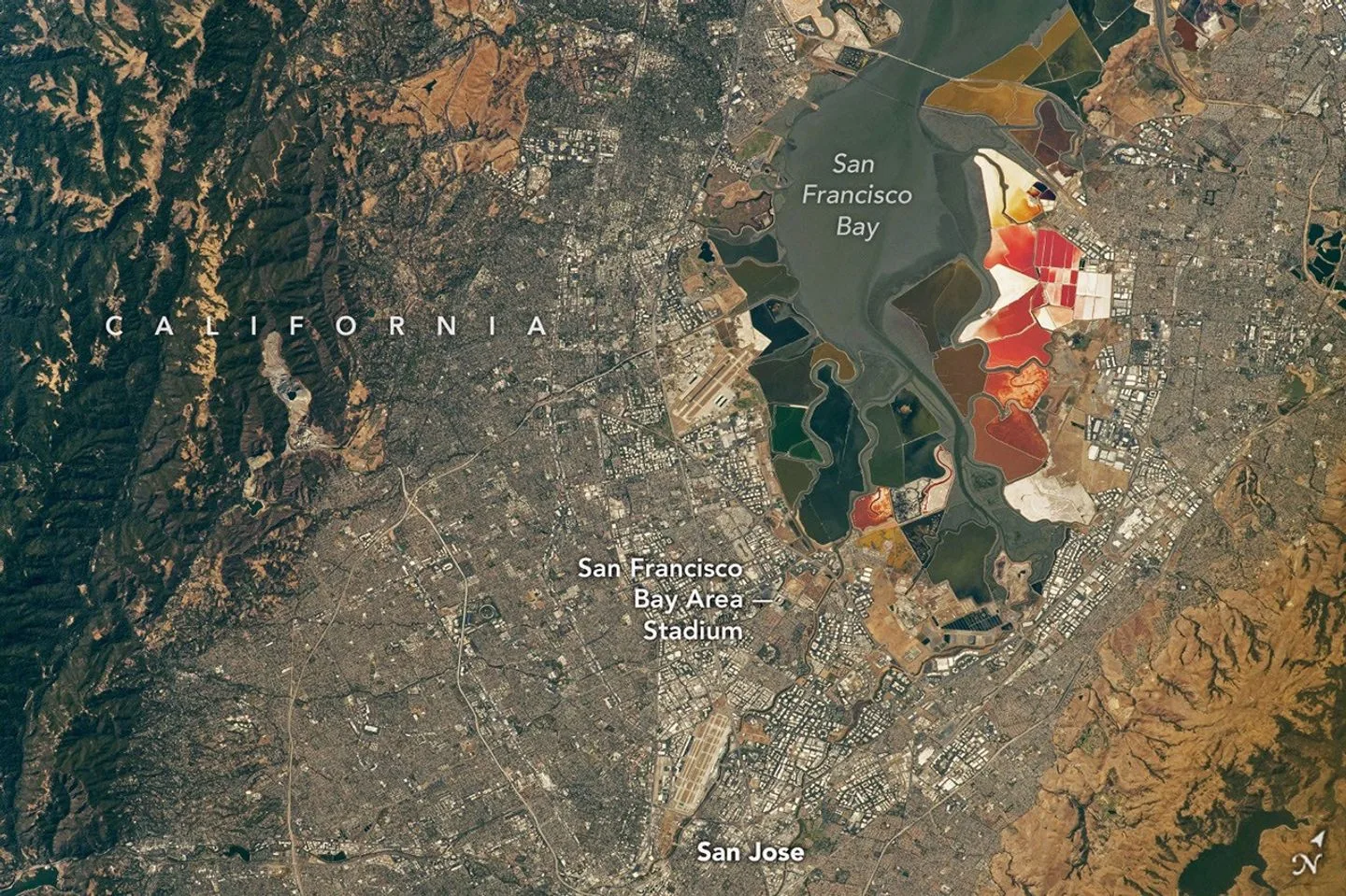
Levi’s Stadium and the Salt Ponds That Surround It
Six World Cup matches were hosted at the San Francisco Bay Area Stadium — better known commercially as Levi’s Stadium — between June 13 and July 1, 2026. The venue opened in 2014 and sits in Santa Clara, roughly 40 miles south of San Francisco and adjacent to San Jose. From orbit, it reads as a compact rectangle wedged between residential blocks, office parks, and highway infrastructure. Unremarkable, almost.
But zoom out and the surrounding landscape tells a far more interesting story. The southern portion of San Francisco Bay visible in the ISS World Cup photos is the site of one of the most ambitious ecological restoration projects in US history. Those vivid, almost painterly ponds in electric shades of pink, orange, and green? Those are the remnants of a commercial salt-making industry that once dominated the shoreline. The South Bay Salt Pond Restoration Project, now roughly 23 years into a planned 50-year timeline, is working to return up to 90 percent of the region’s former salt ponds to functioning tidal wetlands and marshlands. The US Geological Survey has been tracking nesting waterbird populations as one of the key metrics of the project’s success — and from the ISS, you can literally watch the geography of that transformation unfold in colour.
The Bay Area’s final World Cup match came on July 1, when the United States faced Bosnia and Herzegovina in a knockout round. The US won 2–0 and advanced to the round of 16, sending a packed Levi’s Stadium into the kind of noise that probably registered on local seismographs. The ISS World Cup photos of this venue remain among the most visually striking in the entire set, precisely because the ecological context surrounding the stadium is so legible from altitude.
MetLife Stadium: Where the World Cup Final Will Be Decided
On July 19, 2026, the FIFA World Cup final takes place at New York New Jersey Stadium — universally called MetLife Stadium — in East Rutherford, New Jersey. It sits along the New Jersey Turnpike, west of Midtown Manhattan, inside the Meadowlands Sports Complex. In the ISS World Cup photos, the stadium appears on the right side of the frame with Manhattan’s dense grid of towers filling the left. The contrast is stark and deliberate: you’re looking at two versions of American infrastructure in a single shot.
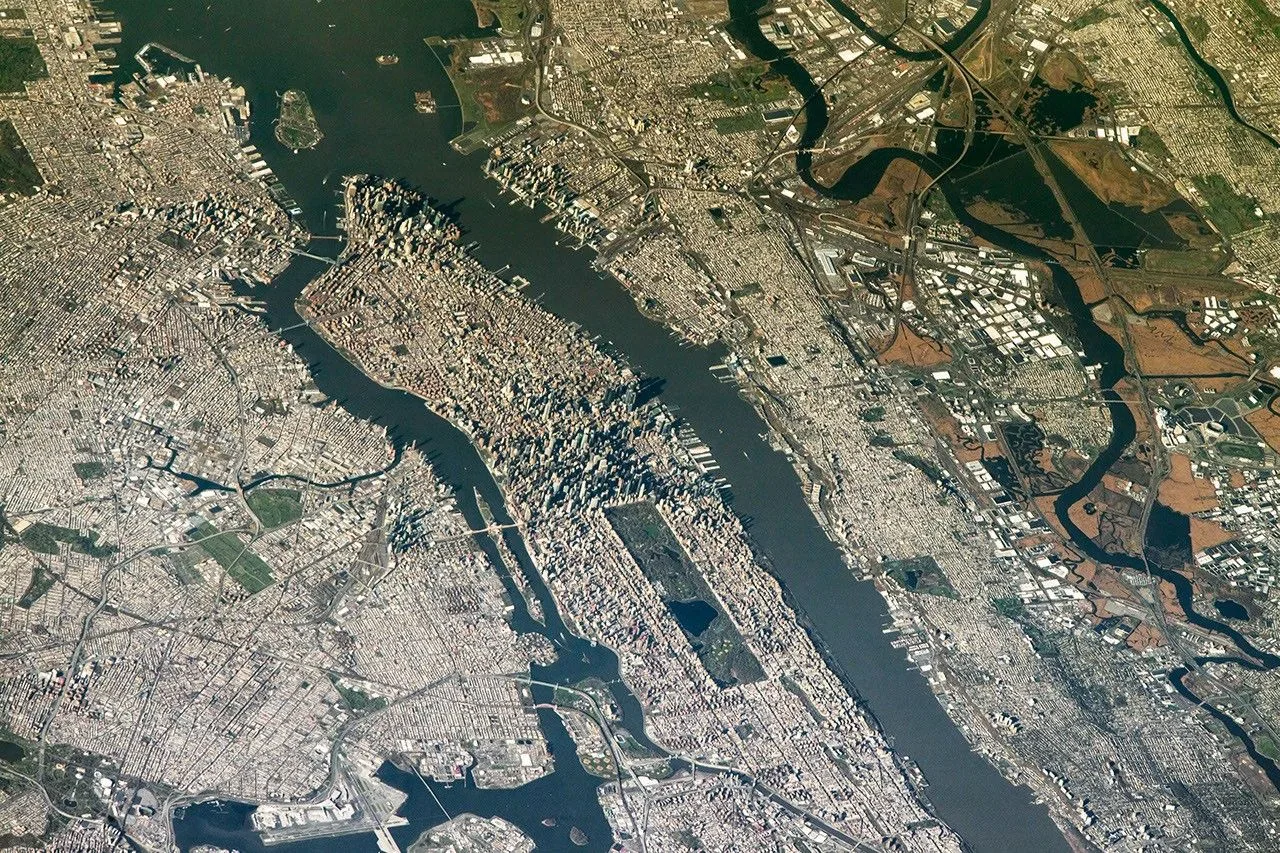
The Meadowlands has a complicated environmental biography. European colonists cleared the original wetlands and cedar forest to build settlements, and the area spent the better part of the 20th century absorbing the consequences — industrial development, unregulated dumping, and decades of contamination. It became, in the bluntest terms, a dumping ground. The transformation into a major sports and entertainment hub came alongside, not instead of, those scars. Recent decades have brought wetland restoration efforts to the area, a partial reckoning with that history, but the landscape captured in the ISS World Cup photos is still one defined by layered human intervention stretching back centuries.
The choice of MetLife for the final carries its own symbolism. With a capacity exceeding 82,000 and proximity to the largest media market in North America, it’s the most logistically obvious pick. Whether you’re watching from the upper deck or from 250 miles directly above, the scale of the venue is hard to argue with.
The Broader Program Behind the Images
It would be easy to treat the ISS World Cup photos as a fun PR exercise — NASA riding the wave of a major sporting event to surface archive imagery. And there’s some truth to that. But the underlying program is substantive. The ISS National Lab’s Crew Earth Observations initiative has produced tens of thousands of images over decades of continuous habitation on the station. The goal is explicitly scientific: documenting land use change, urban expansion, natural disasters, and environmental transformation at a spatial resolution and temporal frequency that satellite systems don’t always match.
Other World Cup host venues have also shown up in the astronaut photography archive. Estadio Akron in Guadalajara, SoFi Stadium in Los Angeles, NRG Stadium in Houston, and BC Place in Vancouver have all been observed from above. Each image, taken at a different point in time, becomes a data point in a long-running record of how these cities and their surroundings change — or don’t. Reviewing the full set of ISS World Cup photos together makes that cumulative record easier to appreciate. NASA has also noted that its data has been used by the CDC to monitor air quality during the World Cup, another practical application that runs well beneath the surface of the sports coverage.
The cameras themselves are off-the-shelf professional equipment — the Nikon D5 — operated by astronauts who’ve received training in Earth observation photography but aren’t dedicated remote sensing scientists. That human element matters. An automated satellite follows a fixed orbit and a predetermined schedule. An astronaut can look out the window, recognise something worth capturing, and fire the shutter. Some of the most scientifically valuable images in the archive came from exactly that kind of opportunistic observation.
What These Images Actually Tell Us
There’s a tendency to treat astronaut photography as inspirational wallpaper — beautiful, but not especially useful outside a science classroom. The ISS World Cup photos push back against that framing. When you look at Levi’s Stadium and see the salt pond restoration project framing it on three sides, you’re getting a real-time visual record of a multi-decade environmental intervention that will still be running in 2053. When you look at MetLife and see the Meadowlands, you’re seeing the physical residue of centuries of land use decisions compressed into a single frame.
That’s the argument for keeping humans on the ISS and keeping cameras pointed at Earth: not every image needs to be scientifically scheduled to be scientifically valuable. The broader archive of ISS World Cup photos is a case study in how opportunistic observation — driven by human curiosity rather than mission parameters — can generate lasting scientific and cultural value. As low Earth orbit gets more crowded — with commercial stations from Axiom and others beginning to come online — the question of who gets to do Earth observation, and under what mandate, is going to matter more. NASA’s existing archive, built over more than two decades of continuous occupation, is an asset that’s easy to underestimate right up until you need it.
Frequently Asked Questions
What cameras were used to take the ISS World Cup photos?
Astronauts used Nikon D5 digital cameras to capture the ISS World Cup photos. The Levi’s Stadium image used a 400mm focal length, while the MetLife Stadium shot used a 1150mm focal length.
How many stadiums hosted the 2026 FIFA World Cup across North America?
Sixteen stadiums across North America hosted 2026 FIFA World Cup matches. Host venues included Levi’s Stadium in Santa Clara, MetLife Stadium in New Jersey, SoFi Stadium in Los Angeles, NRG Stadium in Houston, BC Place in Vancouver, and Estadio Akron in Guadalajara.
What environmental restoration project appears in the Levi’s Stadium space photo?
The image shows a 50-year effort to restore up to 90 percent of the southern San Francisco Bay’s historic salt ponds back into tidal wetlands and marshlands, while preserving some of the area’s salt-making heritage. At the time the photo was taken, the project was 23 years into that effort.
Are NASA’s astronaut Earth photos available to the public?
Yes. The ISS National Lab and NASA’s Johnson Space Center make astronaut Earth photography freely available online through the NASA/JSC Gateway to Astronaut Photography of Earth, covering locations photographed over the course of crewed spaceflight.