
The most important shift happening in AI right now isn’t about bigger models or faster inference. It’s about who initiates the conversation. Proactive AI agents — the kind that watch your systems, process information in the background, and reach out to you when something matters — represent a fundamentally different relationship with software. And if you’re still treating your AI like a search box you occasionally shout into, you’re already behind.

- Proactive AI agents don’t wait for your prompt — they monitor systems, run jobs, and reach out to you first.
- Proactive AI agents with persistent memory stop wasting your time re-explaining preferences every single session.
- Scheduled cron-style jobs turn an AI assistant from a chat tab into always-on background infrastructure.
- Reusable skill libraries mean agents get meaningfully better over time, not just faster at the same one-off tasks.
Table of Contents
Why Waiting for a Prompt Is the Wrong Model
Think about how most people use AI tools today. You open a tab. You re-explain your project. You paste in the same context links you pasted last week. You spend twenty minutes fact-checking whether the output is even real. That workflow made sense when AI was essentially a very confident autocomplete engine. It doesn’t make sense for proactive AI agents.
The difference between an AI assistant and an AI agent isn’t just about tool access — it’s about initiative. An assistant answers when called. An agent acts when needed. That sounds like a small distinction until you actually start building workflows around it, at which point the gap becomes enormous.
Hermes Agent, which targets exactly this space, frames its pitch around an “always-on chief of staff” model — a resident process that lives on your server, watches the dull repetitive corners of your digital life, and messages you when something’s actually worth your attention. Not a sci-fi butler. More like a relentlessly caffeinated operations person who doesn’t sleep, doesn’t forget preferences, and isn’t shy about flagging when your TODO list is a disaster. That’s the practical promise proactive AI agents are built to deliver.
Proactive AI Agents and the Shift to Long-Running Workflows
The broader industry is clearly moving in this direction. Developer-facing coding agents like GitHub Copilot Workspace, Devin from Cognition, and a growing list of open-source alternatives are already running for minutes or hours — inspecting repos, writing tests, opening pull requests, and iterating without a human typing every step. Teams are wiring tools together using the Model Context Protocol (MCP), Anthropic’s open standard for connecting AI models to external systems, rather than writing one-off integrations every time a new model drops.
The consumer side is catching up fast. Personal agent users increasingly care less about raw prompt cleverness and more about memory — because they’re exhausted from re-explaining their lives to a rectangle every single session. That exhaustion is a real product signal, and it’s one that proactive AI agents are designed to answer directly.
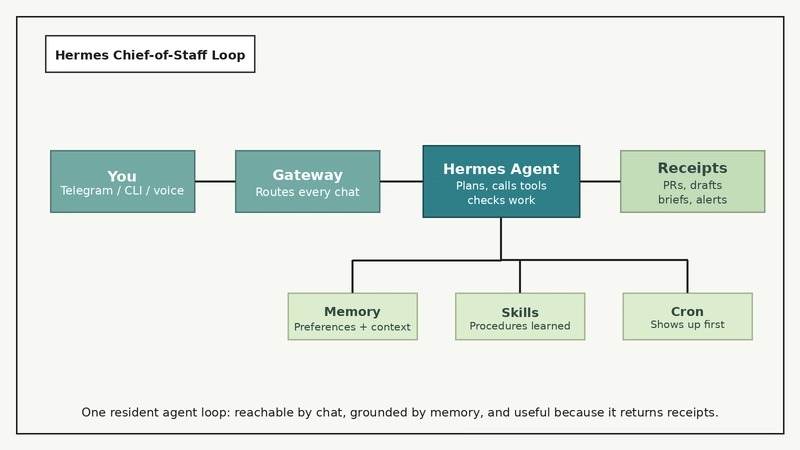
Hermes sits at that intersection by combining several capabilities that, individually, aren’t unusual — but together change the shape of the product considerably. It can run on a personal machine, VPS, container, or cloud backend. It has a messaging gateway that connects to wherever people already communicate: Telegram, Discord, Slack, WhatsApp, email. It has cron job support and webhook triggers, so it can act without waiting for you to remember you forgot something. And it has persistent memory, session search, and reusable skill libraries. That last part is where proactive AI agents get genuinely interesting.
What an Actually Useful Proactive Workflow Looks Like
To make this concrete, consider the difference between two versions of the same task. A standard AI assistant can summarize a news article when you paste it in. A proactive AI agent workflow does something qualitatively different: every morning, it checks the AI ecosystem news, verifies the genuinely useful stories, filters duplicates, writes a brief in your preferred style, generates a cover card, posts it to Telegram, and then tells you what changed since yesterday. If the pipeline breaks, it explains exactly where and why.
That’s not a chatbot with extra steps. That’s infrastructure. And it starts to look like infrastructure the moment you stop triggering it manually and let it run on a schedule.
The best version of proactive AI agents operates in a consistent loop: watch the data sources that currently make you say “I’ll check that later” — news feeds, GitHub issues, calendars, inboxes, dashboards, RSS feeds. Verify by fetching primary sources and comparing references rather than trusting a hallucinated summary. Produce the output, whether that’s a brief, a diagram, a drafted pull request, or a prepared message. Report it back through whatever channel the human actually uses. Then save what worked as a reusable skill for next time.
That final step — saving what worked — is the part people consistently underestimate. A tool-using agent is useful in a limited, session-by-session way. A tool-using agent that writes down its own playbooks and gets better at repeating them is a different proposition entirely. The first run is messy. By the fifth run, it starts to feel less like software and more like someone you’ve actually trained.
Cron Jobs Aren’t Glamorous — That’s Exactly Why They Work
There’s a version of proactive AI agents that sounds like science fiction. There’s another version that’s just a cron job with a brain. The second version is the one worth building.
Scheduled jobs have run the internet’s back office for decades — not because they’re exciting, but because they’re reliable. An agent that checks in every weekday at 9am to brief you on AI agent news, or scans your open-source issues every Friday to suggest a realistic contribution, or generates tomorrow’s priority list every night from your notes — that’s not impressive in a demo. It’s impressive six months later when you realize you’ve stopped forgetting things.
The accessibility dimension matters here too. If you think of a blog post idea while making coffee, you shouldn’t need to open a laptop, navigate to a specific repo, activate a virtual environment, and perform some kind of ritual. You should be able to send a voice note to Telegram and move on. That’s only possible when your agent isn’t trapped inside a terminal waiting for you to invoke it. Proactive AI agents that live where you live — in your messaging apps, your email, your calendar — collapse the distance between the moment you think of something and the moment something happens.
The Memory Problem Most AI Tools Are Still Ignoring
Without persistent memory, proactive AI agents are essentially expensive goldfish. You explain your preferences — short wording, times in IST, don’t restart the gateway mid-session, here’s where my images live — and a week later, the agent asks again. At that point, the AI hasn’t saved you time. It’s outsourced your irritation to a GPU cluster.
Hermes separates memory into three distinct layers, and that separation turns out to matter a lot. User memory stores durable preferences and facts — the kind of thing that should never need repeating. Session search captures what happened in past conversations, so context doesn’t evaporate between chats. Skills store reusable procedures for entire classes of work.
These aren’t just three buckets for the same stuff. “Prefers IST times” is user memory. “How to publish a DEV.to article with hosted images” is a skill. “We fixed yesterday’s cover image” is session history. Mix them together and the agent becomes incoherent. Keep them separate and the agent starts to behave like someone who’s actually been on the job for a while.
Skills in particular are undersold. Most people think the hard part of agent design is getting the agent to complete one task correctly. That’s only half the problem. The real win is making sure the agent doesn’t need the same painful hand-holding the next time the same class of problem comes up. A useful skill isn’t a preference stuffed into a memory field. It’s a playbook: when to use it, which tools to call, which files or APIs matter, what can go wrong, and how to verify the result. That’s also, not coincidentally, how experienced people in any field operate — not by memorizing every detail, but by remembering the shape of the problem, the known failure modes, and the checklist that prevents embarrassing mistakes.
Where This Leaves the AI Assistant Market
The broader implication here goes beyond any single tool. The conversational AI assistant model — you prompt, it responds, you prompt again — is quietly being displaced at the top end of the market. Developers and power users are increasingly looking for proactive AI agents that behave like persistent processes rather than web pages. They want something that can be triggered by a calendar event, a webhook, an inbound email, or a schedule — not just by a human sitting down and typing.
Proactive AI agents that combine memory, scheduling, multi-channel messaging, and self-improving skill libraries aren’t a niche use case. They’re where the serious productivity gains are. The tools that figure out how to make that accessible — not just to developers who can configure a VPS, but eventually to less technical users — are going to define the next phase of this market. The agents that wait patiently for you to open a tab are already starting to look like the previous generation.