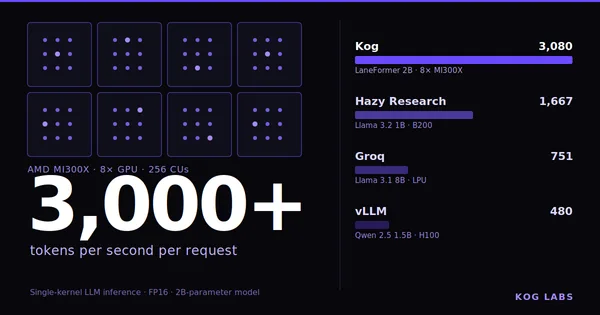
- LLM inference speed of 3,000 tokens/s on standard GPUs is now achievable through full software stack optimization.
- Current LLM inference speed is bottlenecked by software, not the underlying GPU hardware’s memory bandwidth ceiling.
- For AI agents running sequential workflows, per-request decode speed matters far more than aggregate server throughput.
- Next-gen GPUs like NVIDIA Rubin and AMD MI450 could push this performance 4x higher by late 2026.
Table of Contents
LLM Inference Speed Just Hit a New Bar — on Hardware You Already Own
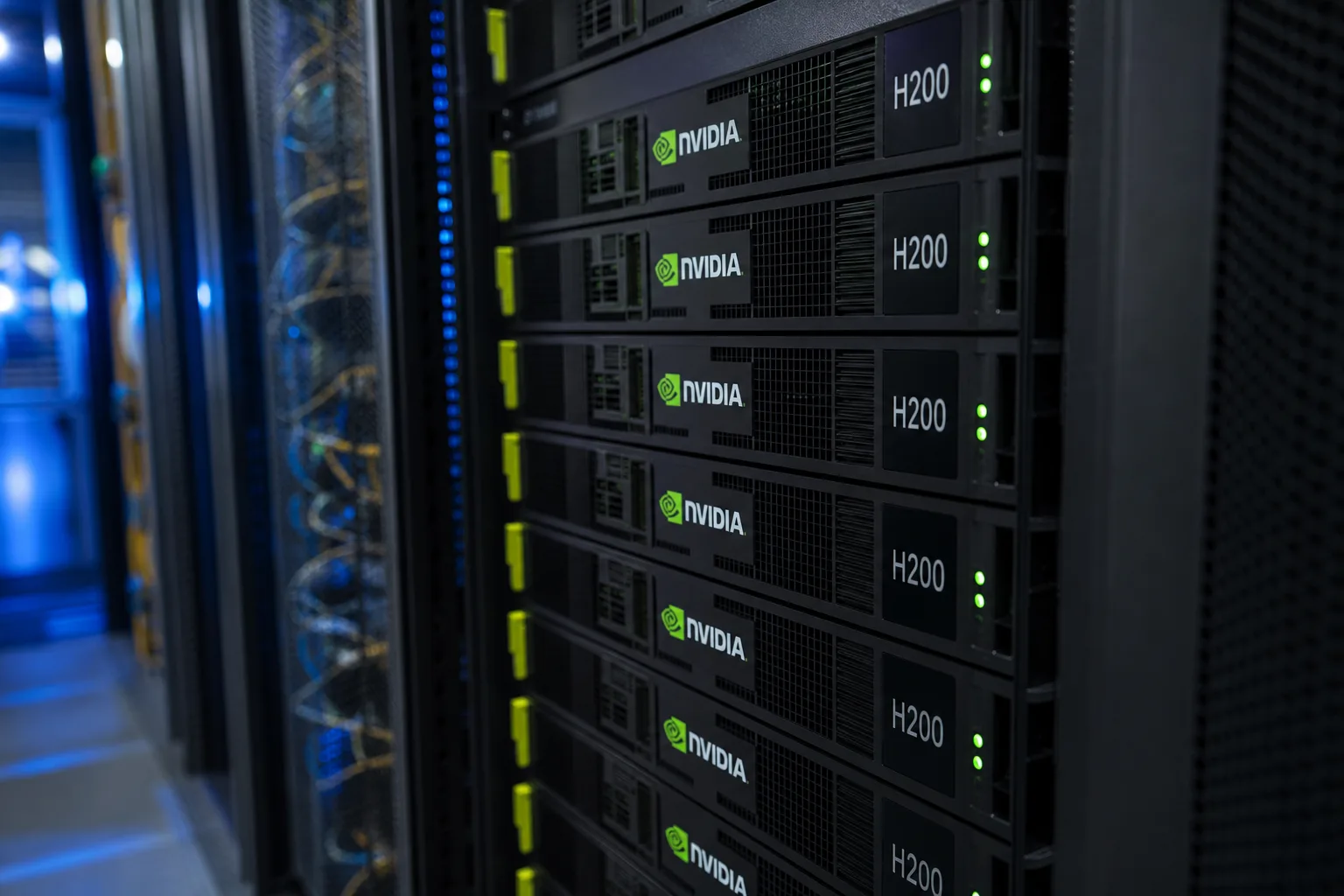
A startup called Kog AI is claiming something the AI infrastructure world has largely assumed impossible without exotic silicon: genuine LLM inference speed of 3,000 tokens per second per request, running on standard datacenter GPUs. No custom ASICs. No proprietary inference chips. Just the NVIDIA H200s and AMD MI300Xs that enterprise data centers have already deployed — running smarter software.
The claim is notable not because 3,000 tokens/s is theoretically shocking — it isn’t, if you do the math — but because nobody else running production inference stacks is getting anywhere close to it. And Kog’s argument is that this gap is almost entirely a software problem, not a hardware one. That framing has big implications for anyone currently eyeing Groq cards or custom inference accelerators as the only path to low-latency AI.
Why the Industry Got Obsessed with the Wrong Metric
The AI industry’s standard performance benchmarks tend to report aggregate throughput — how many total tokens a server can generate per second across all active users. That number is useful for infrastructure planning and cost-per-token calculations. It rewards batching, which in turn rewards the cloud hyperscalers who can amortize compute across thousands of simultaneous requests.
But that metric tells you almost nothing about how fast a single AI agent thinks. And as the industry shifts toward agentic workflows — where a model isn’t just answering one question but executing dozens of sequential reasoning and coding steps — per-request LLM inference speed becomes the number that actually governs the user experience.
Think about what an autonomous software engineering agent actually does: it reads a codebase, plans changes, writes code, runs tests, analyzes failures, and revises. Each step depends on the output of the previous one. You can’t batch that loop across other users’ requests. The agent has to wait for its own previous output before it can continue. LLM inference speed per individual request is the rate-limiting factor.
Kog’s own example makes the stakes concrete: generate 50,000 tokens at 100 tokens/s and you’re waiting roughly eight minutes. At 3,000 tokens/s, that same output lands in under twenty seconds. That’s not a marginal improvement — it’s the difference between an agent that feels like a background job and one that feels interactive. Products built on top of those two numbers look completely different.
The Real Bottleneck: Memory Bandwidth, Not FLOPS
Here’s where Kog’s technical argument gets interesting — and where most of the AI infrastructure conversation has been looking in the wrong direction. The conventional assumption is that faster LLM inference speed means more raw compute, more FLOPs, more tensor cores. That’s true when you’re running large batches. It’s largely irrelevant for single-request decoding.
At batch size 1, autoregressive token generation is dominated by memory-bandwidth-bound operations. For every token the model generates, all the active weights need to move from high-bandwidth memory (HBM) through the GPU’s memory hierarchy to its compute processors. The arithmetic intensity of this operation — FLOPs per byte of memory traffic — is extremely low, around 1 FLOP per byte in FP16, 2 in FP8, 4 in FP4.
Modern AI GPUs, by contrast, expose hundreds of FLOPs per byte of memory bandwidth. The NVIDIA H200’s theoretical peak balance is roughly 400 FLOPs per byte. What that means in practice: the GPU’s compute units are sitting largely idle during single-request decoding. The limiting factor is how fast weights can be streamed out of HBM. More FLOPS won’t help. More — or better-utilized — memory bandwidth will.
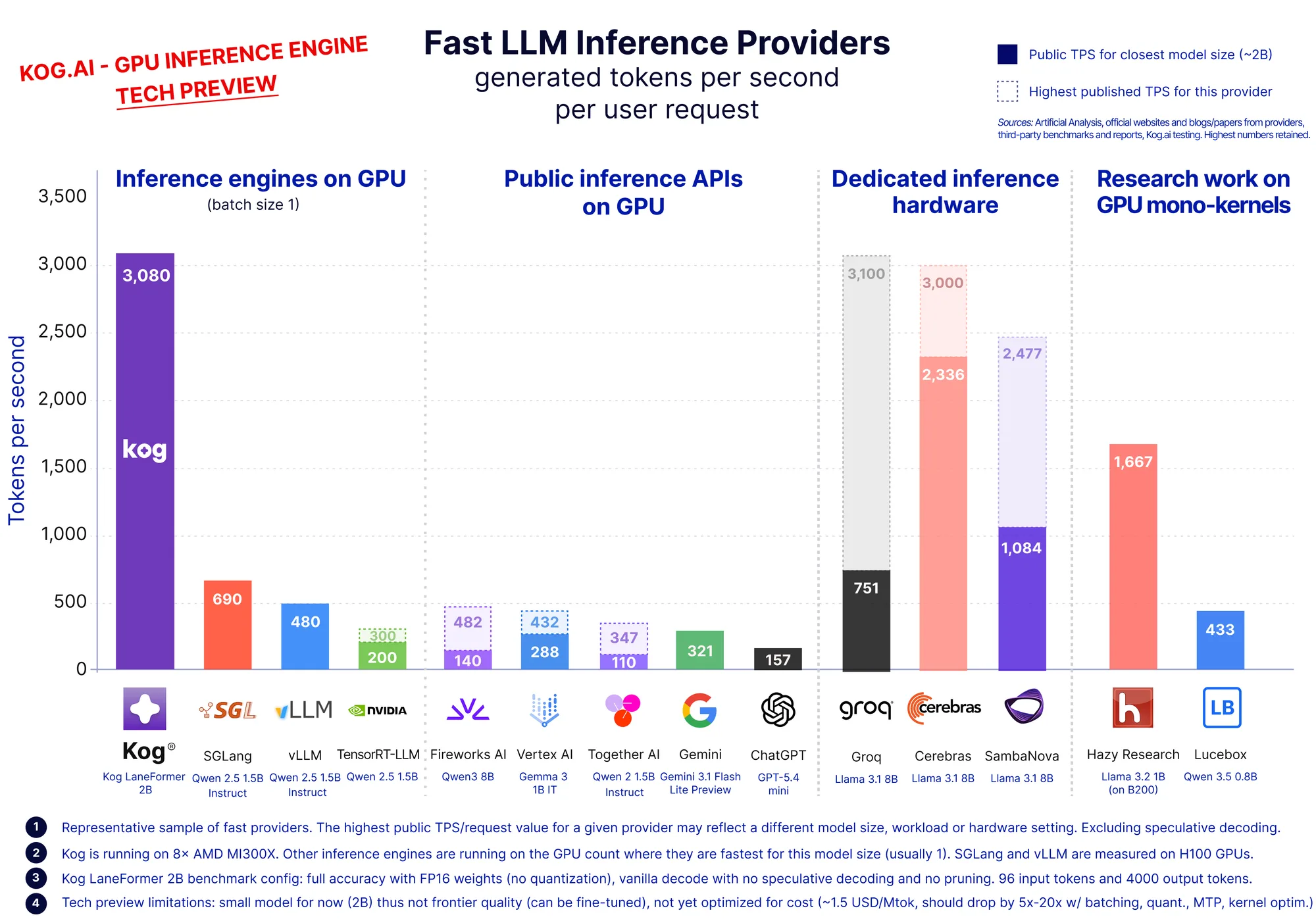
This is why Kog frames Memory Bandwidth Utilization (MBU) as the central metric for this workload, rather than the Model FLOP Utilization (MFU) figure most inference benchmarks report. MBU tells you how close you are to the hardware’s actual ceiling for this specific task. And the ceiling, it turns out, is very high on hardware that’s already widely deployed.
An eight-GPU NVIDIA H200 node delivers roughly 30.7 TB/s of effective aggregate memory bandwidth (assuming 80% of the 4.8 TB/s theoretical per-card figure as a realistic ceiling). An eight-way AMD MI300X node reaches approximately 33.6 TB/s in practice. For a 2B-parameter model in FP16, which has around 4 GB of active weights, those numbers imply theoretical speed-of-light upper bounds of around 7,700 tokens/s for the H200 node and 8,400 tokens/s for the MI300X node — before accounting for KV cache traffic and other overhead.
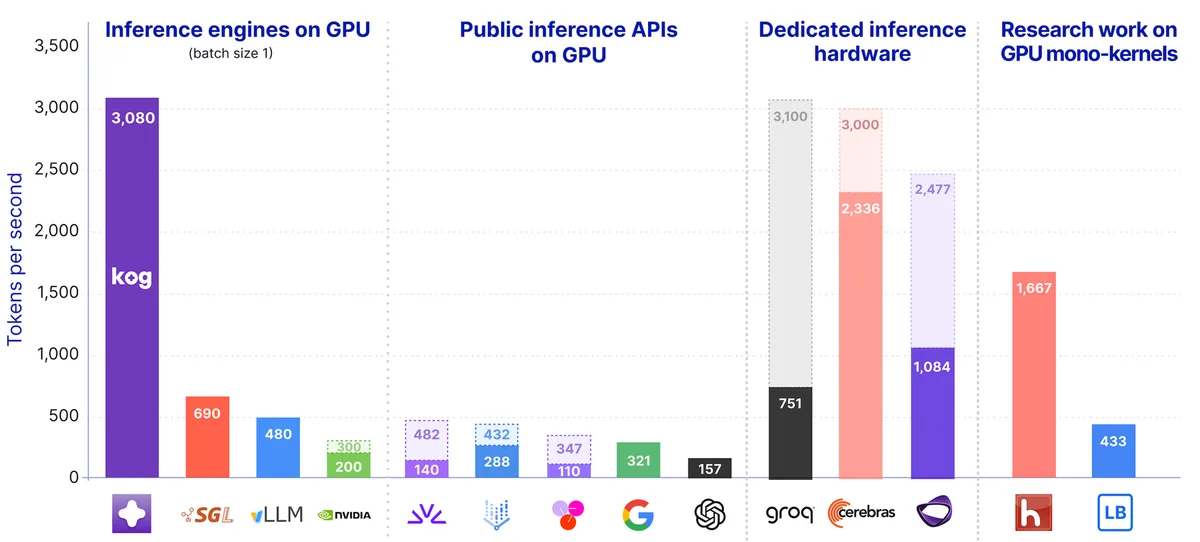
Kog’s 3,000 tokens/s figure, achieved on a real model with real workloads, represents a meaningful fraction of that ceiling. Current mainstream inference stacks are capturing far less of it. Understanding this gap is essential for anyone trying to benchmark or improve LLM inference speed in production environments.
What’s Actually Blocking Existing Inference Stacks
If the hardware headroom is that large, why is everyone leaving so much LLM inference speed on the table? Kog’s diagnosis points squarely at software architecture. Existing inference frameworks — vLLM, TensorRT-LLM, and similar tools — were designed primarily to maximize aggregate throughput across large batches. That’s a legitimate and important optimization target for serving many users simultaneously. But it comes at the cost of per-request latency.
Batching multiple requests together does improve arithmetic intensity and compute utilization, which is why those frameworks score well on throughput benchmarks. The tradeoff is that each individual request has to wait for others in its batch, and more KV cache data gets streamed through memory simultaneously, adding latency per user. Optimizing for one metric structurally works against the other.
Kog’s approach is to co-design the model architecture, the runtime engine, and the low-level GPU kernel code as a single latency-optimized pipeline — treating the entire stack as one problem rather than layering optimizations on top of a general-purpose framework. The company runs at batch size 1 for this preview specifically because that’s the configuration that matters for agentic workloads, and it’s where existing stacks perform worst relative to what the hardware can theoretically deliver.
MoE Models and the Broader Applicability
One of the more interesting details in Kog’s technical writeup is how this analysis extends beyond small dense models. The memory bandwidth math scales with active parameter count, not total parameter count — which means Mixture-of-Experts (MoE) architectures, which only activate a fraction of their weights per token, sit much more favorably on this curve than their headline sizes suggest.
Kog notes that at batch size 1, a MoE model with 4 billion active parameters in FP8 hits the same LLM inference speed bounds as a 2B dense model in FP16. A larger MoE with 32 billion active parameters in FP4 would still be bounded at around 2,000 tokens/s on that eight-way H200 node. These aren’t small models by any measure, and the implication is that genuinely capable frontier-scale MoE models could be served at near-interactive speeds on infrastructure that enterprises already have.
The current public preview uses a 2B coding model — Kog acknowledges it’s not a frontier model, and that the team has been deliberately prioritizing speed research over scale. It’s available to test at their live coding playground. But the broader argument doesn’t depend on the 2B model being impressive in isolation; it depends on the architecture being extensible to larger models as the software matures.
What Comes Next — and Why It Matters for the GPU vs. Custom Silicon Debate
There’s a political subtext running through all of this that’s worth naming. Dedicated inference accelerators — Groq’s LPU, Cerebras’ wafer-scale chips, and various custom ASICs from cloud providers — have marketed their low-latency advantages partly on the premise that general-purpose GPUs simply can’t compete on per-request LLM inference speed. If Kog’s results are reproducible at scale, that premise deserves serious scrutiny.
The GPU path, as Kog puts it, could deliver fast LLM inference speed without the lock-in of proprietary silicon. For enterprise AI buyers — especially those investing in sovereign AI infrastructure who can’t or won’t rely on hyperscaler APIs — that’s a meaningful consideration. The hardware is already purchased. The question is whether the software has been leaving most of its performance sitting unused. Kog’s argument is yes, emphatically.
Looking further out, Kog points to NVIDIA’s Rubin architecture and AMD’s MI450, both expected in the second half of 2026, as delivering roughly four times the memory bandwidth of current-generation cards. Running the math forward: that would push the practical LLM inference speed ceiling on a single node to equivalent performance for models four times larger, or achieve the same speeds with far fewer GPUs — potentially one or two cards rather than a full eight-way node. The economics of low-latency agentic AI start looking very different in that scenario. The race isn’t just about making models smarter. It’s increasingly about making them think fast enough to be genuinely useful inside a real workflow.