
Most beginner developers treat GitHub as a place to push their own code and little else. That’s a significant missed opportunity. The platform hosts some of the best free GitHub repos ever assembled — structured curriculums, visual learning roadmaps, algorithm libraries, and interview prep guides maintained by thousands of contributors, all completely free. If you haven’t been mining GitHub for learning resources, here’s where to start.
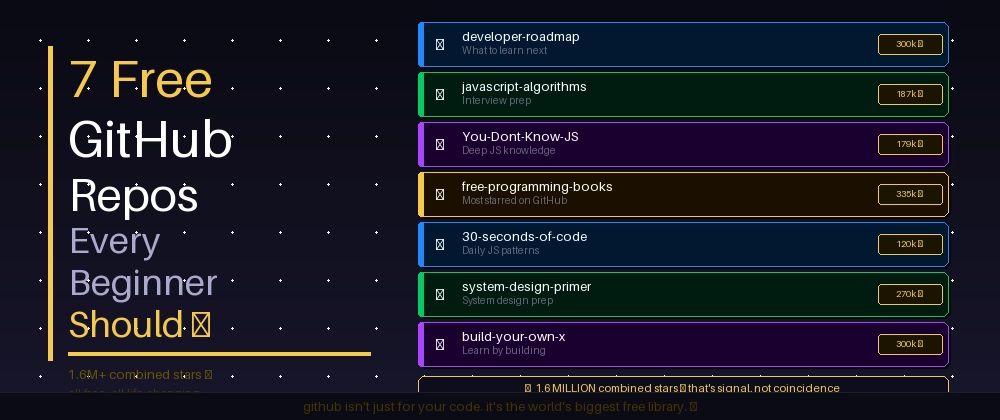
- These free GitHub repos collectively hold over 1.4 million stars and rival any paid developer course on the market.
- Free GitHub repos like roadmap.sh and YDKJS cover everything from learning paths to deep JavaScript fundamentals.
- Beginners who skip these resources are leaving structured, community-maintained curriculums completely untouched.
- Several repos directly target coding interview prep, covering algorithms, system design, and JS patterns in depth.
Table of Contents
Why Free GitHub Repos Beat Most Paid Courses
Paid coding bootcamps and online courses aren’t going anywhere — Coursera, Udemy, and Pluralsight still pull in millions of learners every year. But there’s a growing argument that the best developer education is already sitting in free GitHub repos, maintained in real time by working engineers who actually use these skills daily. Unlike a course filmed in 2021 that nobody’s updated since, a well-starred GitHub repo gets pull requests, corrections, and new content constantly. The community is the curriculum.
The seven repos below have accumulated well over a million collective stars. That’s not hype — it’s signal. When hundreds of thousands of developers independently decide something is worth bookmarking, it usually is. Knowing which free GitHub repos deserve your attention is half the battle.
The 7 Free GitHub Repos Worth Starring Today
1. roadmap.sh — Visual Learning Paths for Every Role
roadmap.sh sits at over 300,000 GitHub stars, making it one of the most starred free GitHub repos on the entire platform. The concept is straightforward but genuinely useful: interactive visual maps showing exactly which skills connect to which, in what order, for every major developer role. Frontend, backend, full-stack, React, Node.js, DevOps, AI/ML — there are more than 20 paths available, each one breaking down required versus optional skills so you’re not wasting time on things that don’t matter for the role you’re targeting.
What separates this from a generic blog post about “what to learn” is the interactivity. Click any node on the roadmap and you get resources, explanations, and context. It functions less like a static guide and more like a syllabus that adapts as the industry does. For anyone staring at a blank screen wondering what to learn next, this is the most efficient starting point available — free or paid.
2. JavaScript Algorithms and Data Structures — Interview-Ready Code in JS
With 187,000+ stars, this repo is exactly what it sounds like and exactly what most developers need before job interviews. Every major data structure — linked lists, trees, graphs, heaps, hash tables, tries — is implemented in clean JavaScript with time and space complexity analysis included. The algorithms section covers sorting methods, binary search, dynamic programming, recursion patterns, and string manipulation. Among free GitHub repos focused on interview prep, this one is consistently referenced by working engineers.
The value here isn’t just having the code. It’s having it explained. Each implementation comes with a visual breakdown and links to go deeper. Two weeks before any technical interview, working through the data structures section systematically is a better use of time than grinding LeetCode problems you don’t fully understand.
3. You Don’t Know JS (YDKJS) — The JavaScript Books Nobody Tells You About
Kyle Simpson wrote six complete books about JavaScript and published all of them free on GitHub. Permanently. That decision alone has probably done more for developer education than most corporate training programs combined. The series is called You Don’t Know JS and the title isn’t arrogant — it’s accurate. Most developers who’ve been writing JavaScript for years haven’t properly worked through closures, prototypal inheritance, or the subtleties of this binding. These books fix that, and they remain among the most cited free GitHub repos in the JavaScript community.
The second book, Scope & Closures, is arguably the most important. Closures trip up even experienced developers in interviews because they require understanding how JavaScript actually manages memory and function scope — not just how to write functions that work. The third book, this & Object Prototypes, covers the other half of what interviewers probe when they want to test genuine JS knowledge versus surface-level familiarity. Read those two before any frontend interview and you’ll be better prepared than candidates who’ve spent twice as long grinding tutorials.
4. Free Programming Books — 3,000+ Resources, Zero Cost
At 335,000+ stars, this is reportedly the most-starred repository on all of GitHub. The pitch is simple: thousands of free programming books, courses, and resources organized by language, topic, and skill level. For web developers specifically, there are 50+ free JavaScript books, 20+ React resources, 15+ Node.js books, and over 20 CSS references. The list spans 30+ programming languages and keeps growing. It’s one of the free GitHub repos that every developer should bookmark on day one.
The practical rule here is worth internalizing: before buying any course or book, check this repo first. The odds that a high-quality free alternative already exists are surprisingly high. That doesn’t mean paid resources are never worth it — but spending money before checking is just leaving value on the table.
5. 30 Seconds of Code — Short Snippets, Deep Understanding
This repo, sitting at 120,000+ stars, takes a different approach to learning. Rather than books or roadmaps, it’s a curated collection of short JavaScript snippets — debounce functions, deep clone implementations, array deduplication, date utilities — each one explained clearly and concisely. The snippets themselves aren’t the point. Understanding why they work is. As far as free GitHub repos go, this one rewards consistent daily use more than almost any other.
Patterns like debouncing and deep cloning come up constantly in both real projects and interview questions. Developers who’ve internalized these patterns — not memorized the syntax, but genuinely understood the mechanism — handle those questions with a fluency that’s immediately obvious to interviewers. Spending 15 minutes a day browsing this repo and breaking down anything unfamiliar is a low-effort habit with disproportionate returns.
6. System Design Primer — Not Just for Seniors Anymore
There’s a persistent myth that system design is only relevant once you’re a senior engineer. The reality is that mid-level and even some junior roles at larger companies now include system design questions in their interview loops. This repo, at 270,000+ stars, covers distributed systems, scalability, caching, database design, and the architectural patterns that underpin large-scale applications — all for free, all in one place. It stands out among free GitHub repos because it makes genuinely complex topics accessible without dumbing them down.
Even if system design interviews aren’t on your immediate horizon, understanding how large systems are built changes how you write code at the small scale. Developers who grasp why stateless services exist, or what a message queue actually solves, make better decisions in their day-to-day work. This repo makes those concepts accessible without requiring a computer science degree or a $400 course.
7. The Odin Project and Open Source Curriculums — Honorable Mentions
Beyond the six named above, GitHub hosts entire bootcamp-style curriculums built and maintained by the open-source community. The Odin Project is one of the most respected — a full-stack web development curriculum that’s completely free and has helped tens of thousands of developers land their first jobs. It’s not a single repo so much as an ecosystem, but it lives on GitHub and represents exactly the kind of free GitHub repos most beginners never discover.
Free GitHub Repos Are Reshaping How Developers Actually Learn
The broader trend here matters. The cost of learning to code has been collapsing for a decade, but the quality gap between free and paid resources has largely closed in the last few years. Repos like these aren’t inferior substitutes for paid courses — in several cases, they’re objectively better: more current, more community-vetted, more honest about what actually matters in professional practice.
That shift has real implications for how companies like Coursera and Udemy compete going forward. When the most-starred repository on GitHub is a free library of thousands of programming books, the value proposition of paying $15 a month for access to similar content gets harder to justify. The developers who figure this out early — who treat free GitHub repos as a library rather than just a code host — tend to build knowledge foundations that paid-course graduates simply can’t match. The resources have always been there. Most people just never looked.