

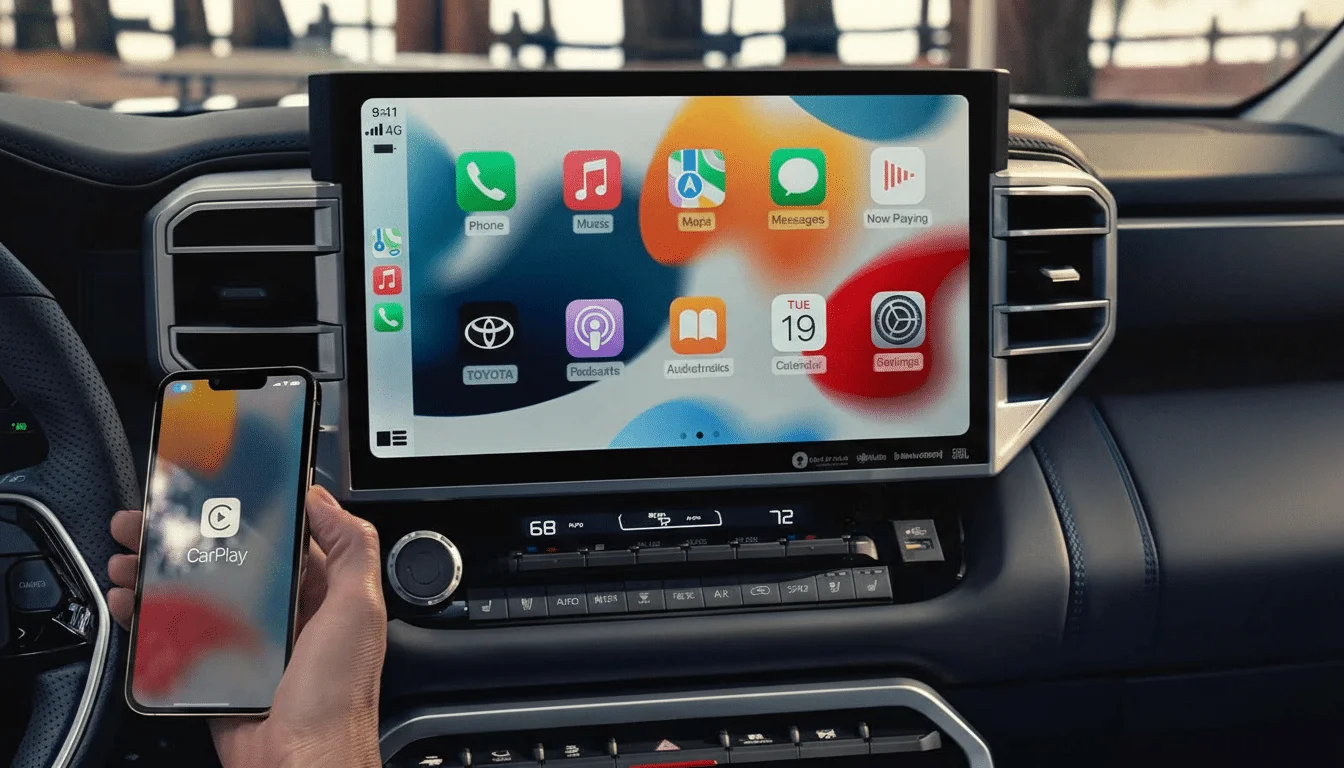
Apple CarPlay already mirrors selected iPhone apps onto a vehicle display and gives drivers a way to interact through Siri. Bloomberg reports that Apple is now exploring support for AI chatbot apps inside CarPlay, a move that would allow services such as ChatGPT, Gemini, and Claude to operate in a driving environment.
That sounds like a straightforward app-category expansion. It is not. CarPlay has long been defined by limits: a narrow set of approved functions, a familiar interface, and a clear expectation that the vehicle display should not become a less restrained version of the iPhone. Apple has traditionally limited CarPlay to tightly controlled app categories. Making room for conversational AI would test the logic of that approach because chatbots are designed to be open-ended. They do not simply play a track, read a message, or direct a driver to a destination. They invite follow-up questions.
The change would reflect a larger shift in how people use software. Conversational systems increasingly sit between a user and information, planning, writing, search, and communication. Apple appears to recognize that these tools now shape how users search, plan, and communicate. Bringing them into vehicles would be less about adding another dashboard icon than acknowledging that some drivers may expect their preferred AI service to be available wherever Siri is available.
The harder question is whether that expectation belongs in a moving car.
Apple CarPlay Ultra adds another dimension to the discussion. As CarPlay extends beyond a single infotainment display and toward the main dashboard and vehicle settings display, the consequences of any new interaction model become more serious. A chatbot that is merely another voice option for a travel question is one thing. A chatbot that sits near trip planning, vehicle information, climate controls, or dashboard functions is another.
Table of Contents
Why Apple CarPlay AI Chatbots Matter for Drivers
Apple CarPlay AI chatbots could change the kind of request a driver can reasonably make while on the road. Siri currently handles messaging, music playback, and navigation, but it often struggles with extended or contextual requests. That weakness matters because real driving questions are rarely as tidy as “play this” or “navigate there.” A driver may want help understanding a complicated message, thinking through a route change, or planning the next stop without issuing a string of rigid commands.
AI chatbots specialize in conversational understanding and multi step responses. In theory, that could produce clearer answers to travel questions, better summaries of messages, or faster help with planning stops. The appeal is not that a driver needs an essay delivered through the speakers. It is that a conversation can reduce the number of separate commands needed to reach a useful answer. When voice interaction works, it can keep attention away from a screen. When it works poorly, users tend to reach for the screen instead.
That distinction should shape Apple’s approach. A car is one of the least forgiving places to introduce a product that can be verbose, uncertain, or easily distracted by an ambiguous prompt. The usual chatbot experience often depends on a person reading alternatives, correcting an answer, and asking for more detail. Those are normal interactions at a desk or on a phone. They are not automatically appropriate in a vehicle.
Apple will need to define strict boundaries to prevent distraction while still allowing useful interaction. Those boundaries could matter as much as the chatbot support itself. The most sensible driving experience would favor short spoken responses, clear confirmation before a consequential action, and an easy way to return to a known CarPlay task such as navigation or media. A system should be willing to say less when a longer exchange would demand too much attention.
Permissions are just as important. If AI chatbot apps gain access to the CarPlay Ultra environment, they could influence how drivers interact with climate controls, vehicle data, or trip planning screens. The phrase “could influence” carries a lot of weight here. There is a meaningful difference between an assistant explaining information displayed by the car and an assistant acting on vehicle settings. Apple will need to decide which requests remain conversational, which need an explicit driver confirmation, and which should stay outside third-party chatbot access altogether.
Consistency will be another challenge. CarPlay’s value has partly come from predictability: controls appear in familiar places and basic actions follow familiar patterns. Chatbots have different personalities, response styles, and levels of restraint. ChatGPT, Gemini, and Claude may all answer a similar question differently. That variety is the point for users who have a preference, but it can become a liability if each service creates a different driving interaction. Apple’s rules would need to make the experience feel like CarPlay rather than a collection of unrelated voice products.
What This Signals About Siri and Apple Strategy
Apple CarPlay AI chatbots also highlight pressure on Siri’s role inside Apple’s ecosystem. Allowing third party conversational tools into CarPlay risks reducing Siri’s central position as the primary voice interface. Apple has historically protected Siri by limiting alternatives on its platforms. That protection made practical sense when voice assistance was mostly a way to trigger device functions. It looks less secure when users see AI assistants as distinct products with different strengths and preferences.
The reported exploration of chatbot support suggests Apple may now prioritize user choice over assistant exclusivity. That would align with broader platform trends: people increasingly expect to choose the service they use for search, communication, and AI assistance instead of accepting a single default. CarPlay is a particularly revealing place to make that concession because the car has traditionally demanded more control, not less. Apple is not simply opening a casual software surface. It is considering outside conversational tools in an environment where attention and trust are central.
There is also a strategic upside to keeping CarPlay relevant as AI habits change. If drivers want to use a preferred chatbot, blocking that preference could make CarPlay feel narrower than the iPhone it is meant to complement. Supporting those services, by contrast, lets Apple retain control over the vehicle interface while giving users more choice over the intelligence behind the interaction. That is a more complicated balance than total exclusivity, but it may be a more durable one.
In the near term, Apple will likely test limited chatbot functions under strict rules. That would be the prudent path. The first useful version does not need to hand chatbots broad authority over the car; it needs to prove that conversational assistance can improve a drive without turning every request into a distracting exchange. The best test will be mundane: whether drivers can get useful help quickly, understand what the system is doing, and stay focused on the road.
Over time, success could influence how Apple approaches AI across iOS and vehicle software. For drivers, the outcome could define whether the car becomes an extension of personal AI preference or remains a tightly curated Apple experience. Apple CarPlay AI chatbots represent an early signal of that decision, and the safety rules around them may matter more than the novelty of having another assistant in the driver’s seat.
Stay Updated: Tech News

