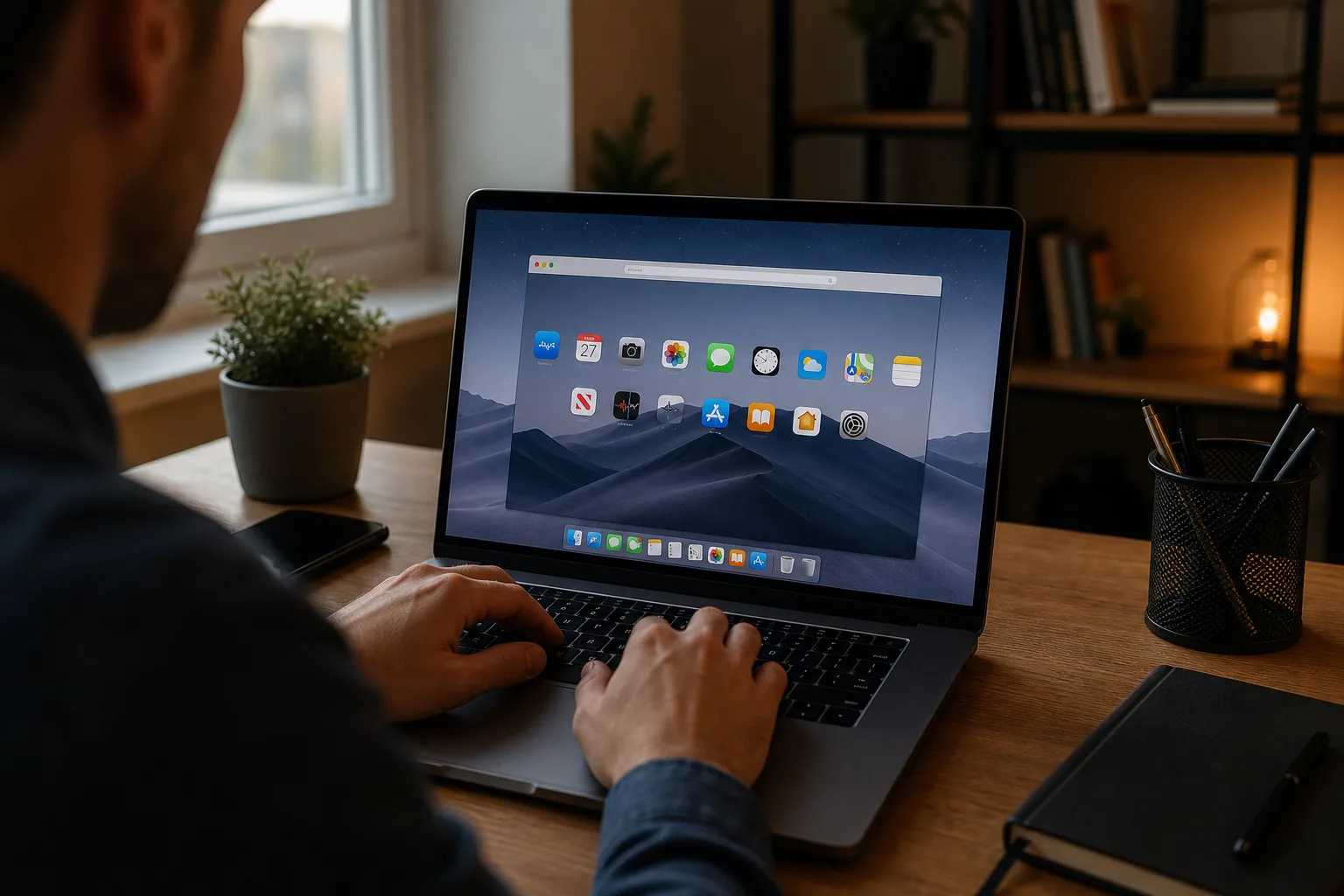
- Gnöke Station is a browser OS that runs entirely on the client, requiring no server, cloud, or install.
- The browser OS persists state across sessions using only HTML, CSS, and pure JavaScript — no frameworks needed.
- Nigerian developer edmundsparrow built the project as a philosophical counter to Google’s cloud-managed infrastructure.
- With over 20 apps already in its suite, Gnöke Station aims to become a lightweight, decentralised app ecosystem.
Table of Contents
A Browser OS Built in Defiance of the Cloud
While Google was busy at I/O 2026 announcing managed agents, one-click Cloud Run deployments, and ever-thicker layers of abstracted infrastructure, a developer in Nigeria was quietly doing the opposite. His browser OS, called Gnöke Station, runs entirely inside the browser — no server, no cloud account, no dependency graph. Just a URL. That contrast alone makes it worth paying attention to.
The timing isn’t coincidental. Google I/O 2026 made its message crystal clear: let the platform handle it. Antigravity 2.0 provisions agents in the cloud. Managed Agents abstract away the runtime. Google AI Studio deploys to Cloud Run in a single click. It’s a coherent, polished vision — and it increasingly defines what “modern development” looks like inside Big Tech’s orbit.

But Gnöke Station asks a different question entirely: what if the platform is the browser? What if sovereignty over your computing environment doesn’t require trusting any infrastructure you don’t control?
What Gnöke Station Actually Is
Describing Gnöke Station as a “web app” undersells it. It’s a persistent, offline-first browser OS designed to turn any modern browser into a desktop-like workspace manager. The developer behind it, who goes by edmundsparrow on Dev.to, has built more than 20 applications for what he calls the Gnöke Suite — and the entire stack is written in vanilla HTML, CSS, and pure JavaScript. No React. No Node. No build pipeline. No npm install.
The architecture centres on state persistence. Most mobile browsers are ruthless about reclaiming memory — switch away from a tab, refresh a page, or let a session idle too long, and your work is gone. Gnöke Station fights that by persisting application state, form data, and file handles across sessions. The goal, as edmundsparrow describes it, is continuity: “Users should not lose their workspace because a mobile browser decided to reclaim memory.”
That’s not a trivial problem to solve. Mobile browser memory management has frustrated developers and users alike for years, and the lack of a persistent runtime is one of the key reasons Progressive Web Apps have struggled to fully replace native apps on mobile. Gnöke Station’s approach — engineering around that constraint entirely using client-side state — is technically creative even if it comes with trade-offs.
The Gnöke Store and the Browser OS Ecosystem
What elevates this beyond a clever experiment is the ecosystem ambition. edmundsparrow is building a Gnöke Store — a decentralised launcher for Gnöke-compatible applications. The model is unconventional. Instead of searching, downloading, and installing software in the traditional sense, users can load a web URL directly into the Gnöke environment. If the app is Gnöke-compatible, it runs natively inside the workspace. If not, it opens as a standard browser tab.
During a demonstration, edmundsparrow loaded Google directly into Gnöke Station’s process manager — treating an external web service as just another application window inside his browser OS. Navigation continuity was an immediate challenge: once Google loaded, the “home” context disappeared. His fix is elegantly minimal. The “Gnöke Station” branding itself becomes a persistent start button. No matter what application is open, that anchor stays visible and clicking it snaps you back to the launcher.
It’s a small design decision, but it reveals the underlying philosophy. Where most OS-like browser projects reach for complexity — custom tab APIs, service worker tricks, heavyweight shell frameworks — Gnöke Station reaches for the simplest thing that works.
Vibe Engineering and the Anti-Bloat Manifesto
edmundsparrow uses the term “Vibe Engineering” to describe his development approach, and while the phrase might raise an eyebrow, the philosophy behind it is serious. It’s a direct critique of the dependency-heavy, framework-layered culture that dominates modern web development. The average production web app today ships hundreds of kilobytes — sometimes megabytes — of JavaScript before a user sees a single pixel of UI. Frameworks compound other frameworks. Build tools require configuration tools. Toolchains become their own infrastructure problem.
Gnöke Station rejects all of that. The entire browser OS is built for portability and low resource consumption, specifically to run well on older hardware. That’s not an abstract design goal — in large parts of Africa and Southeast Asia, where lower-end Android devices dominate and data costs remain high, software that runs fast on a three-year-old budget phone is genuinely valuable. The choice of vanilla JavaScript isn’t aesthetic minimalism for its own sake; it’s a practical bet on accessibility.
This puts edmundsparrow in interesting company. The W3C’s own offline web application guidelines have long argued for client-side capability as a first-class concern, not an afterthought. Projects like tiddlywiki — a single-file personal wiki that has persisted for over two decades — prove that browser-native, server-free software can have real staying power. Gnöke Station is reaching for something more ambitious, but it’s not working in a vacuum.
Security, Autonomy, and the Honest Trade-offs
Any browser OS that allows dynamic URL loading has an obvious security surface. edmundsparrow doesn’t pretend otherwise. His answer is philosophical before it’s technical: “Autonomy belongs to the user.” Rather than locking down the environment with rigid platform rules, Gnöke Station focuses on recovery — Reset, Backup, Workspace Recovery, and Hibernation features that let users restore sessions across systems and devices.
Hibernation is the most interesting of those. It allows an entire workspace session to be saved and resumed on a different device — effectively turning a browser OS session into a portable, server-free state capsule. Whether that holds up under real-world conditions with complex multi-tab workspaces remains to be tested, but the concept is sound.
The honest critique here is that “autonomy belongs to the user” can also mean “the blast radius belongs to the user.” A user who loads a malicious URL into the Gnöke process manager gets whatever that URL delivers, and Gnöke Station won’t stop them. That’s a real limitation. But it’s also arguably no worse than a standard browser tab — and it’s a known, declared trade-off rather than a hidden one.
Browser OS vs. the Cloud: Two Visions of Who Owns the Runtime
The framing that makes Gnöke Station genuinely interesting isn’t technical — it’s political, in the software sense. Google’s I/O 2026 vision is about consolidation: more capability, more integration, more managed services, all of it flowing through infrastructure that Google controls and prices. That’s not a conspiracy; it’s just how platform businesses work. And for most enterprise developers, it’s a reasonable deal.
But “who controls the runtime” is a question that doesn’t have one correct answer. ChromeOS requires a Chromebook, a Google account, and a live internet connection to be fully functional. Gnöke Station, as edmundsparrow puts it, requires a URL. That difference in dependency weight is enormous for anyone who can’t take reliable infrastructure for granted.

There’s a growing conversation in developer communities about the cost of abstraction — not just in performance terms but in terms of agency. When your entire development environment depends on cloud services, API keys, and managed runtimes, you’re not sovereign over your own tools. For developers in regions with unreliable connectivity, currency volatility that makes SaaS subscriptions expensive, or simply a distrust of Big Tech lock-in, a browser OS that works offline and costs nothing to run is more than a novelty. It’s a real alternative.
Gnöke Station is early-stage, built by a single developer, and carries all the rough edges you’d expect. But the ideas it’s wrestling with — offline-first architecture, client-side state persistence, zero-dependency portability — are ideas the industry keeps circling back to every time cloud costs spike or a platform shuts down a beloved service. edmundsparrow’s bet is that the browser itself, given enough thoughtful engineering, is a sufficient operating system. As cloud infrastructure grows more centralised and more expensive, that bet is going to look increasingly reasonable to a lot of people.