

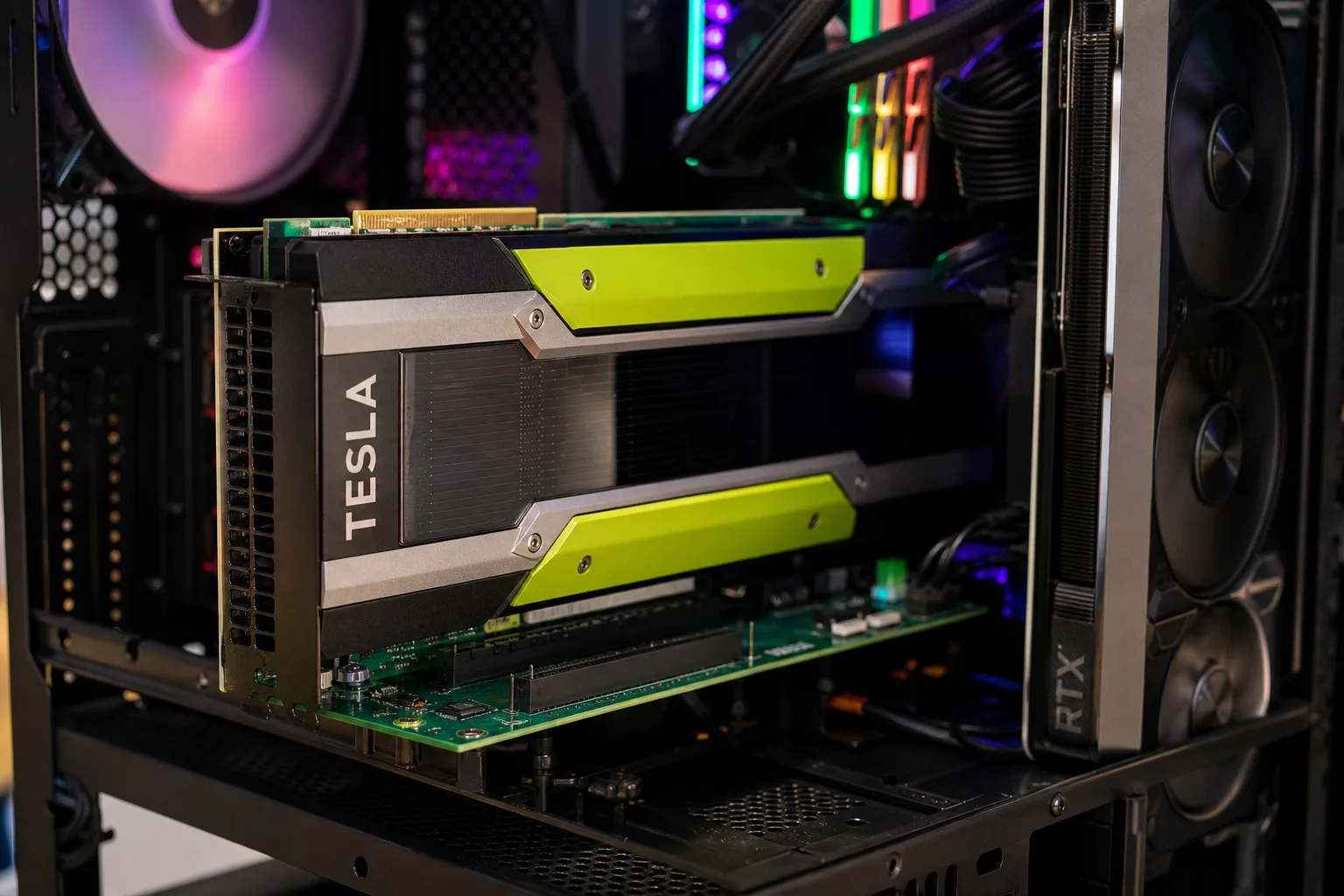
- A datacenter GPU upgrade using a £150 Tesla V100 doubled available VRAM to 32GB for under £200 total.
- This datacenter GPU upgrade delivers 900 GB/s memory bandwidth — outpacing Apple’s brand-new M5 Max laptop chip.
- The V100’s SXM2 form factor requires an unofficial PCIe adapter, plus custom fan wiring to avoid 82dB noise levels.
- llama.cpp tensor splitting lets the V100 and RTX 4080 share model layers, running a 27B parameter model at 32 tokens per second.
Table of Contents
The Datacenter GPU Upgrade Nobody Expected
When you hit the VRAM ceiling on a consumer GPU, the options are usually bleak. Spend £2,000+ on an RTX 5090. Buy a Mac Studio. Accept that local AI inference at any meaningful scale simply isn’t for you. One engineer found a fourth option: pull a seven-year-old datacenter GPU upgrade off eBay, bodge it into a gaming PC with an unofficial adapter, and run a 27 billion parameter model at a perfectly usable 32 tokens per second — total cost, around £200.
The build centres on a Tesla V100 SXM2, a card NVIDIA originally designed for its DGX-1 servers and hyperscaler racks back in 2017. It never had display outputs. It never had a standard power connector. It communicates over NVLink and lives on a proprietary board inside a server chassis. You absolutely cannot plug it into a consumer motherboard — at least, not without a bit of creative hardware sourcing.
Why Memory Bandwidth Is the Real Story
To understand why this particular datacenter GPU upgrade makes sense, you have to understand what actually limits local LLM inference speed. It’s not raw compute. When you’re running inference — generating tokens from a model that’s already loaded — the GPU is mostly reading weights from memory and passing them through relatively simple matrix operations. The bottleneck is almost always how fast the GPU can shuttle data between its memory and its compute cores. That’s memory bandwidth, and it’s where the V100 genuinely surprises.
The V100 uses HBM2 — High Bandwidth Memory — across a 4096-bit bus. That combination produces 900 GB/s of memory bandwidth. For context, the RTX 4080 with its modern GDDR6X manages 736 GB/s. A GPU launched in 2022 loses a bandwidth race to one from 2017 by a margin of around 22%. That’s not a rounding error. That’s a generational architectural difference that NVIDIA’s consumer line still hasn’t fully closed.
The Apple comparison is even more striking. Apple has spent years marketing the unified memory architecture of its M-series chips as a transformative advantage for AI workloads — and those chips are genuinely impressive. But the M3 Max does 400 GB/s. The M4 Max manages 546 GB/s. The M5 Max, shipping inside laptops that cost over £3,000, hits 614 GB/s. Every one of those figures sits well below a datacenter GPU upgrade that you can pick up secondhand for the price of a decent dinner out.
To be fair, AMD’s RX 7900 XTX does edge ahead at around 960 GB/s, and it comes with 24GB of GDDR6. But the 7900 XTX costs upwards of £700, and ROCm — AMD’s compute stack for AI workloads — remains noticeably rougher than NVIDIA’s CUDA ecosystem when it comes to tools like llama.cpp. The V100 delivers 94% of that bandwidth for less than a quarter of the price, and it just works. The only consumer card that clearly wins on bandwidth is the RTX 5090 at 1,792 GB/s, but that costs over £2,000 and is barely in stock anywhere.
Getting a Datacenter GPU Upgrade Into a Gaming PC
The SXM2 form factor is the obvious problem. Unlike standard PCIe cards, the V100 SXM2 has no edge connector, no display outputs, and no standard power plug. It was designed to slot into a proprietary board inside a server. Getting it into a consumer PC required an unofficial SXM2-to-PCIe adapter — a bare PCB with an SXM2 socket on one side and a standard PCIe connector on the other. Not made by NVIDIA. Not supported by anyone officially. Available for around £50 if you know where to look, which apparently includes a fair amount of copper in the cost.
With the adapter, the V100 slots in alongside an RTX 4080, giving a combined VRAM pool of 32GB — the same total as a single RTX 5090 at a fraction of the price. The two cards aren’t equivalent. You’re crossing PCIe rather than NVLink, so inter-GPU communication is slower. But for inference workloads running through llama.cpp’s tensor splitting, that trade-off is entirely workable. The 4080 handles some layers of the model; the V100 handles the rest. The whole thing runs a 27B parameter model at 32 tokens per second, which is fast enough to feel genuinely responsive in practice.
The Fan Problem Nobody Warns You About
There’s a complication the eBay listing won’t mention: the cooling. The V100 SXM2 was designed to sit inside a 2U server with industrial airflow dragging heat away from it. The fan on the SXM2-to-PCIe adapter is not designed for a bedroom. It’s designed to run at 100% speed, permanently, inside a rack where the nearest human is several floors away. Measured with an Apple Watch, it hits 82 decibels. That’s in lawnmower territory. Not “loud gaming PC” loud — actually disruptive.
Worse, none of the normal controls work. nvidia-smi can’t touch it. Neither can MSI Afterburner. The fan simply isn’t designed to respond to software commands. It’s a fixed-speed industrial blower that happens to be sitting on your desk.
The fix required going analog. A 9V battery test on the fan connector confirmed standard case fan pinout behaviour — just using a non-standard JST PH2.0 connector instead of the typical 2.54mm pitch motherboard header. Wiring the tachometer and PWM pins to a spare motherboard fan header via a JST PH2.0-to-2.54mm jumper cable brought the fan under PWM control. Running it at 10% keeps temperatures under 50°C at full inference load. The 82dB nightmare becomes something you can genuinely ignore.
It’s fiddly. It requires identifying connector pinouts, sourcing specific jumper cables, and being comfortable prodding electrical components with a battery to test hypotheses. This isn’t a plug-and-play datacenter GPU upgrade. But it’s also not particularly dangerous, and the result is a stable, quiet setup.
What This Actually Costs Versus the Alternatives
Let’s put the numbers together plainly. A Tesla V100 SXM2 16GB on eBay: around £150. The SXM2-to-PCIe adapter: around £50. Total datacenter GPU upgrade cost: roughly £200. What does £200 get you in the consumer GPU market right now? Not a lot. You’re in budget GPU territory — RX 7600 or RTX 4060 range — cards with 8GB or 12GB of VRAM that would actually make the VRAM shortage worse, not better.
The comparison that really lands is against a single 32GB GPU. The RTX 5090 with its 32GB of GDDR7 is the consumer card that matches the combined VRAM here. It costs over £2,000. This setup — RTX 4080 plus V100 plus adapter — achieves the same VRAM headroom for roughly 10% of that price. The performance isn’t comparable for gaming or rendering workloads, but for local LLM inference, where VRAM capacity and bandwidth are what drive the experience, it’s a genuinely compelling asymmetry.
Power draw is worth mentioning. The V100 peaks at around 150W under inference load. That’s not negligible, but it’s well within what most mid-range consumer cards draw, and far below the V100’s rated 300W TDP in full datacenter use. The SXM2 form factor running through a PCIe adapter with a PWM-throttled fan appears to operate well within reasonable thermal limits in practice.
Datacenter GPU Upgrade: The Bigger Picture
This project matters beyond the novelty. The local AI inference movement is growing fast — tools like llama.cpp, Ollama, and LM Studio have made running capable models on consumer hardware increasingly accessible. The limiting factor for most people isn’t CPU speed, RAM, or even GPU compute. It’s VRAM. Models that require more than 16GB are effectively locked behind a steep paywall in the consumer market.
The secondhand datacenter GPU upgrade route — V100s, A100s, and similar cards flooding the market as hyperscalers cycle through hardware generations — represents a genuine alternative that the AI hobbyist community is only starting to fully map. The V100 SXM2 isn’t the only option. The 32GB variant of the same card exists and appears on eBay with some regularity. Earlier HBM-based cards like the Tesla P100 offer similar ideas at even lower price points, though with reduced bandwidth.
Anyone seriously considering a datacenter GPU upgrade of this kind should factor in the hidden preparation costs: the adapter, the jumper cables, and the time spent diagnosing connector pinouts. None of those are expensive individually, but together they shape whether this route suits your situation. The real question is how long this window stays open. As more people discover that enterprise-grade memory bandwidth is available for pocket change, prices on these cards will likely rise. The V100 SXM2 at £150 is already a better deal than it has any right to be. Whether it stays that way as local LLM inference keeps pulling in new enthusiasts is a different matter entirely.

