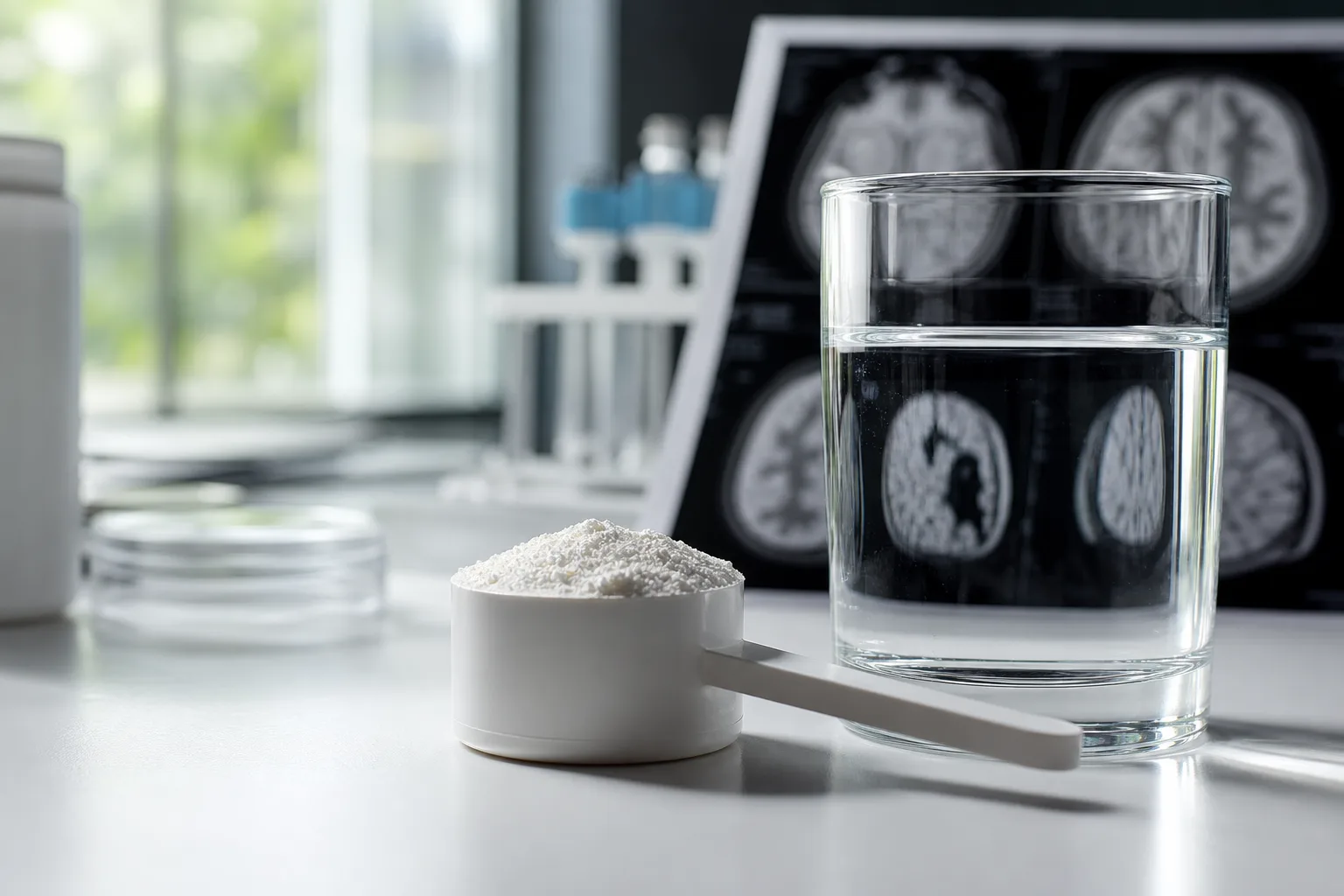
- New clinical trials show creatine brain health benefits include slowing early Alzheimer’s cognitive decline by roughly 30%.
- Creatine brain health research confirms oral supplements cross the blood-brain barrier and measurably raise phosphocreatine levels in neurons.
- The brain consumes 20% of the body’s energy despite being just 2% of its mass — making ATP supply a critical vulnerability.
- A 240-person placebo-controlled trial at 5g per day showed short-term memory gains and slower decline on standard cognitive scales.
Table of Contents
The Supplement Nobody Told You Was Also Working on Your Brain
Creatine brain health isn’t a phrase you’ll find on any tub at your local supplement retailer. The marketing is all about power output, faster recovery, and bigger lifts. But a pair of landmark studies published in 2025 and early 2026 have assembled the most compelling body of evidence yet that the white powder millions of people scoop into their morning shakes is simultaneously doing something significant inside their skulls — something the fitness industry has never advertised and most users have never thought to ask about.
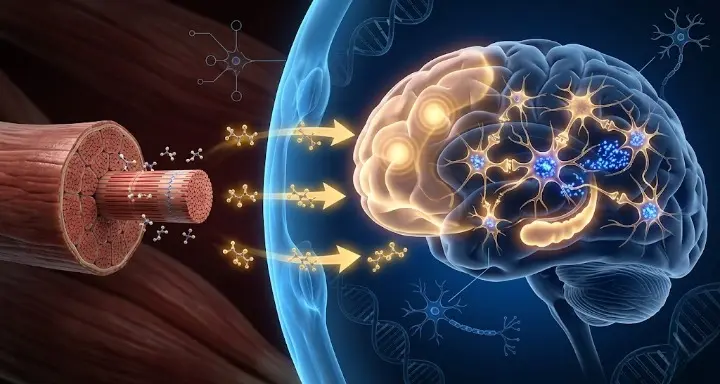
A major review published in the Journal of Psychiatry and Brain Science in 2025, combined with a pilot trial in Alzheimer’s and Dementia: Translational Research and Clinical Interventions, found that creatine supplementation crosses the blood-brain barrier, raises phosphocreatine concentrations in neural tissue, and — most strikingly — slowed cognitive decline in early Alzheimer’s patients by around 30% in controlled conditions. That’s not a marginal effect. That’s a number that, if it holds up at scale, would put creatine in serious conversations about preventive neurology.
Why the Brain Has an Energy Problem in the First Place
To understand why creatine brain health research has gathered so much momentum, you have to start with a basic and somewhat alarming fact about human neurobiology: the brain is extraordinarily expensive to run. It accounts for roughly 2% of body mass but consumes approximately 20% of total energy output. Neurons don’t maintain meaningful energy reserves. They depend on a continuous, uninterrupted supply of ATP — adenosine triphosphate — the molecular currency that powers everything from ion gradients across cell membranes to neurotransmitter release at synapses.
Creatine’s role in that system is well understood at the muscular level. After uptake into cells, creatine is converted into phosphocreatine, which the enzyme creatine kinase can rapidly break down to regenerate ATP during periods of peak demand. In a muscle, that means the explosive energy needed for a heavy squat or a sprint. In a neuron, it serves a different but equally critical function: a rapid-response energy buffer when the cell is firing at high intensity and oxidative phosphorylation simply can’t keep pace.
Think about what that means practically. When the prefrontal cortex is working through a complex decision, or the hippocampus is encoding a new memory, ATP consumption spikes sharply and briefly. The phosphocreatine system fills that gap in milliseconds. Without adequate creatine reserves, neurons hit an energy ceiling. Processing slows. Working memory capacity contracts. The brain keeps functioning, but it’s not operating at full capacity in exactly the moments that demand the most from it.
What Aging and Alzheimer’s Do to Creatine Brain Health
This is where the research gets more urgent. Creatine brain health isn’t just a performance question for healthy adults — it appears to be a clinically meaningful factor in neurodegeneration. Phosphocreatine levels in the brains of Alzheimer’s patients are measurably lower than in age-matched healthy controls. Creatine kinase activity — the enzyme responsible for converting phosphocreatine into usable ATP — is reduced in Alzheimer’s brain tissue. And mitochondrial dysfunction, a well-documented feature of Alzheimer’s pathology, compounds the problem by impairing the primary ATP production pathway.
Researchers describe the result as a bioenergetic crisis: the neurons most responsible for memory and higher-order cognition become chronically energy-deprived, increasingly unable to maintain the ATP levels required for normal synaptic function. It’s a slow-motion power failure in the parts of the brain you least want going dark.
What makes creatine an interesting therapeutic candidate is precisely that it bypasses the broken pathway. The phosphocreatine system regenerates ATP through a route that doesn’t depend on fully functional mitochondria. It’s not fixing the underlying problem, but it may be keeping the lights on while the rest of the system struggles.
The CABA Trial: Creatine Brain Health Put to the Test
The University of Kansas Medical Center’s CABA trial — Creatine to Augment Bioenergetics in Alzheimer’s — published its initial results in early 2026. Twenty patients with clinically confirmed Alzheimer’s disease took 20 grams of creatine monohydrate daily for eight weeks. Brain phosphocreatine levels, measured non-invasively using magnetic resonance spectroscopy, increased measurably after supplementation — confirming that oral creatine was successfully reaching neural tissue and raising intracellular concentrations. Patients also showed improvements on cognitive assessments covering sorting, reading, and attention tasks.
The follow-up multicenter, placebo-controlled trial enrolled 240 participants with early-stage Alzheimer’s. At a lower maintenance dose of 5 grams per day over 12 weeks, participants still showed a 10–15% increase in brain phosphocreatine on MRS scans. Short-term memory test scores improved modestly. And on standardised cognitive decline scales, the creatine group declined approximately 30% more slowly than the placebo group.
That 30% figure deserves some context. Current FDA-approved Alzheimer’s treatments — including the recently approved lecanemab (Leqembi) from Eisai and Biogen — are targeting amyloid plaques and showing roughly 27–35% slowing of decline in their own trials, at enormous cost and with significant side effect profiles. Creatine monohydrate, by contrast, costs a few dollars per month. It doesn’t require infusion clinics. It’s available over the counter. The comparison isn’t meant to suggest creatine is a replacement for disease-modifying therapies — the mechanisms are completely different — but it does raise an obvious question about whether combination approaches might be worth investigating seriously.
Beyond Alzheimer’s: What the Broader Research Shows
The creatine brain health picture extends well beyond Alzheimer’s. The 2025 review in the Journal of Psychiatry and Brain Science also examined evidence in healthy adults, finding measurable cognitive performance benefits — particularly in tasks requiring working memory and processing speed — following creatine supplementation. There’s a growing body of literature on creatine’s effects during sleep deprivation, where maintaining brain energy levels appears to buffer some of the cognitive cost of poor sleep. There’s also emerging data on depression, where energy metabolism dysfunction is increasingly recognised as part of the pathophysiology.
None of this is entirely surprising once you accept the basic premise that the brain runs on energy and creatine is an energy system component. What’s surprising is how long it’s taken for the research to get serious traction outside sports science circles. Creatine has been one of the most studied supplements in human history — decades of safety data, broad tolerability, minimal side effects at standard doses. The infrastructure for studying it is mature. The gap has been scientific attention, not scientific capability.
What This Means — and What We Still Don’t Know
The honest answer is that the CABA trial and the studies around it represent strong early signals, not settled science. The placebo-controlled trial enrolled 240 people over 12 weeks. That’s meaningful, but Alzheimer’s research typically demands multi-year follow-up with thousands of participants before any intervention gets taken seriously as a clinical tool. The 30% slowing figure needs replication. Longer trials need to confirm whether the effect sustains or attenuates. And the question of optimal dosing — 5 grams, 20 grams, something in between — hasn’t been resolved.
There are also population questions worth asking. The creatine brain health benefit seen in early-stage Alzheimer’s patients may not translate the same way to healthy adults seeking prevention, or to late-stage disease where neuronal loss has already advanced significantly. Age, diet (vegetarians have lower baseline creatine levels and tend to show stronger supplementation responses), sex, and genetics may all modulate the effect.
What’s harder to argue with is the direction of the evidence. Several independent research groups are now pointing at the same biological mechanism. The measurable increase in brain phosphocreatine on MRS scans — an objective biomarker, not a subjective patient report — gives the cognitive findings a plausible and specific mechanistic grounding. And the safety profile of creatine monohydrate, built over decades of athletic use, removes one of the biggest barriers to moving this research forward quickly.
The fitness industry sold creatine as a muscle supplement. The neuroscience community may end up making a much bigger case for it. Whether that translates into formal clinical guidance — and how quickly — will depend on whether research funders decide a cheap, off-patent supplement is worth the investment to study properly. That’s a question with uncomfortable answers, but it’s the one that will determine whether creatine brain health moves from intriguing finding to standard clinical conversation.