

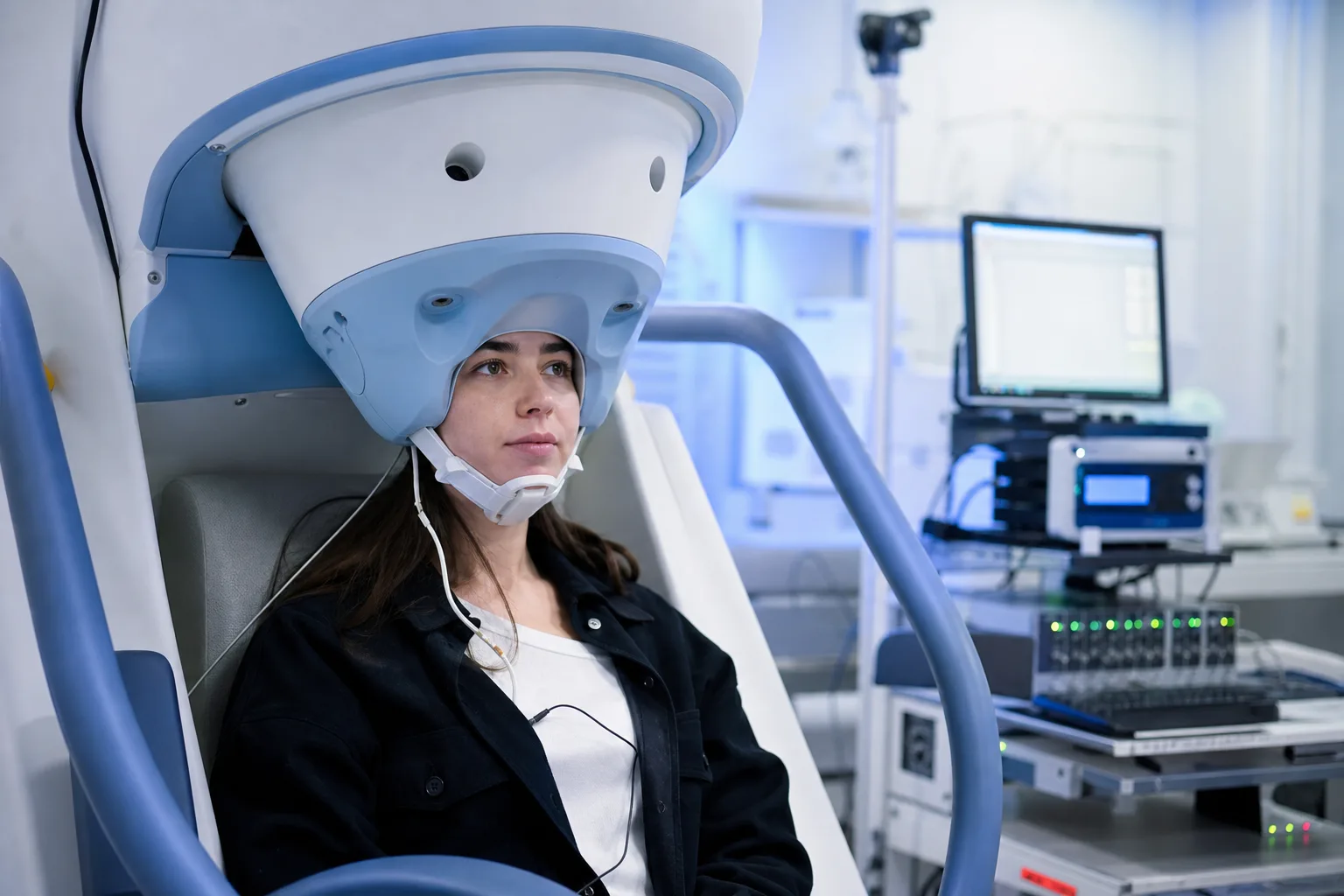
For years, the most capable brain-computer interfaces came with a hard requirement: open-skull surgery. This week, Meta is pushing back on that trade-off. The company has unveiled Brain2Qwerty v2, a system that translates brain activity to text using nothing more invasive than a helmet. And the accuracy numbers it’s reporting are enough to make the neuroscience community sit up straight.
- Meta’s Brain2Qwerty v2 converts brain activity to text non-invasively, reaching 61% average word accuracy in testing.
- The brain activity to text system uses a MEG helmet and end-to-end deep learning trained on 22,000 sentences from nine participants.
- Previous non-invasive methods averaged around 8% word accuracy, making Meta’s result a significant leap forward.
- Meta is open-sourcing training code, and its research partner is releasing datasets, as part of its Digital Brain Project.
Table of Contents
What Brain2Qwerty v2 Actually Does
The system centers on a magnetoencephalography (MEG) scanner — a large, helmet-shaped device that’s already widely used in neuroscience research to measure the magnetic fields produced by electrical activity in the brain. It’s bulky, it requires careful setup, and it definitely won’t fit in your bag. But it doesn’t require a surgeon. That distinction matters enormously when the goal is translating brain activity to text at scale.
Participants wore the MEG device while actively typing sentences — not imagining typing, but physically doing it — allowing the system to capture neural signals tied to real motor and linguistic processes. Meta then fed those raw signals directly into an end-to-end deep learning model, skipping the hand-crafted signal processing pipelines that have traditionally bottlenecked non-invasive approaches. On top of that base model, the team fine-tuned large language models on the neural data, effectively giving the system a way to use sentence-level context when it encounters ambiguous or noisy signals.
‘We trained Brain2Qwerty v2 on approximately 22,000 sentences from nine volunteer participants, each recorded for 10 hours wearing a magnetoencephalography (MEG) device while actively typing,’ Meta wrote in its announcement. ‘Instead of relying on hand-crafted pipelines to detect neural events, we use end-to-end deep learning to decode directly from raw brain signals.’ The result is a brain activity to text pipeline that bypasses many of the limitations that have held back earlier non-invasive work.
The result: 61% average word accuracy. To understand why that number is significant, consider that prior non-invasive methods had been stuck at around 8%. That’s not an incremental gain — it’s a near-complete reimagining of what’s achievable without breaking the skull.
Brain Activity to Text Without the Surgical Risk
The reason surgically implanted electrodes have dominated high-performance brain-computer interface research isn’t mysterious. Getting hardware directly onto or into brain tissue produces cleaner, stronger signals. Neuralink, which has now implanted its device in several human patients, and Synchron, which threads its Stentrode through blood vessels to the motor cortex, both benefit from that proximity. The signal quality is simply better.
But surgery carries real costs. There’s the obvious risk of the procedure itself. Then there are the long-term challenges: keeping implants sterile, managing tissue response, dealing with hardware degradation over years. As Meta’s researchers pointed out in their paper published in Nature Neuroscience, these constraints make implanted systems hard to scale — not just commercially, but in terms of who can realistically access them. A clinical trial centered on brain activity to text decoding with a MEG helmet is a fundamentally different proposition than one requiring neurosurgery.
Meta’s position is that Brain2Qwerty v2 now approaches accuracy levels that previously required implants. That claim deserves some scrutiny — 61% word accuracy, while impressive for a non-invasive brain activity to text system, still falls short of what the best implant-based decoders achieve. Neuralink’s first human patient reportedly reached typing speeds that would be transformative for someone with ALS. But the gap has narrowed considerably, and Meta argues that more training data will push accuracy further still. The company noted explicitly that decoding performance kept improving as the dataset grew, which is a good sign for a research program with a significant fund behind it.
The Open Science Angle
One of the more interesting dimensions of this announcement is what Meta is doing with the research artifacts. The company is releasing training code for both Brain2Qwerty v1 and v2, while its research partner is making the v1 dataset publicly available — all under the umbrella of the Digital Brain Project. That’s a meaningful gesture in a field where data scarcity has been a persistent obstacle. MEG recordings from ten-hour sessions across multiple participants aren’t easy to collect, and making that data accessible to other researchers could accelerate brain activity to text work that would otherwise take years.
‘Our hope is that this work, done in the open, advances neuroscience to identify, diagnose, and treat neurological disorders faster than in siloes,’ Meta wrote. That framing — openness as a competitive advantage for science — fits neatly with how Meta has positioned its AI research division more broadly. Whether this openness also serves Meta’s longer-term interests in wearable technology and ambient computing is a question worth keeping in mind, even if the immediate research goals are clearly medical.
A Field in Motion
Brain2Qwerty doesn’t exist in isolation. The broader landscape of neural interface research has accelerated sharply over the past two years, driven by a mix of AI improvements, miniaturized sensors, and serious venture capital. Neuralink grabbed headlines with its first human implants. Merge Labs, backed by OpenAI CEO Sam Altman, is also developing communication restoration technology for people with neurological disorders. The race isn’t just about performance — it’s increasingly about which approach can reach the most patients safely and affordably.
On the non-invasive side, there’s been genuine movement. In September 2024, startup Neurable introduced EEG-based headphones using AI to track focus and cognitive fatigue — consumer-oriented, but built on the same principle of reading neural signals through the scalp. A year later, MIT spinout AlterEgo went further, unveiling a wearable that converts silent neuromuscular signals from the face and throat into text and commands. That system doesn’t even need to read brain signals directly; it intercepts the downstream signals before speech is articulated. Each of these approaches to brain activity to text conversion makes a different set of trade-offs between signal quality, form factor, and user burden.

What Meta is doing with Brain2Qwerty sits closer to the clinical end of that spectrum. The MEG scanner used here is not a consumer device — these machines typically cost millions of dollars and require specialized facilities. For now, this is research infrastructure, not a product. The practical path to helping people communicate after brain injury runs through clinical partnerships, regulatory approval, and eventually either miniaturization of MEG hardware or a successful handoff to more portable sensor modalities.
What Comes Next
The 61% word accuracy figure is best understood as a floor, not a ceiling. Meta’s own data suggests performance scales with training volume, and the open-source release means other labs can now contribute to that effort. The Nature Neuroscience paper provides a rigorous scientific foundation, which matters for the kind of regulatory and clinical conversations that will eventually determine whether any of this reaches patients.
For the broader brain activity to text field, the more consequential question is whether non-invasive accuracy can reach a level that’s genuinely useful in daily communication — not just impressive on a benchmark. Something in the high eighties or nineties percent, under real-world conditions, with a wearable that doesn’t require a hospital visit. That target is still some distance away. But the gap between 8% and 61% happened in a relatively short time, powered largely by better AI rather than better sensors. If that trajectory holds, the next few years could change what’s achievable for the millions of people worldwide who’ve lost the ability to speak.
Frequently Asked Questions
How does Meta’s brain activity to text system actually work?
Brain2Qwerty v2 uses a helmet-like MEG scanner to record neural signals while a person types. Those raw signals feed into an end-to-end deep learning model, which is further refined using large language models trained on neural data, allowing it to use semantic context to interpret noisy brain recordings.
Does Brain2Qwerty require any surgical implants?
No. Brain2Qwerty is entirely non-invasive — it records brain activity through a wearable MEG scanner with no surgery required. This distinguishes it from implant-based systems like Neuralink, and Meta says its non-invasive approach could help bridge the gap between invasive neuroprosthetics and communication systems that do not require surgery.
Who is Brain2Qwerty designed to help?
Meta says the research is primarily intended to help people who have lost the ability to communicate due to brain lesions or other neurological conditions. The open-source approach is designed to accelerate research into diagnosing and treating such disorders more broadly.
Is Meta’s Brain2Qwerty code publicly available?
Yes. Meta released training code for both Brain2Qwerty v1 and v2 as part of its Digital Brain Project. Its research partner is also releasing the v1 dataset. The project is accompanied by a $5 million fund to support open neuroscience datasets.

