

The battle over sports prediction markets has moved squarely into the halls of Congress. Major US gaming industry groups are now pressing lawmakers to include an outright ban on sports and casino-style prediction markets in the crypto market structure bill — and the stakes for both the gambling and crypto industries couldn’t be higher.
- Major US gaming industry groups are lobbying Congress to ban sports prediction markets from an upcoming crypto regulation bill.
- Sports prediction markets operated by crypto platforms like Kalshi have drawn fire for mimicking licensed sports betting without oversight.
- The push reflects a broader turf war between regulated gambling operators and crypto-native prediction platforms seeking federal cover.
- A ban on sports prediction markets in the crypto bill could reshape both industries and set a precedent for future regulation.
Table of Contents
Why Sports Prediction Markets Are Suddenly a Political Target
To understand why gaming lobbyists are alarmed, you need to understand what sports prediction markets actually are — and why they look, to a licensed sportsbook operator, uncomfortably like a competitor that never had to follow the rules.
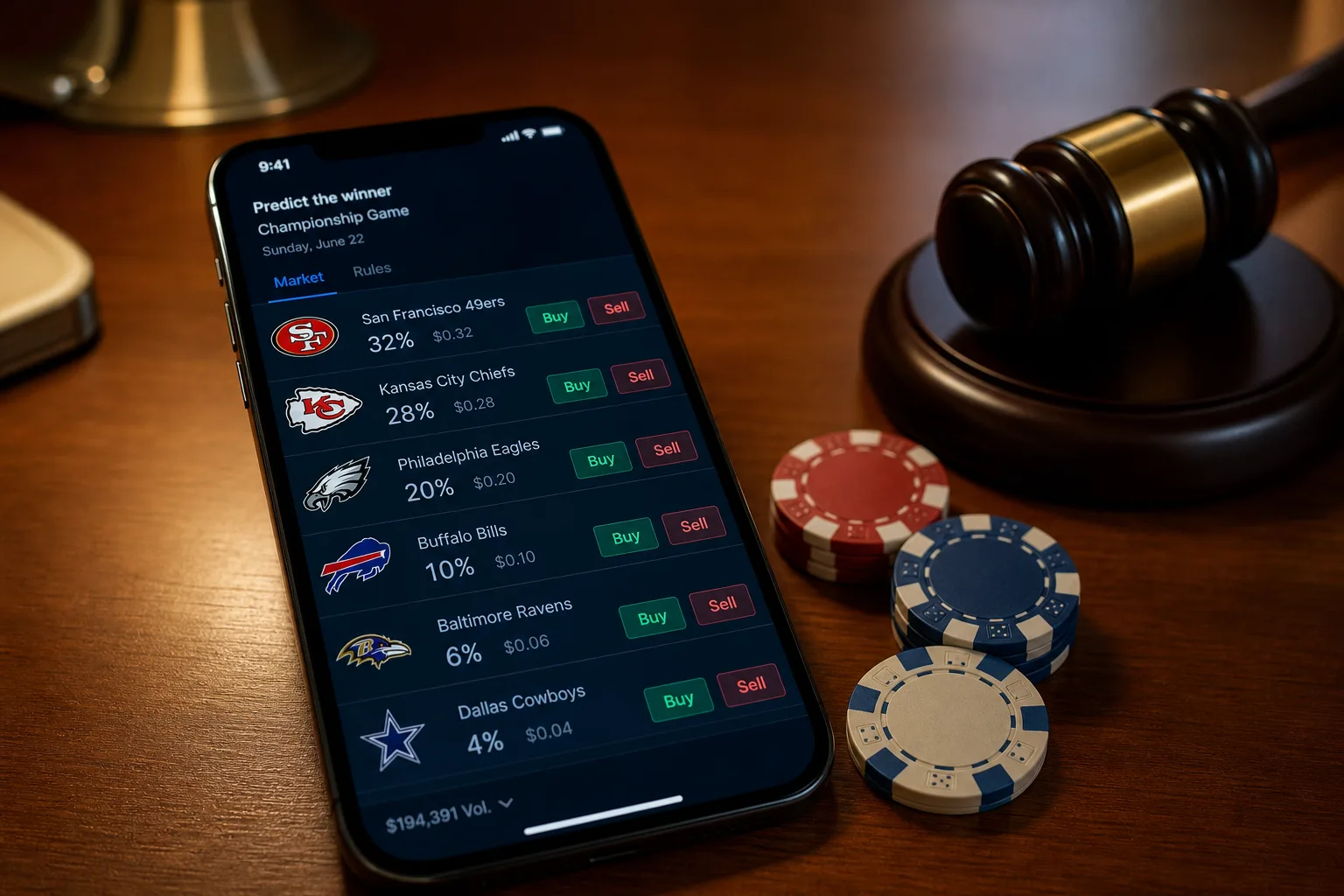
Prediction markets let users take positions on the outcome of real-world events, including sporting contests, using derivatives-style contracts. Platforms like Kalshi — which holds a Commodity Futures Trading Commission (CFTC) licence as a designated contract market — have been aggressively expanding into sports event contracts. From a user’s perspective, placing a contract on whether the Kansas City Chiefs win on Sunday is functionally indistinguishable from placing a bet at a licensed sportsbook in New Jersey or Nevada. The legal underpinning, however, is entirely different.
That distinction is exactly what US gaming groups are reportedly urging Congress to collapse. According to Semafor, these organisations called on Congress to argue that the crypto bill represents a critical moment to clarify that sports and casino-style prediction contracts don’t get a free pass simply because they’re structured as financial derivatives.
The Regulatory Arbitrage Problem
At the heart of this fight is a classic regulatory arbitrage play. Traditional sportsbooks in the US operate under a patchwork of state licences, pay substantial tax rates that vary by jurisdiction, comply with responsible gambling mandates, and face rigorous identity verification requirements. They’ve invested billions building that compliance infrastructure since the Supreme Court’s 2018 Murphy v. NCAA ruling opened the door to legal sports betting state by state.
Crypto-native sports prediction markets, by contrast, have been threading a needle: arguing that because their products are structured as CFTC-regulated commodity contracts rather than state-regulated wagers, they sit outside the traditional gaming framework entirely. It’s a clever legal argument — and one that, so far, has had legs. Kalshi and similar platforms have pursued event contracts under federal derivatives frameworks, a approach that has opened the door for other political and sports-related prediction contracts.
From the gaming industry’s perspective, this isn’t innovation — it’s an unlevel playing field. Why should DraftKings or FanDuel spend enormous resources obtaining licences in 30-plus states while a crypto platform can potentially offer a near-identical product under a single federal derivatives framework? The gaming groups’ letter to Congress frames the issue in exactly those terms, and it’s a hard argument to dismiss on its merits.
What the Crypto Bill Actually Does — and What’s at Stake
The broader crypto market structure bill is one of the most consequential pieces of digital-asset legislation the US has attempted. It aims to draw clearer boundaries between which crypto assets fall under SEC jurisdiction and which fall under the CFTC, a question that has been driving regulatory uncertainty and endless litigation for years. The bill was already contentious before sports prediction markets entered the picture.
Adding a specific ban on sports prediction markets into the legislation would represent a significant carve-out — essentially using a crypto bill to resolve a gambling policy question. That’s an unusual legislative move, but it reflects how blurred the lines between crypto finance and consumer gambling have become. Prediction markets sit right at that intersection, and neither the CFTC nor state gaming commissions have been entirely sure who owns the problem.
If the ban makes it into the final bill, the implications for platforms like Kalshi are severe. Sports event contracts have been a major growth driver, and losing the ability to offer them under a federal derivatives framework would effectively push that business back into the state-by-state licensing grind that crypto platforms have been explicitly trying to avoid. For the broader prediction market sector, it would signal that Congress views the CFTC umbrella as insufficient cover for anything that closely resembles consumer gambling.
Sports Prediction Markets and the Question of Consumer Protection
There’s a consumer angle here worth taking seriously. Licensed sportsbooks are required to offer self-exclusion programmes, display responsible gambling messaging, and in many states contribute to problem gambling funds. Crypto prediction platforms operating under CFTC oversight have far weaker obligations on that front — the CFTC is a derivatives regulator, not a consumer protection agency in the gambling sense.
That gap matters. Sports prediction markets attract casual bettors, not just sophisticated derivatives traders. If a platform markets event contracts around March Madness to a general audience, the distinction between ‘prediction market participant’ and ‘sports bettor’ is largely academic. Gaming groups have been making exactly this point to regulators for over a year, with limited traction — until now, with a major piece of legislation in play.
A Turf War With Long-Term Consequences
It would be too easy to frame this purely as incumbents protecting their turf — though that’s certainly part of it. The regulated gaming industry has a genuine policy argument: consistent rules matter for consumers, and a two-tier system where identical products face radically different oversight creates real risks.
But the crypto industry’s counter-argument has force too. Prediction markets aren’t inherently the same as gambling; their intellectual roots are in the idea that aggregated market signals produce better forecasts than expert opinion. Polymarket, another major player in the space, has drawn serious interest from institutional and media users who treat its contracts as genuine signals about election and economic outcomes, not just as a way to bet on sport.
The challenge is that sports prediction markets sit at the least defensible end of that spectrum. It’s genuinely difficult to argue that a contract on whether a specific NFL team covers the spread this weekend serves a meaningful price-discovery function that couldn’t be served just as well — and more responsibly — by a licensed sportsbook.
Congress will ultimately have to decide whether to treat this as a financial markets question, a gambling regulation question, or both. The gaming industry’s lobbying push makes it harder to defer that decision. Whatever Congress does with this provision, the outcome will define the competitive landscape for both sports prediction markets and traditional regulated betting for the next decade.

