

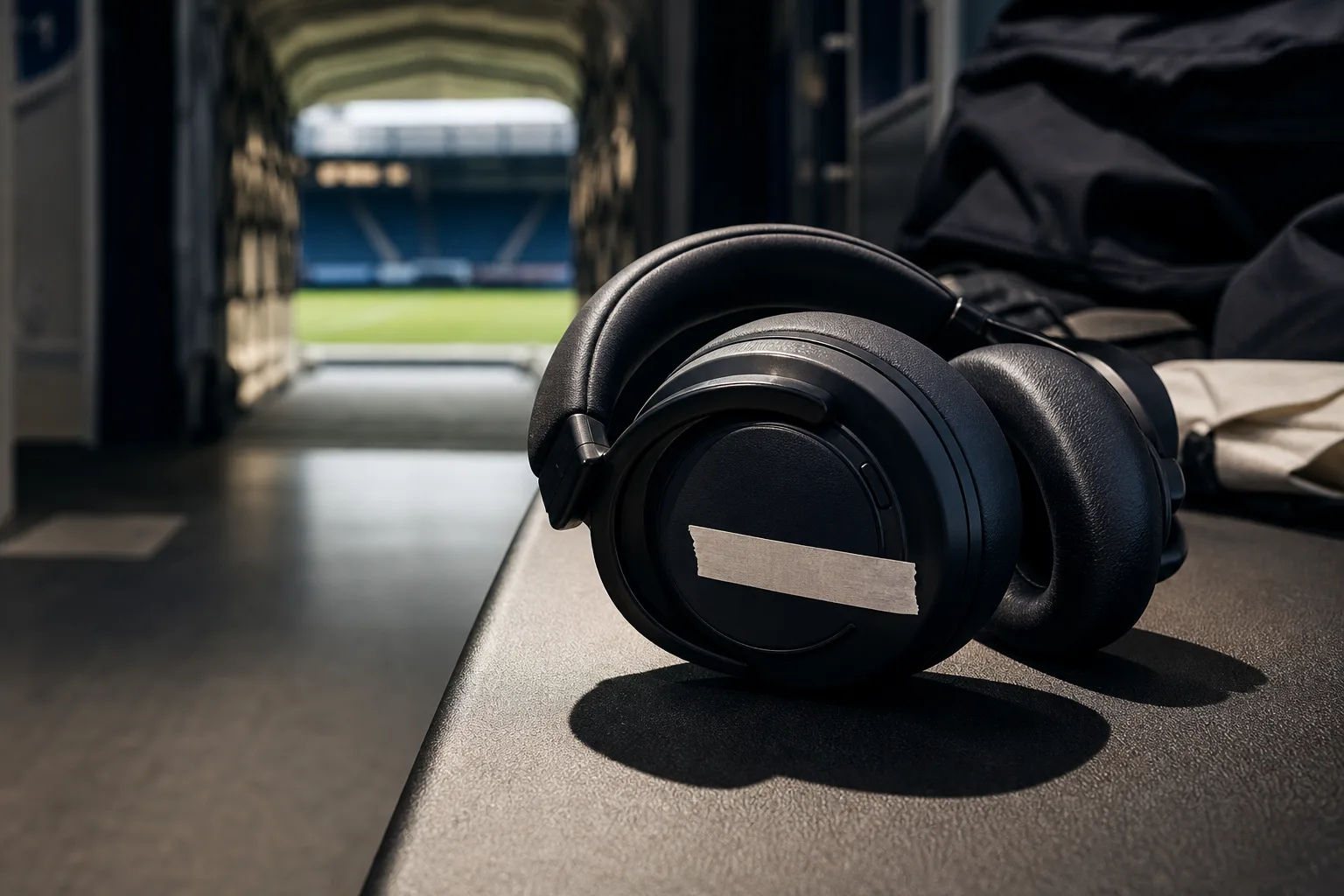
FIFA brand rules have long been one of the more quietly aggressive forms of commercial enforcement in professional sport — and at the 2026 World Cup in North America, they’re playing out in unusually visible ways. The latest example: Bayern Munich and Germany midfielder Jamal Musiala was spotted before his side’s match against Curaçao on June 16 with a strip of tape carefully placed over the logo on his Beats by Dre headphones, a direct result of FIFA’s standing policy on non-sponsor brand visibility.
- FIFA brand rules forced Jamal Musiala to tape over his Beats by Dre headphone logo before Germany’s match against Curaçao.
- FIFA brand rules also required Levi’s Stadium in Santa Clara to cover its branding, rebranded as San Francisco Bay Area Stadium for the tournament.
- Levi’s turned the enforced logo cover-up into a marketing win, replacing its social media profile picture with a tarp-covered version of its logo.
- Beats by Dre appears to be using World Cup player appearances to tease an unannounced over-ear headphone model with customizable colors.
Table of Contents
FIFA Brand Rules and the Tape Heard Round the Internet
The image, posted by X account @iMiaSanMia, a well-followed Bayern Munich and Germany fan account, quickly circulated across football and tech media simultaneously. It’s a small detail in the grand scheme of a World Cup warmup, but it neatly captures just how seriously FIFA takes its commercial ecosystem. Musiala wasn’t being punished — he was simply complying with the same FIFA brand rules every player at the tournament is subject to. If the brand on your gear hasn’t paid FIFA for official tournament sponsorship rights, it doesn’t get to exist on the pitch, even partially.
Beats by Dre is not among FIFA’s official World Cup partners for 2026. FIFA’s official sponsors — companies that have paid substantial sums for the right to have their logos visible during the most-watched sporting event on the planet — hold exclusive commercial rights that Beats, whatever its cultural reach among footballers, simply hasn’t paid for. So tape it is.
This Isn’t New — But It’s Getting More Attention
FIFA brand rules aren’t a 2026 invention. The organisation has enforced similar policies at every World Cup for decades, drawing on a framework that mirrors what the International Olympic Committee applies to its own athletes. The IOC’s Rule 40, which restricts athletes from being used in non-sponsor advertising during the Games, has generated its own share of controversy over the years. FIFA operates on comparable logic: the tournament’s commercial value depends entirely on exclusivity, and that exclusivity has to be policed aggressively or it erodes fast.
What’s changed is the media environment. In the pre-smartphone era, a piece of tape on a player’s headphones during warmup wouldn’t have registered beyond the stadium. Today, a single photo from a fan account reaches millions within hours. The enforcement is the same — it’s just infinitely more visible now, which creates an interesting double-edged dynamic for FIFA. The tape story reinforces its authority, sure. But it also generates exactly the kind of earned media attention for Beats that FIFA was trying to prevent in the first place.
Levi’s Stadium Gets the Same Treatment
The Musiala tape moment isn’t even the most dramatic example of FIFA brand rules at work this summer. In Santa Clara, California, the venue normally known as Levi’s Stadium — home of the San Francisco 49ers — is being called the San Francisco Bay Area Stadium for the duration of the World Cup. Levi’s, like Beats, isn’t an official FIFA tournament sponsor, so its name simply can’t appear on the ground. Large tarps were deployed to cover the stadium’s prominent Levi’s branding.
Levi’s, to its credit, responded with exactly the kind of marketing instinct that turns a corporate inconvenience into a cultural moment. The brand swapped its social media profile picture for a tarp-covered version of its own logo — a deadpan, self-aware move that generated far more goodwill and press coverage than staying quiet ever would have. It’s the 2026 equivalent of a brand running an ad that acknowledges it can’t run an ad. Clever, genuinely funny, and completely free to execute.
Beats Is Playing a Longer Game
Here’s where things get more interesting from a product standpoint. While Beats by Dre can’t show its logo on the actual tournament field, the brand has been very active in players’ social media ecosystems throughout the competition. Multiple high-profile footballers have appeared in Instagram and TikTok posts wearing what appears to be an unreleased over-ear headphone model — and crucially, the colorways keep varying. Some players have been seen with what looks like a red variant, others with blue or white versions.
That kind of deliberate variety doesn’t happen by accident. It strongly suggests Beats is seeding a product launch, likely for a new over-ear model with customizable or interchangeable color options. It’s a smart play: use the World Cup’s enormous social reach without paying FIFA’s sponsorship rates, get the headphones in front of billions of engaged viewers through organic player content, and build pre-launch buzz before an official announcement. The fact that FIFA brand rules prevent Beats from getting field-level visibility almost doesn’t matter when your product is on Musiala’s head in a post that racks up hundreds of thousands of likes.
What This Tells Us About Sponsorship in 2026
The Musiala tape incident is, on one level, a minor procedural story about logo enforcement. But zoom out and it reflects a genuine tension at the heart of modern sports sponsorship. Official tournament partnerships cost tens or hundreds of millions of dollars. In exchange, brands get exclusivity, broadcast integration, and on-site visibility. What they can’t easily buy is authenticity — and that’s exactly what Beats gets for free when a player of Musiala’s stature chooses to wear its headphones on his own time.
FIFA brand rules are designed to protect the commercial model that funds the tournament itself, and that’s a legitimate objective. Without those sponsorship revenues, the World Cup as we know it doesn’t exist. But the tape-on-the-logo moment also exposes how porous the boundaries of that model have become. Social media has created an entirely parallel advertising channel that official sponsorship frameworks were never built to account for, and brands like Beats are clearly paying attention. Understanding how FIFA brand rules interact with player-driven social content is fast becoming one of the defining commercial questions in sport. Whether FIFA eventually tries to extend its reach into player social content — the way some leagues have moved toward social media content restrictions — is a question that’s going to get louder, not quieter, with each passing tournament.

