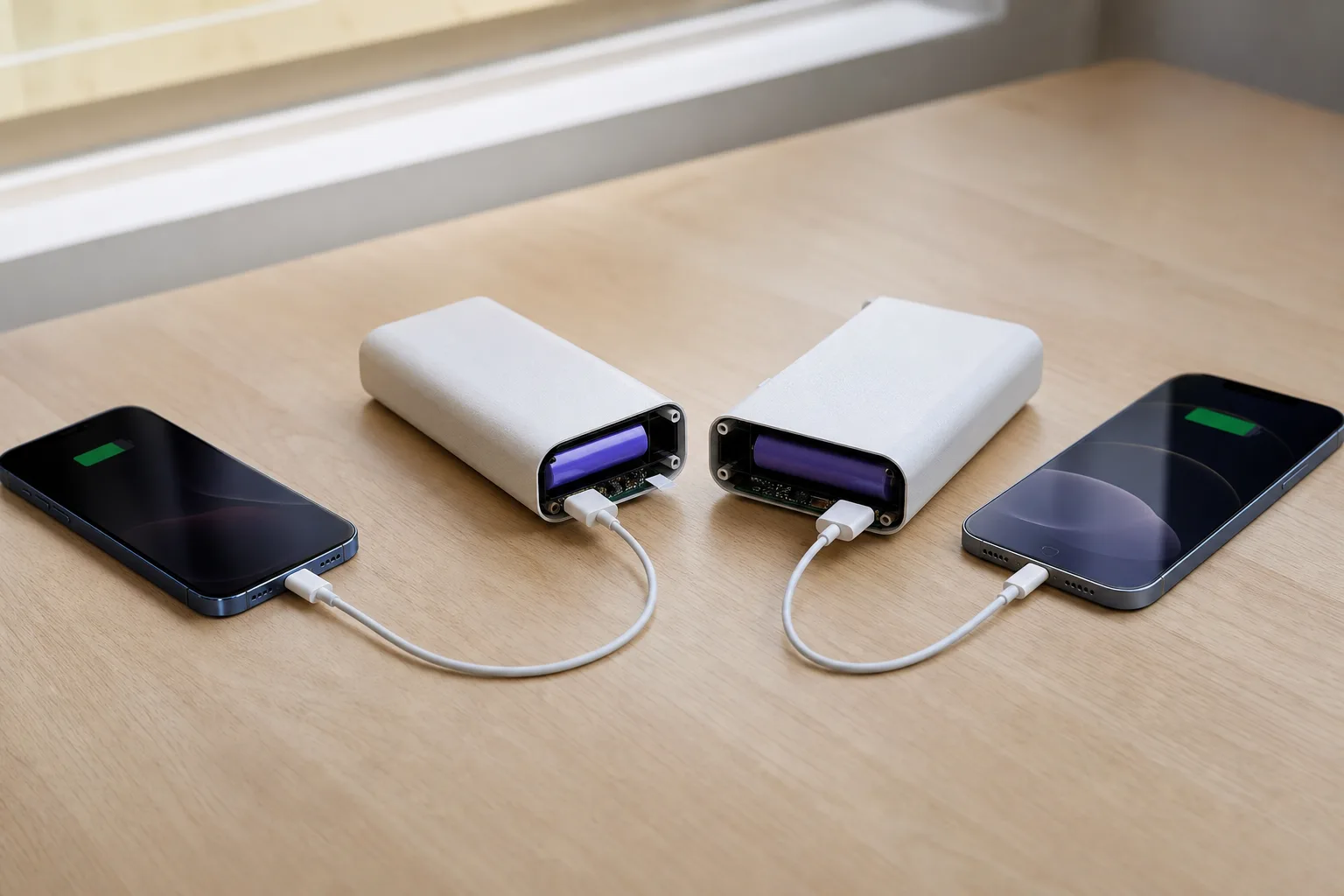
Power banks are one of the most commoditised gadgets on the market. Walk into any electronics store and you’ll find shelves stacked with near-identical black slabs, all promising roughly the same thing. So when a company finds a genuinely clever twist on the formula, it’s worth paying attention. Nimble’s SharePower power bank does exactly that — it’s a 10,000mAh portable charger that physically splits in two, turning one device into a pair of independent 5,000mAh chargers you can hand off to a friend.
- The SharePower power bank splits magnetically into two 5,000mAh halves, letting two people charge their devices simultaneously.
- Nimble’s SharePower power bank delivers 35W combined when paired and 20W per half when separated, retailing for $80.
- Each half includes its own built-in USB-C cable — one braided lanyard-style, one compact pop-out — plus an extra port.
- The SharePower is available in white, blue, and pink from the Nimble website and Apple.com.
Table of Contents
What Makes the SharePower Power Bank Different
The concept behind the SharePower power bank is disarmingly simple: two magnetic halves that snap together when you need a single high-capacity charger, and pull apart when two people need juice at the same time. It’s the kind of idea that sounds obvious in hindsight, which is usually the hallmark of smart product design. Hundreds of companies sell portable chargers, but nobody — at least not in any meaningful mainstream product — has tackled the sharing problem quite like this.
When joined, the two halves deliver up to 35W of Power Delivery, which is fast enough to quick-charge most modern iPhones. Separated, each half steps down to 20W independently. That’s a reasonable trade-off for the added flexibility, though it does mean iPhone 17 Pro users who need maximum fast-charging speeds will want to keep the halves connected — Apple’s Pro models require higher wattage to hit their peak charging rates.
A Closer Look at the Two Halves
The two sides of the SharePower power bank aren’t mirror images of each other — Nimble has clearly thought about how each will actually be used in the real world. The left half comes with a seven-inch braided USB-C cable that doubles as a lanyard, which tucks neatly into the interior when the two halves are clipped together. It’s a tidy solution to the eternal problem of cable storage, and the extra length is useful when your phone needs to sit on a table while charging.
The right half takes a different approach: a short pop-out USB-C cable that plugs directly into the bottom of your iPhone and keeps the whole setup compact. Think of it as the ‘keep it in your pocket’ configuration. Both halves also include an additional USB-C port, meaning the separated duo can simultaneously charge up to four devices total — two cables, two ports. Even when joined, you can run three devices at once through the two built-in cables and one of the external ports.
Smart Display, Faint Flaw
Nimble has put some real thought into the battery indicator system on the SharePower power bank. The right half features an LCD display showing a percentage readout. When the two halves are united, that display automatically switches to reflect the combined charge level rather than just the right half’s individual capacity. The left half, meanwhile, uses LED indicator lights to show its own remaining charge when operating independently. It’s a small detail, but one that makes the split-charger concept feel genuinely polished rather than like a gimmick bolted onto a standard product.
There’s also a green PD indicator light that activates during fast charging — a nice visual confirmation that your phone is pulling maximum power. One minor annoyance surfaced during testing: a faint electronic hum was audible from the device while charging, whether both modules were in use or just one. It’s unlikely to bother anyone who isn’t in a completely silent room, but it’s the kind of thing that can nag at you once you’ve noticed it.
Size, Weight, and the Competition
At 2.8 by 3.1 inches and one inch thick, the SharePower power bank is larger than the slimmest 10,000mAh options on the market — the dual-module design inevitably adds some bulk. It weighs 7.6 ounces, which is on the heavier side for a pocket charger but not unreasonable for a product with this kind of flexibility built in. For context, Anker’s slim 10,000mAh PowerCore Slim comes in under six ounces, though it offers nothing close to the SharePower’s split functionality.
The 5,000mAh per-half capacity is the other practical consideration. That’s enough to charge a standard iPhone 16 to full, but it won’t quite top up an iPhone 17 Pro Max on its own. As a combined 10,000mAh unit, the math works out — but if you’re the person who hands off your half to a friend, you’re accepting a half-charge as your ceiling. That’s the honest trade-off, and most buyers will know going in whether the sharing use case applies to them.
Who Should Actually Buy This
The SharePower power bank has a clear target buyer: couples, friends who travel together, festival-goers, anyone who’s ever been in the situation where two phones are dying and there’s one charger between them. At $80, it’s priced at a modest premium over comparable-capacity single-unit power banks — a standard 10,000mAh Anker model typically runs $25–$40 — but the premium is essentially the cost of the sharing mechanic.
Nimble is a brand that’s built its identity around sustainable, thoughtful hardware design, and the SharePower fits that ethos. The company sells through Apple.com, which speaks to the calibre of retail relationships it’s cultivated and gives the product genuine visibility among iPhone users — clearly the primary audience here.
The power bank market has long needed someone to solve for sharing rather than just raw capacity. Most of the innovation in the space over the past few years has chased MagSafe compatibility or ever-slimmer form factors. The SharePower takes a different bet: that the social use case — two people, one charger — is more common and more underserved than anyone’s acknowledged. If that turns out to be right, don’t be surprised to see other manufacturers scrambling to copy the idea within a product cycle or two.