

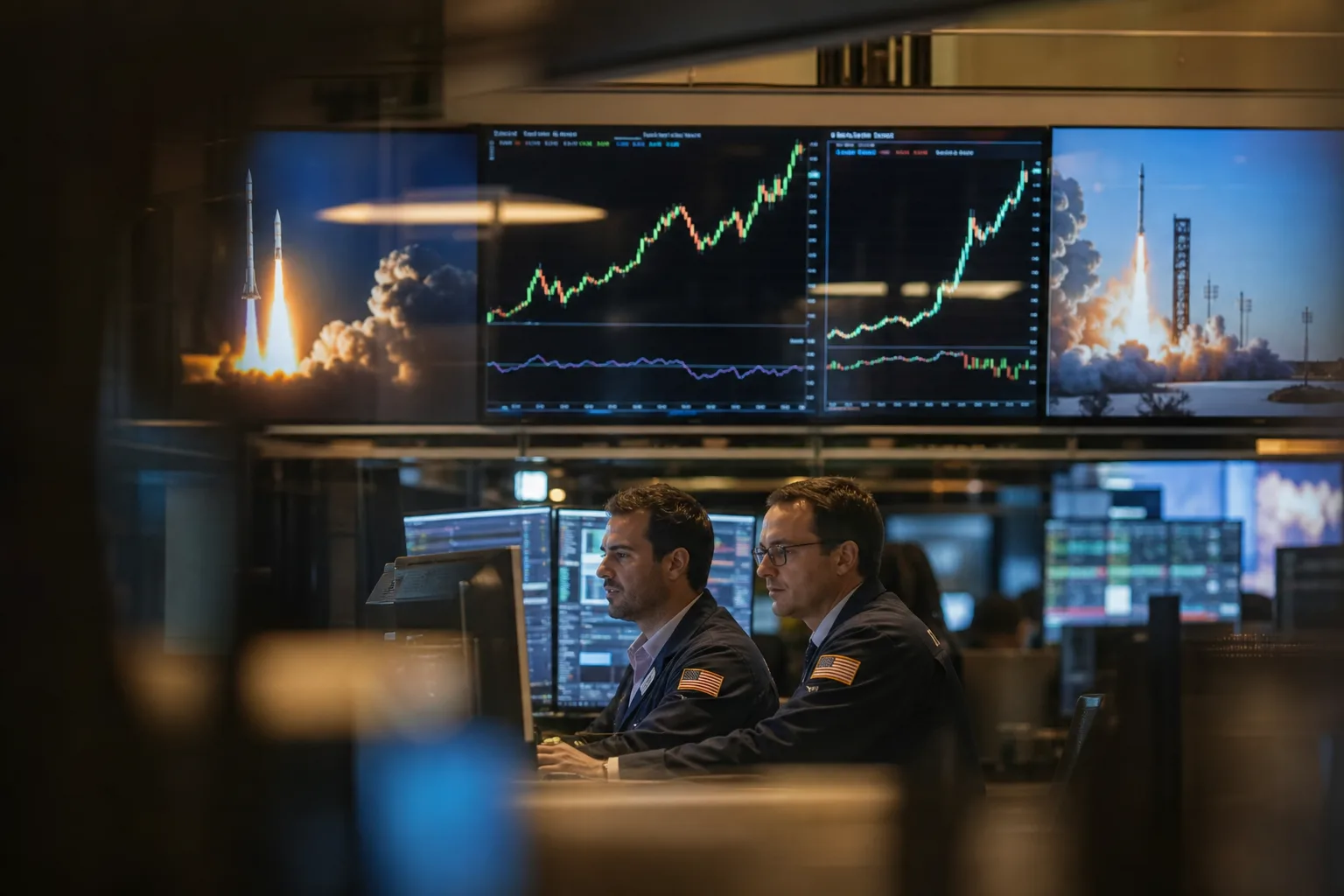
The SpaceX stock rally is now one of the stranger financial stories of 2025. SPCX — trading under that ticker on public markets for less than two weeks — has surged more than 50% above its $135 IPO price, briefly touching $210 in a single Tuesday session. For context, that’s a company already valued in the trillions behaving like a sub-$1 billion token on its first day of exchange listing. Something unusual is clearly going on here, and it’s worth unpacking exactly what mechanics are driving it.
- The SpaceX stock rally has pushed SPCX more than 50% above its $135 IPO price within days of listing.
- The SpaceX stock rally is amplified by one of the thinnest public floats ever attached to a trillion-dollar company.
- Crypto perpetual futures tied to SPCX have logged nearly $9 billion in 24-hour volume, extending speculation around the clock.
- SpaceX’s $60 billion all-stock acquisition of Cursor creator Anysphere adds an AI narrative on top of the momentum trade.
Table of Contents
A Record IPO With a Deliberately Tiny Float
SpaceX’s debut was always going to be a spectacle. The company raised $75 billion at $135 per share — one of the largest IPO proceeds in history — later expanding to roughly $85.7 billion after underwriters exercised their overallotment option. But here’s the catch: SpaceX has approximately 13 billion shares outstanding in total. The IPO released around 639 million of those into public hands. Do the math and you’re looking at a company that handed Wall Street less than 5% of its total equity to trade with.
That setup is what’s making the SpaceX stock rally so ferocious. Thierry Borgeat, co-founder of market structure firm Arvy, described it as an exceptionally tight supply setup for a company of SpaceX’s scale — index funds, retail traders, and momentum buyers are all chasing the same limited pool of tradeable shares. Elon Musk and early insiders still control the overwhelming majority of the company, and lockup agreements mean that won’t change quickly. The result is a market where natural sellers are nearly absent.
CNBC’s Jim Cramer put it bluntly: the stock is behaving like a meme stock because it has ‘no sellers.’ That’s reductive, but it’s not entirely wrong. When demand is broad and supply is artificially constrained, prices don’t find equilibrium — they spike. The SpaceX stock rally is, at its core, a supply-and-demand imbalance story playing out at extraordinary scale.
The SpaceX Stock Rally Has Gone Cross-Asset
What makes this situation genuinely novel is that the frenzy hasn’t stayed in traditional equity markets. Crypto trading platforms have built perpetual futures contracts linked to SPCX’s price, and those products have become some of the most actively traded derivatives on those venues. According to CoinGlass data, SPCX futures saw volume jump 501.5% in a single 24-hour window, reaching nearly $9 billion — while open interest climbed to $813 million. The implied price on crypto platforms briefly reached $222.52, up 27.6% in that same period.
Perpetual futures are a crypto-native instrument: there’s no expiry date, positions are funded continuously, and traders can apply leverage multiples that simply aren’t available in regular stock accounts. That structure has effectively turned the SpaceX stock rally into a around-the-clock speculation loop that doesn’t pause when the New York Stock Exchange closes at 4pm. Colin Talks Crypto, a widely followed crypto analyst, drew a direct comparison to token markets, arguing that SPCX is behaving like a project with a heavily vested release schedule — scarce liquid supply driving early price discovery well beyond what fundamentals would suggest.
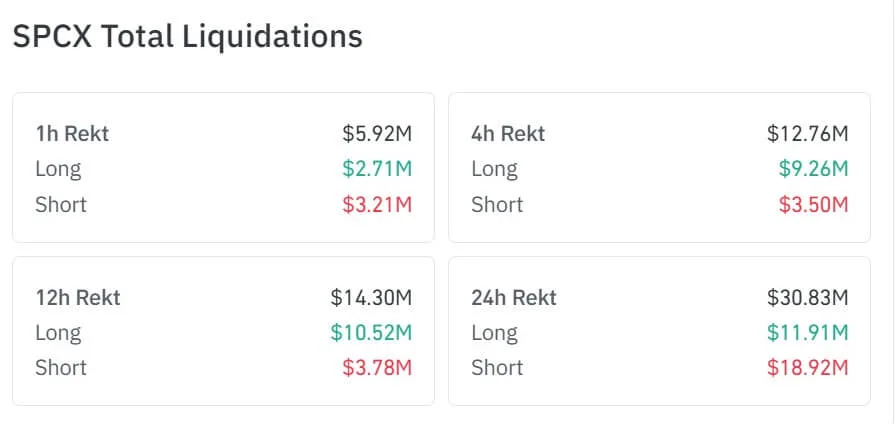
The leverage has already extracted its toll. CoinGlass data showed more than $30 million in SPCX derivatives positions liquidated within 24 hours, with price volatility exceeding 35%. Around $19 million of that came from short sellers being forced to close positions — and when that happens, exchanges automatically buy back exposure to unwind the trade. That forced buying pushes prices higher still, triggering the next wave of short liquidations. It’s the same feedback loop that has driven parabolic rallies in Bitcoin and Ethereum during crowded positioning events. SpaceX, somehow, is now part of that same ecosystem.
Why the SpaceX Stock Rally Feeds on Itself
The mechanics here are self-reinforcing in a way that’s almost elegant, if you’re not the one getting liquidated. Start with a thin public float — every new dollar of demand moves the price more than it ordinarily would. The rising price attracts momentum traders who don’t want to miss the move. Those traders pile into crypto futures because they’re accessible, leveraged, and always open. When the price continues to climb, short sellers take losses and are forced out, generating additional mechanical buying. Each cycle reinforces the narrative that the SpaceX stock rally has more to run.
This is not purely irrational. Some of the demand is structural: when a company joins major indices, index funds are obligated to buy its shares regardless of price. With SpaceX’s weighting in any index calculated against a very small float, even modest index-driven demand represents significant buying pressure against limited supply. That’s a real, fundamental force — it just happens to be amplified by the speculative layer on top.
The Cursor Deal: Using Inflated Stock as Currency
Then came the news that poured rocket fuel on an already burning situation. SpaceX announced it had agreed to acquire Anysphere — the company behind the AI coding assistant Cursor — in an all-stock deal valued at $60 billion, with the transaction expected to close in Q3 2026. SpaceX framed the rationale clearly: ‘SpaceX has exercised the option to acquire Cursor in an all-stock transaction with the goal of building the world’s most useful AI models.’ The two companies had apparently already begun jointly training a model, with outputs planned for release through Cursor and Grok Build. The announcement gave the SpaceX stock rally a fresh fundamental story to attach itself to.
The strategic logic is straightforward. AI coding tools are among the most commercially potent software products right now, with Cursor having carved out a serious following among professional developers since its launch. Attaching SpaceX’s brand and compute ambitions to that userbase is a plausible path toward something genuinely differentiated. But Quinn Thompson, chief investment officer at Lekker Capital, put his finger on the financial angle that matters most right now: SpaceX is using a low-float, retail-inflated share price to buy real businesses before the lockup period expires. The inflated stock is, in effect, cheap acquisition currency — and management appears to know exactly what they have.
The deal also reshapes how investors frame SpaceX entirely. Until now, the narrative centred on Starship, Starlink, and government launch contracts. Adding an AI software business — particularly one as prominent as Cursor — positions SpaceX as a technology platform company, not just an aerospace contractor. That’s a meaningful valuation story, and it gives investors a fresh reason to stay in the stock even as the pure momentum trade eventually cools.
What Could End the SpaceX Stock Rally
The same structure that’s driving SPCX higher is also its biggest vulnerability. Lockup agreements preventing insiders from selling their shares won’t last forever, and when those restrictions lift, the supply dynamics shift dramatically. Musk and early investors hold the vast majority of SpaceX’s 13 billion shares. If even a fraction of that comes to market, the current scarcity premium evaporates. Prices would face what Colin Talks Crypto called ‘unlock sell pressure’ — the crypto equivalent of a token’s vesting schedule kicking in and early holders cashing out. That single event alone could be enough to reverse the SpaceX stock rally quickly and decisively.
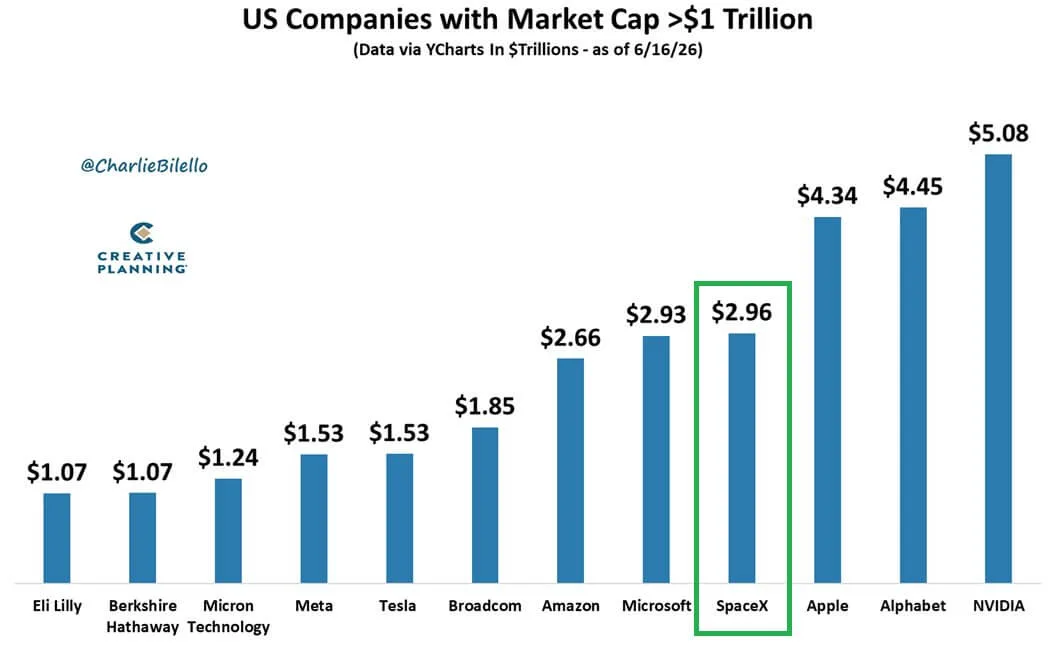
There’s also the simple question of valuation. SpaceX entered the public market at a price implying a multi-trillion dollar enterprise value — already one of the most expensive public companies in the world by any conventional metric. At 50% above its IPO price, the gap between current trading prices and any defensible fundamental valuation has grown even wider. That doesn’t mean the stock can’t keep climbing in the short term; momentum markets routinely ignore fundamentals longer than rational observers expect. But it does mean that when the shift from momentum to fundamentals eventually happens — and it always does — the correction could be sharp.
For now, though, the feedback loop is intact. The SpaceX stock rally is being driven by structural scarcity, speculative leverage, and a fresh AI narrative that gives bulls a story to tell beyond ‘meme stock.’ Whether that combination holds long enough for the Cursor deal to close and demonstrate real value is the question every serious SPCX investor should be asking.
Frequently Asked Questions
Why is the SpaceX stock rally so extreme so quickly?
The SpaceX stock rally is driven by an unusually small public float. SpaceX has roughly 13 billion shares outstanding, but only about 639 million entered the market via its IPO. With so few shares available and heavy demand from retail traders and index funds, even moderate buying pressure moves the price sharply higher.
What are SPCX perpetual futures and how do they work?
SPCX perpetual futures are crypto-native leveraged contracts that track SpaceX’s share price. They trade 24 hours a day on crypto platforms, allowing traders to take leveraged long or short positions. During the post-IPO surge, over $30 million in SPCX positions were liquidated in a single day as volatility exceeded 35%.
Why did SpaceX acquire Anysphere, the company behind Cursor?
SpaceX agreed to acquire Anysphere for $60 billion in an all-stock deal, aiming to build advanced AI models through a joint training effort already underway between SpaceXAI and Cursor. The deal also lets SpaceX use its inflated post-IPO stock as acquisition currency before insider lockups expire.
When could the SpaceX stock rally reverse?
Analysts warn the rally could unwind sharply if lockup agreements expire and insiders begin selling, flooding the market with new supply. The current price action depends heavily on restricted float; once more shares become tradeable, the supply-demand imbalance that has driven gains could reverse quickly.

