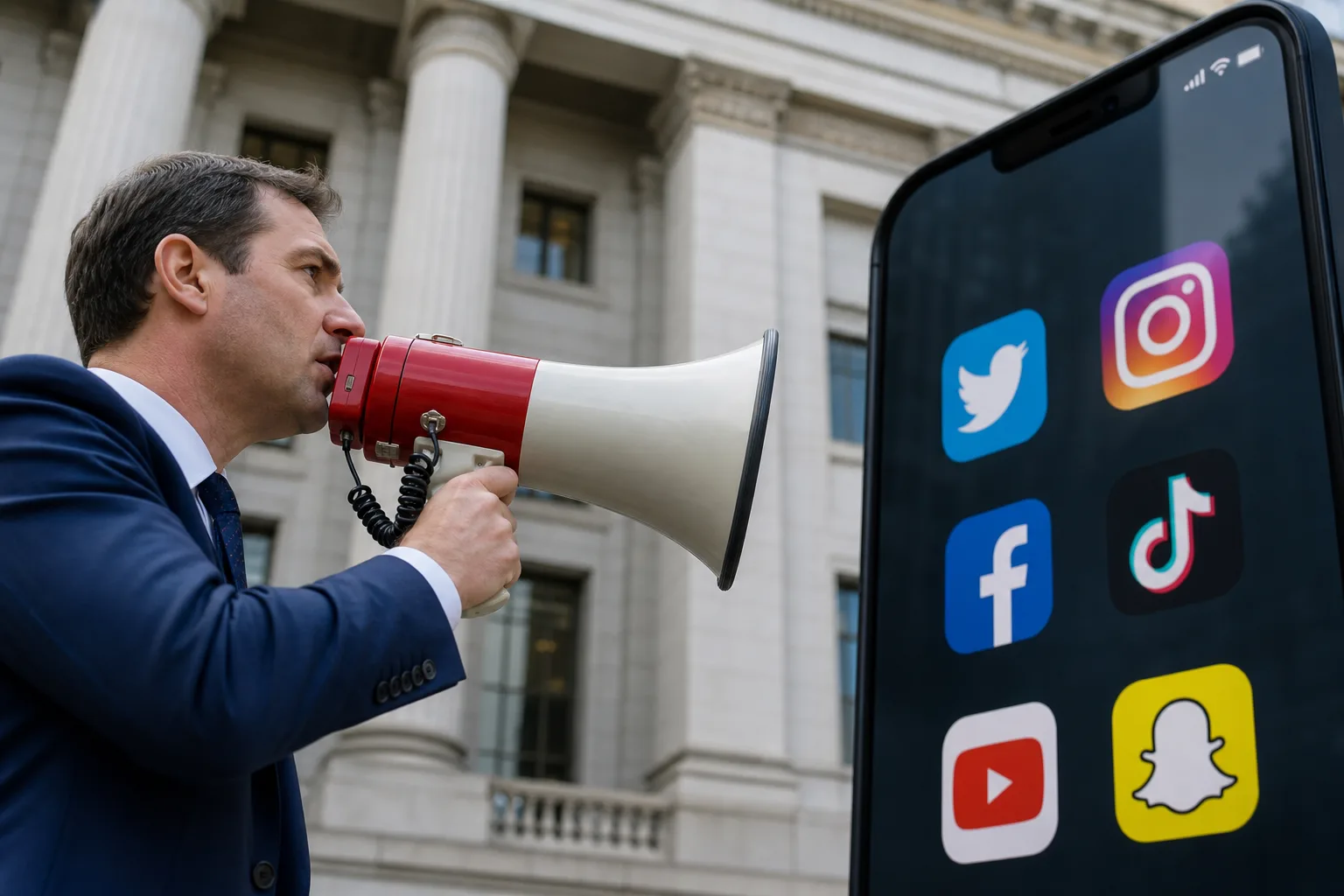
A rare bipartisan moment landed in the U.S. Senate last week — and it’s one that touches directly on who really controls what Americans can say online. Senators Ted Cruz and Ron Wyden, two figures who agree on almost nothing, jointly introduced the JAWBONE Act, legislation squarely aimed at the problem of government online speech coercion. The full name — Justice Against Weaponized Bureaucratic Overreach to Networked Expression — makes the acronym feel very deliberate, but the substance behind it is serious.
- The bipartisan JAWBONE Act gives Americans new federal legal rights when government online speech coercion forces platforms to remove protected content.
- Government online speech pressure — known as jawboning — was used to force Apple to remove ICEBlock, an immigration-tracking app, in 2025.
- The bill requires transparency around government communications with broadcasters, social media platforms, and AI providers about user content.
- Platforms retain their own First Amendment rights to moderate freely, independent of government demands or congressional pressure.
Table of Contents
What Government Online Speech Coercion Actually Looks Like
Most people picture censorship as something that happens through law: a statute gets passed, a court upholds it, speech is banned. The messier reality is that government officials have long found a quieter path — pick up the phone, send a strongly worded letter, schedule a meeting, and let a platform figure out what ‘or else’ might mean. This is jawboning, and it represents one of the most persistent government online speech threats that exists today — one that’s been happening far longer than most people realise.
The Electronic Frontier Foundation, which has been fighting this battle in court for years, offers a concrete and troubling recent example. In June 2025, high-ranking federal officials began threatening to investigate and potentially prosecute Joshua Aaron, the developer behind ICEBlock — an app that let community members report nearby immigration enforcement activity. By October 2025, the U.S. Attorney General had formally demanded that Apple remove ICEBlock from the App Store. Apple complied. The app was gone.
That sequence matters. No court ordered the removal. No law explicitly banned the app. The government expressed its displeasure, applied pressure, and a trillion-dollar company quietly fell in line. Aaron’s First Amendment rights, the EFF argues, were violated — not through legislation but through the implicit weight of federal authority. This is government online speech suppression operating entirely outside the courts. The EFF is now representing Aaron and has filed a Freedom of Information Act lawsuit seeking disclosure of government communications with Apple, Google, and Meta related to the removal of lawful speech from their platforms.
What the JAWBONE Act Would Actually Do
The legislation targets three categories of intermediaries: broadcasters, interactive computer services — which covers most of what we’d call social media and web platforms — and AI providers. That last category is new and significant. As large language models and AI-powered content systems become gateways to information, they’re increasingly subject to the same kind of government online speech pressure that’s been applied to traditional platforms. Including them in this bill suggests Congress is at least partially paying attention to where the internet is heading.
On the enforcement side, the bill creates a new federal cause of action — a legal right to take the government to court — for individuals whose protected speech was suppressed as a result of official coercion. This exists alongside whatever rights the First Amendment itself provides, not as a replacement for them. There’s also a transparency mechanism built in, requiring the government to disclose communications it has with these intermediaries about user expression. That’s a meaningful safeguard against government online speech interference. One of the reasons jawboning is so effective is that it’s invisible. No press release announces that a federal agency called up a platform and suggested it might want to reconsider hosting a particular account.
The Line Between Coercion and Legitimate Contact
Here’s where things get genuinely complicated, and where the EFF — despite applauding the bill — is careful to add nuance. Not every communication between government and platform is an attempt to silence dissent. Agencies flag clearly illegal content. Law enforcement shares threat intelligence. Cybersecurity bodies coordinate with tech companies on nation-state attacks. Treating all of that as presumptively unconstitutional would create its own problems, potentially chilling the kind of cooperation that actually keeps people safer.
The challenge for lawmakers and courts alike is drawing a credible line between ‘here is information you might want to act on’ and ‘we strongly suggest you act on this, or we’ll be asking a lot more questions about your business.’ The former is routine. The latter is coercion — and the clearest example of government online speech manipulation working as intended. In practice, those two things can look almost identical from the outside, which is precisely why the transparency requirements in the JAWBONE Act matter as much as the liability provisions.
The Supreme Court’s NetChoice rulings are relevant context here. The court reaffirmed that platforms have their own First Amendment rights to curate, edit, and moderate the content they host. They are not state actors. They are not obligated to carry all speech. That means government online speech directives aimed at dictating how platforms moderate their content run directly into the platforms’ own constitutional protections — a dynamic the JAWBONE Act is designed to make more legally actionable.
Why the Cruz–Wyden Partnership Signals Something Bigger
Ted Cruz and Ron Wyden represent opposite poles of American politics, and both have been vocal about platform power from very different directions. Cruz has long argued that platforms unfairly suppress conservative voices. Wyden, who co-authored Section 230 — the law that gives platforms legal immunity for user content — has spent decades defending the open internet from a civil liberties perspective. The fact that they’ve found common ground here says something about how broadly felt the concern over government online speech overreach really is.
It’s also worth watching how this bill interacts with the ongoing debate over Section 230 reform. Critics on both the left and right have pushed to modify or repeal 230, arguing platforms are either too permissive or too restrictive. The JAWBONE Act doesn’t touch 230 directly, but it does reinforce the idea that the bigger threat to free expression online may not be what platforms choose to do — it’s what they’re quietly pressured into doing.
The EFF has made it clear it intends to stay involved as the bill moves through Congress, and that’s probably essential. Legislation targeting government overreach has a history of being amended in ways that create new forms of overreach. The balance here — protecting users from invisible government online speech pressure while preserving both platform autonomy and legitimate government-platform cooperation — is genuinely difficult to strike in statutory language. Whether Congress can actually get that balance right will determine whether the JAWBONE Act ends up being a meaningful protection for everyday users or just a well-intentioned piece of political theatre that satisfies nobody.