
Google has spent years turning the microphone on Android’s homescreen search bar into a small but surprisingly important shortcut. Now Google Voice Search appears to be getting its most consequential redesign in years: one screen for ordinary web queries, AI Mode prompts, live conversations, and the familiar song-identification tool.
At first glance, this looks like a tidy interface refresh. But the redesign, currently appearing for some Google app beta users, exposes a strategic question Google has mostly kept tucked behind separate buttons and experiments: when you speak to Google, are you searching the web, asking an AI assistant, or starting a conversation?
Google’s apparent answer is simple: pick what you mean, and Google will remember your choice. For users, Google Voice Search is no longer being presented as a single destination.
- Google Voice Search is testing a bottom toolbar that switches between conventional search, AI Mode, Search Live, and song recognition.
- The Google Voice Search redesign remembers whether a user last chose standard Search or AI Mode before opening the microphone again.
- Search Live keeps Google’s conversational voice experience available alongside one-shot queries and music identification.
- The interface currently appears limited to the Google app beta, with no announced timeline for a broad Android release.
Table of Contents
Google Voice Search becomes a four-part launcher
The existing experience is bluntly simple. Tap the multicolor microphone in the Google widget or inside the Google app, speak, watch your words appear, and receive an ordinary Google Search results page. A song-search shortcut is also available for those inevitable ‘what was that track in the coffee shop?’ moments.
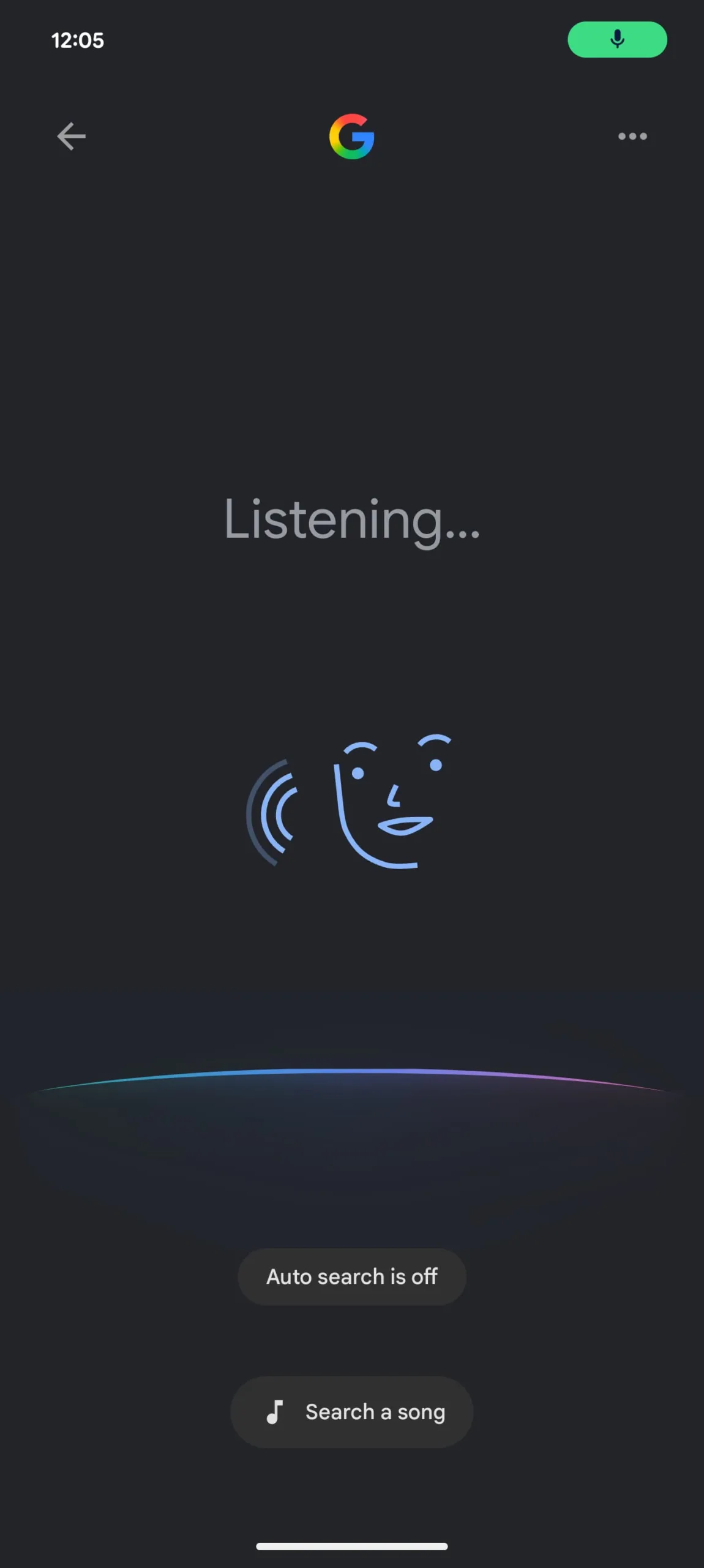
The new Google Voice Search interface reportedly replaces that single-purpose screen with a bottom switcher. Its choices are Search, AI Mode, Search Live, and Song Search. The visual idea resembles the mode bar Google has already used in Lens, where users can choose among functions such as Search, Translate, Live, and Create rather than hoping the app guesses their intent.
It’s a sensible pattern. Google Lens taught the company that a camera can serve several jobs, but users need a clear door for each one. Voice is heading the same way.

Standard Search gets a new animated waveform made of four bars, while the transcription sits toward the top of the display. This remains the fast route for commands such as ‘weather this weekend,’ ‘train times to Boston,’ or ‘how tall is Mount Fuji?’ Speak, stop, search. No conversational detour required. In practice, Google Voice Search still needs to make those quick, ordinary requests feel effortless.
That distinction matters because a conventional search engine still has virtues. It returns links, sources, shopping results, maps, videos, and all the wonderfully messy material of the open web. For plenty of questions, that’s preferable to an AI-written answer that may be fluent but incomplete. Frankly, Google shouldn’t make regular search feel like the legacy option simply because AI is the current industry obsession.
AI Mode gets a clearer voice entry point
The larger change is the direct place for AI Mode. Google has been pushing AI Mode as a more conversational, reasoning-oriented layer of Search, designed for longer and more exploratory questions. In the revamped Google Voice Search flow, users speak an AI Mode prompt and then tap a forward arrow to submit it. A stop control can instead take them to an editable Search box containing the transcript.
That edit option is quietly excellent. Voice input is convenient right up until it transcribes a name, street, product model, or technical term incorrectly. Anyone who has dictated ‘Wi-Fi 7 router’ and watched their phone produce something nonsensical knows the problem. Letting users inspect and fix the query before sending it gives AI Mode a little more friction, but it’s the productive kind.
AI Mode is framed around complex questions, follow-ups, and deeper exploration. Voice fits that pitch naturally. People tend to speak in full thoughts, not the compressed keyword fragments they type into a search box. A spoken question might begin as ‘What laptop should I buy?’ and become ‘I travel twice a month, need good battery life, and I edit photos.’ That’s precisely the kind of query AI products claim to handle better.
But a dedicated AI Mode tab is also an admission that this is not the same thing as search. That may sound obvious, yet tech companies have often blurred the line until users can’t tell which system is answering them. Google’s approach is more honest than forcing every voice request through generative AI and calling it progress.
Search Live is the assistant Google has been circling
Search Live occupies the middle ground. It offers a back-and-forth voice conversation rather than a single question followed by a page of results. If AI Mode is for forming a substantive prompt, Search Live is for keeping the microphone open and working through a task aloud.
The Google Voice Search redesign puts that experience one tap away from ordinary search, which changes how Google presents it. Live, spoken interaction is being treated as a normal search behavior now, not a niche demo hiding behind an experimental badge.
Whether people agree is another matter. Continuous conversational systems can feel magical when you’re cooking, driving, troubleshooting a device, or planning a trip with both hands occupied. They can also feel awkward in public, slow when a typed question would do, and mildly unsettling when you’re unsure what data is being retained. The best interface cannot solve every social hesitation around talking to a phone. Ask anyone who still whispers voice commands into a smartwatch.
Still, the feature has a practical advantage over the old Google Assistant model. Assistant was frequently expected to control devices, answer trivia, set timers, send messages, and somehow understand context across all of it. Search Live appears more focused on information discovery. That narrower remit could make it more dependable, assuming Google avoids turning every exchange into a pitch for AI-generated prose.

Remembering the last mode is a small decision with big consequences
Perhaps the most revealing detail is that Google Voice Search will reportedly remember the last mode a person used, defaulting to either Search or AI Mode on the next launch. Search Live and Song Search remain available in the switcher, while song recognition itself is said to be unchanged.
This is good product design. If you consistently use AI Mode for research questions, reopening into that mode saves a tap. If you’re a traditional search user, Google doesn’t immediately shove you into a chatbot. The system adapts without pretending it knows more than you do. That makes Google Voice Search feel more like a useful shortcut than a forced AI funnel.
There is a catch: defaults become habits, and habits become metrics. If Google can gently steer a growing share of voice searches into AI Mode by making it the remembered destination, the company will gather more signals about how people use generative answers. That could shape the future of Search far more than a splashy launch event. Defaults are the steering wheel of consumer software.
For now, this remains a beta sighting rather than a broad rollout. Google regularly tests interface changes in the Google app before expanding them, revising them, or occasionally letting them vanish. So don’t expect every Android phone to show the new toolbar tomorrow.
My read is that the design is Google’s clearest attempt yet to stop treating voice as one feature. It’s becoming an input method for several distinct products: web search, AI research, live assistance, and music recognition. The interface is cleaner because it acknowledges that reality. The harder job will be ensuring users still understand which Google they’re talking to—and what kind of answer they should expect back.