
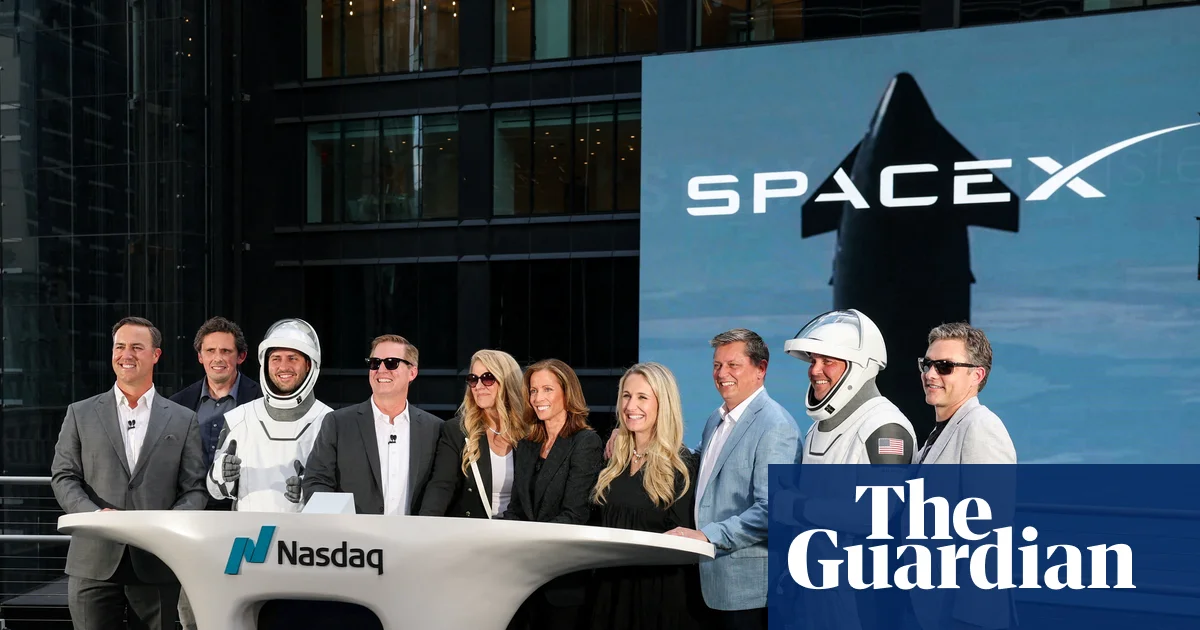
Last week, Elon Musk became the world’s first trillionaire. That milestone, extraordinary as it sounds, wasn’t the result of some slow accumulation of dividends or a lucky private bet — it came the moment SpaceX hit public markets with a valuation of $1.77 trillion. And for millions of ordinary Americans whose SpaceX retirement savings exposure is about to become involuntary, the celebration feels rather one-sided.
- SpaceX retirement savings exposure is growing as Musk pushed for early index fund inclusion after the $1.77tn IPO.
- Most Americans’ SpaceX retirement savings risk is involuntary — index funds tied to the S&P 500 leave little choice.
- Over 150 Americans surveyed expressed concern about wealth concentration and the long-term sustainability of AI-driven markets.
- Some savers are actively diversifying or exiting index funds entirely in response to the SpaceX IPO.
Table of Contents
SpaceX Retirement Savings: The Index Fund Problem Nobody Asked For
Here’s the structural issue nobody in the financial press is explaining clearly enough: the majority of Americans don’t pick their own stocks. They contribute to a 401(k), that money flows into index funds tracking the S&P 500 or similar benchmarks, and those benchmarks include whatever companies meet the criteria. Historically, a company needs to be publicly traded for some time before it earns inclusion. SpaceX retirement savings implications accelerated dramatically when Musk reportedly pushed for a rule change to fast-track SpaceX’s entry into those indices — compressing the usual waiting period and forcing passive investors into the position of SpaceX shareholders before they’ve had a chance to form an opinion on the stock.
It’s a feature of modern portfolio theory that has quietly become a political flashpoint. According to the Investment Company Institute, more than 70 million American workers participate in 401(k) plans. The vast majority of those plans funnel contributions into broad index funds. When a $1.77 trillion company lands in those funds, the weighting matters — and at that scale, SpaceX would immediately become one of the largest holdings in the most widely held investment vehicle in the country. For many workers, SpaceX retirement savings exposure will arrive without a single conscious investment decision on their part.
Tim, a 62-year-old engineer from Alameda, California, didn’t mince words when describing how this feels from the ground. ‘We’ve all been forced into a giant casino,’ he told The Guardian. ‘I’ve never wanted to participate in the so-called AI bubble. Basically my entire retirement is in the S&P 500 — not out of choice, but if you don’t have investments in the stock market, you’re losing ground compared to everybody who does. That’s the pernicious thing about it. There’s really no way for the average person to diversify.’ His frustration captures why SpaceX retirement savings anxiety has spread so quickly among passive investors.
That’s not hyperbole. It’s a reasonably accurate description of how passive investing works in practice. The S&P 500 has outperformed the vast majority of actively managed funds over the past two decades. Opting out doesn’t feel like a principled stand; it feels like financial self-harm. And yet the alternative — accepting significant SpaceX retirement savings exposure without any say — doesn’t feel like a free choice either.
A $1.77 Trillion Question About Valuation
Even setting aside the political dimensions of Musk’s influence, the valuation itself is drawing serious scepticism. Stephen, a 33-year-old engineer from Michigan, was blunt that he thinks the valuation is absolutely ridiculous and untethered to the company’s actual value, and finds it abhorrent that his savings and retirement funds are tied so intricately to these tech companies, especially when they cannot be held accountable by investors. The SpaceX retirement savings question for him isn’t abstract — it’s personal and immediate.
He has a point worth unpacking. SpaceX is, by any reasonable measure, a remarkable engineering organisation. It has transformed launch economics, made reusable rockets commercially viable, and built Starlink into a genuinely global broadband network. These are real achievements. But $1.77 trillion reflects a bet on future AI integration and interplanetary ambition as much as it does current revenue. For context, that valuation eclipses Boeing, Lockheed Martin, Northrop Grumman, and Raytheon combined — companies that collectively generate hundreds of billions in annual revenue from government and commercial contracts. SpaceX’s revenue, while growing quickly, isn’t in the same neighbourhood yet.
The tension between genuine admiration and financial anxiety is something Dimitris Eleas, a 52-year-old political scientist from Brooklyn, captured well: ‘It is hard not to admire what the company has achieved. SpaceX has transformed the space industry, and the same can be said for some of the advances we are seeing in artificial intelligence. At the same time, I am very uneasy about the growing concentration of wealth and power in the hands of a small number of technology companies and their greedy founders.’ That unease is precisely what makes SpaceX retirement savings a mainstream concern rather than a niche financial complaint.
The Accountability Gap Is the Real Issue
What runs through nearly all of the concerns people raised — and more than 150 Americans responded to The Guardian’s callout, overwhelmingly to express worry — is something more fundamental than stock price volatility. It’s the disconnect between who holds the risk and who holds the control. SpaceX retirement savings are caught right at the centre of that disconnect.
Matt Reynolds, a 57-year-old professor in eastern Washington approaching retirement within the next decade, put it in terms that a lot of people will recognise: ‘I’m alarmed at big tech’s market consolidation and its impact on my savings and investments. As a human being, I’m distraught that these companies all seem to be run by people with little accountability or moral compass.’
Steven, the engineer from Michigan, echoed the same structural frustration: ‘CEOs receive lavish sums of money even when they fail while our retirement funds and employment are married to the companies they run.’ That sentence is essentially a summary of the principal-agent problem as it plays out in late-stage tech capitalism — the people taking the risks and the people reaping the rewards are not the same people.
For Kendra Ford, a 54-year-old climate activist in Portsmouth, New Hampshire, the issue has a broader moral dimension. ‘It is heartbreaking and enraging that Elon Musk can use the system to enrich himself while most people are not being paid fairly and so can’t afford food and healthcare,’ she said, adding a warning about social stability: ‘I do think this brings us closer to profound social upheaval when the folks who are being exploited and hurt the most are going to refuse to participate.’
How Some Americans Are Responding
Not everyone is sitting still. A handful of people are taking active steps to manage their SpaceX retirement savings exposure — though the options are more limited than you might expect.
Jeffrey Munsie, a 57-year-old architect in Middletown, Connecticut, is spreading his assets more deliberately. ‘This IPO is far too large for any one entity or person to control or benefit from,’ he said. ‘I intend to now keep my investments well-diversified more actively.’ Pedro, a retired businessman from Denver, has gone further, divesting from index funds altogether — a more drastic move that carries its own long-term risks, particularly given how consistently passive index investing has outperformed active stock picking. For Pedro, reducing SpaceX retirement savings risk was worth accepting those trade-offs.
Then there’s Mia, a 58-year-old writer in Washington DC, who chose years ago not to invest in the stock market at all. ‘I have intentionally not invested in the stock market — it’s a money game for rich people and I think it’s crazy that American taxpayers have allowed their life savings to be gambled in 401(k) accounts,’ she said. Her position is philosophically coherent, but it’s also a financial luxury that requires either significant alternative wealth or an acceptance of reduced retirement security — which is exactly the trap Tim described.
What This Moment Really Signals for Markets
SpaceX retirement savings anxiety isn’t an isolated consumer sentiment story — it’s a symptom of a structural shift that’s been building for years. The S&P 500 is increasingly dominated by a small cluster of mega-cap technology companies. The top ten holdings in a standard S&P 500 index fund now account for more than 35% of the entire index’s weight. Adding a $1.77 trillion SpaceX to that mix would push concentration even further, meaning that the diversification many Americans believe they have in their retirement accounts is increasingly theoretical.
This is the paradox at the heart of passive investing in 2026: the more money flows into index funds, the more it props up the largest companies, which drives their valuations higher, which increases their index weighting, which forces more money into them. It’s a self-reinforcing cycle that works brilliantly when markets are rising — and becomes a serious problem when the largest names correct sharply. The implications for SpaceX retirement savings are direct: a sharp correction in a single mega-cap holding can ripple through the 401(k) balances of tens of millions of people who never consciously chose to own it.
Whether SpaceX’s valuation holds, grows, or eventually deflates will depend on things most 401(k) holders have no ability to influence: rocket launch contracts, Starlink subscriber growth, AI monetisation strategies, and — inevitably — the continued public reputation of the man who controls it all. That last variable alone should give pension fund managers pause. Musk’s influence on his own companies’ stock prices via social media and public behaviour is well-documented. Putting that kind of idiosyncratic risk at the centre of America’s retirement infrastructure isn’t exactly sound fiduciary practice. But here we are — and for anyone tracking their SpaceX retirement savings exposure, that reality is growing harder to ignore.
Frequently Asked Questions
How will the SpaceX IPO affect my retirement savings?
If your 401(k) is invested in index funds that track major stock market indices, you may automatically gain exposure to SpaceX shares once the company is included. Musk has pushed for a rule change to allow SpaceX shares into index funds earlier than is typical, which could speed up that process for millions of passive investors.
Can I opt out of owning SpaceX stock in my 401(k)?
Not easily. Most 401(k) plans default to broad index funds that track major indices. To avoid SpaceX exposure, you’d need to manually switch into funds that specifically exclude the company — an option many plans don’t offer. Active diversification is one workaround, but it requires effort and financial literacy.
Why is the SpaceX valuation considered high by some investors?
SpaceX debuted with a valuation of $1.77 trillion, a figure some critics argue is disconnected from the company’s actual value. Concerns have been raised that such valuations reflect speculative enthusiasm around AI and space commercialisation rather than underlying fundamentals.
What is the risk of having retirement savings tied to a single tech company?
Concentration risk is a core concern raised by many Americans. If a company like SpaceX underperforms or its valuation corrects sharply, index funds with significant exposure to that stock can drag down entire retirement portfolios. This is especially worrying for people approaching retirement who have less time to recover from market swings.