

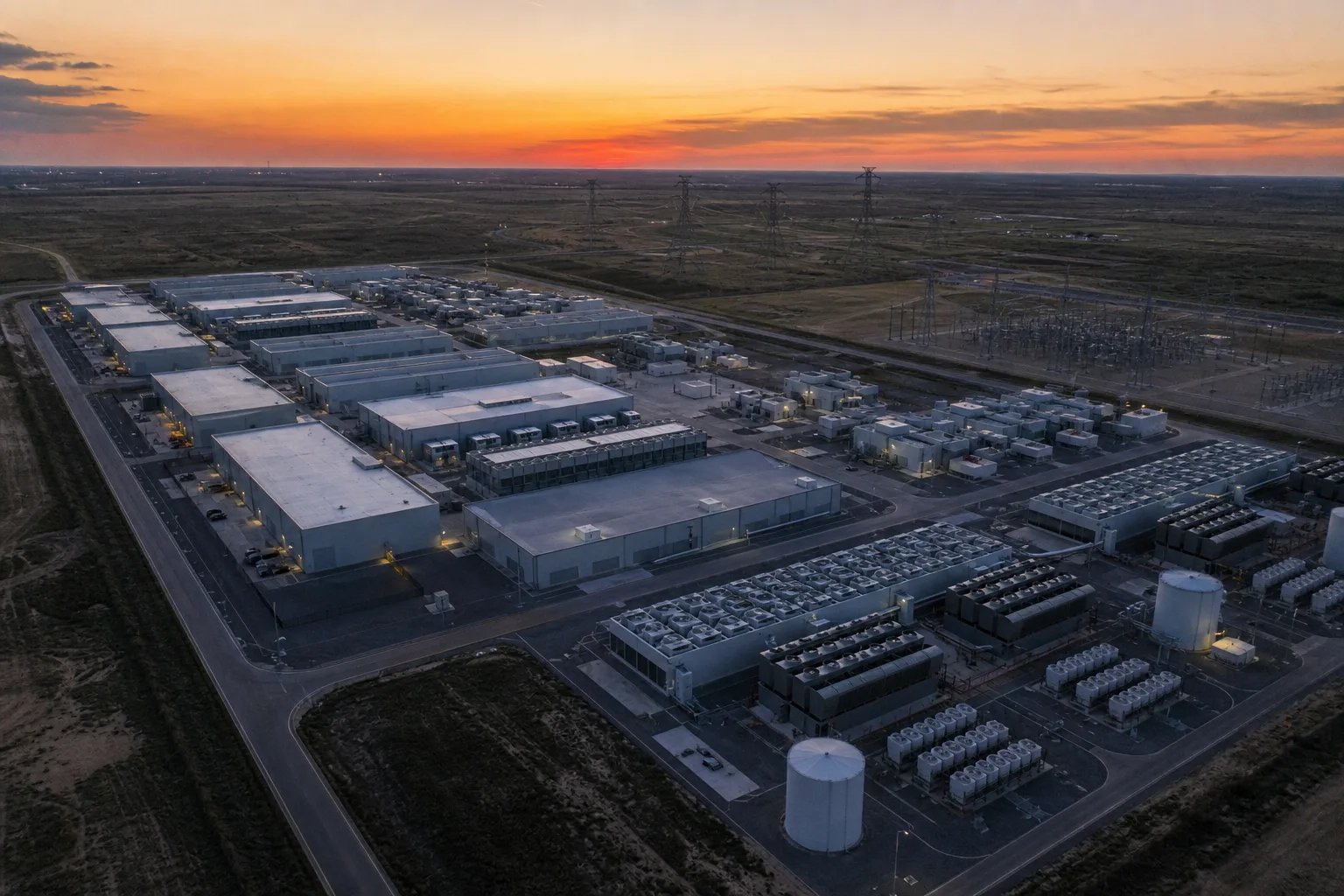
For years, Texas wrote the playbook on how to attract data centers: cheap land, deregulated electricity markets, and a generous sales tax exemption that wiped the slate clean on everything from server racks to cooling towers. It worked spectacularly. Now Governor Greg Abbott has decided the bill has come due — and he wants Texas AI data centers to pay it themselves, not pass it on to the family paying their electric bill in Houston or San Antonio.
- Texas AI data centers could soon pay for all grid upgrades they require, ending a costly subsidy for residential customers.
- Texas AI data centers consumed $3.2 billion in sales tax exemptions over two years, covering servers, cooling, and electricity.
- ERCOT’s peak demand forecast could quadruple to 367,790 megawatts by 2032, driven largely by AI infrastructure growth.
- Bitcoin miners may benefit under new rules because their flexible, curtailable load contrasts sharply with AI’s constant power draw.
Table of Contents
Abbott’s Directive and What It Actually Says
On June 10, Abbott sent a letter to the Public Utility Commission of Texas and ERCOT laying out a clear instruction: stop letting residential customers subsidize ‘one of the fastest-growing industries in the world.’ His directive told the PUC and ERCOT to require Texas AI data centers to fully fund the electrical infrastructure — substations, transmission lines, interconnection work — that gets built specifically to serve them. He also asked the commission to start reducing residential transmission charges by the end of July and ordered both agencies to submit a joint memo by July 17 outlining what they can accomplish under their existing authority and what will need new legislation when the Texas Legislature reconvenes in 2027.
That’s not a vague suggestion. Abbott also called for mandatory water efficiency standards, annual reporting on power and water consumption, and a direct look at whether the state’s lucrative sales tax exemption for Texas AI data centers should be narrowed or eliminated entirely. The exemption currently waives Texas’s 6.25% sales tax on qualifying equipment and electricity for 121 facilities — and it’s costing the state roughly $3.2 billion over two years, with about $1.3 billion landing in fiscal 2025 alone, according to the comptroller’s office.

The Scale of What Texas Is Actually Dealing With
To understand why even a business-friendly governor like Abbott felt compelled to act, you need to look at the demand numbers — and they’re striking. ERCOT set its all-time peak at 85,508 megawatts in August 2023. Its preliminary long-term forecast now puts peak demand at up to 367,790 megawatts by 2032. That’s more than four times the current record. Even the conservative scenario climbs from roughly 98,000 megawatts in 2026 toward 111,000 by 2032, before any large industrial loads are factored in.
Texas AI data centers are a primary driver of that acceleration. Large-load interconnection requests jumped approximately 270% in 2025 compared to the prior year. Texas already has around 6.5 gigawatts of data center capacity under construction — roughly a fifth of the entire national pipeline. Real estate firm JLL projects that Texas could overtake Northern Virginia as the world’s largest data center market by 2030. That’s an extraordinary trajectory for a state that was barely on the data center map a decade ago.
The math is simple: the grid wasn’t designed for this, and someone has to pay to upgrade it. Abbott’s position is that it shouldn’t be the person running a window unit in a Midland apartment.
Texas AI Data Centers: What Changes on the Ground
Under the new framework Abbott is pushing toward, the economics of breaking ground in Texas look meaningfully different. Texas AI data centers should expect to shoulder upfront capital costs for substations, transmission upgrades, and interconnection work that were previously spread across the entire ratepayer base. That raises the bar for new projects and creates a strong incentive to bring generation on-site rather than relying entirely on the grid.
Behind-the-meter power — co-located gas turbines, utility-scale solar, large battery storage — becomes more financially attractive when a company knows it’s responsible for its own connection costs from day one. One project already pointing in this direction is Fermi America’s Project Matador near Amarillo, which is privately funding its own power grid so the campus adds new generation capacity to the system as it draws from it. That model may shift from a novelty to a standard expectation.

Abbott pointed to Senate Bill 6, passed in the 2025 session, as evidence that Texas had already started moving in this direction. SB 6 requires large loads to maintain backup power and curtail during grid emergencies. His directive frames that as a foundation to build on, not a destination.
Operators already in Texas with signed interconnection agreements have some insulation here — those contracts are legally binding and difficult to reopen unilaterally. The biggest disruptions hit new builds and expansions that haven’t yet locked in infrastructure terms. But the uncertainty around the 2027 legislative session hangs over everyone. If the Legislature moves to scale back or eliminate the sales tax exemption, the economics shift for the entire sector, not just newcomers.
Why Clearer Rules Might Actually Suit the Industry
The industry’s response has been notably measured, and that’s worth paying attention to. In a sector where regulatory uncertainty has dogged project timelines and rattled lenders, a clear rulebook — even a more expensive one — can actually be a feature rather than a bug. Developers and their financing partners would rather build a model around known infrastructure costs than face political blowback halfway through construction. Texas AI data centers have attracted exactly that kind of backlash in communities across the state and country, from Virginia to Georgia to the Pacific Northwest, as residents push back against power demand spikes, noise, water consumption, and the visual footprint of massive hyperscale campuses.
Abbott’s framing — that Texas AI data centers should fund what they consume — gives the sector a cleaner social contract to operate under. Whether that translates to smoother project approvals at the local level is a separate question, but it at least removes one of the most politically combustible grievances: the idea that ordinary ratepayers are effectively subsidizing billion-dollar infrastructure for the world’s largest tech companies.

The Bitcoin Miner Wildcard
One angle on Abbott’s directive that hasn’t gotten nearly enough attention is what it means for Bitcoin miners, who’ve spent years embedding themselves into ERCOT’s grid management programs and building a reputation as flexible demand resources. A Bitcoin mining facility can ramp its power draw down to near-zero within minutes when prices spike or reserves tighten. ERCOT has leaned on that flexibility heavily, integrating miners into its controllable load resource programs as a real-time balancing tool.
Texas AI data centers don’t offer that flexibility. Training runs and inference serving need to run continuously at full power — pausing a large language model training job mid-run isn’t a practical option. If the regulatory framework that emerges from Abbott’s directive rewards loads that can bend with the grid and penalizes those that can’t, Bitcoin miners end up looking structurally better alongside hyperscalers than they do today. That’s a meaningful shift in the competitive dynamic between two industries that have often been painted with the same ‘energy-hungry’ brush.

A Template for the Rest of the Country?
Texas isn’t acting in a vacuum. States across the country are grappling with the same fundamental tension: they competed hard to attract data center investment with incentives that made sense at the time, and now the power grid consequences are arriving faster than anyone anticipated. Virginia, the current global leader in data center capacity, has seen its own regulatory and political debates about who pays for grid upgrades. Georgia and Ohio are having similar conversations.
What makes Texas worth watching closely is scale and speed. No state has more capacity under construction, no grid operator has published demand forecasts as stark as ERCOT’s, and few governors have issued directives as specific as Abbott’s. The July 17 memo from the PUC and ERCOT will be the first real test of whether regulators can act meaningfully within their current authority or whether the heavy lifting waits until 2027. Either way, Texas AI data centers getting an essentially free ride on grid infrastructure looks like it’s ending — and the model that replaces it could reshape how the entire country thinks about who pays for the AI buildout.
Frequently Asked Questions
Why are Texas AI data centers now being asked to fund grid infrastructure?
Texas Governor Greg Abbott directed state regulators to stop passing grid upgrade costs onto residential customers. With roughly 6.5 gigawatts of data center capacity under construction and peak demand forecasts quadrupling by 2032, the financial burden on households had become impossible to ignore.
How much does the Texas data center sales tax exemption cost the state?
According to the Texas comptroller’s office, the sales tax exemption for qualifying data center facilities will cost the state approximately $3.2 billion in forgone revenue over two years, with around $1.3 billion attributed to this year alone across 121 participating facilities.
What does Abbott’s directive actually require from regulators?
Abbott asked the Public Utility Commission and ERCOT to require data centers to fully fund grid infrastructure built to serve them, begin reducing residential transmission costs by the end of July, and submit a joint memo by July 17 on what they can change under existing authority.
Will existing Texas data center operators be affected immediately?
Operators with signed interconnection agreements are largely protected in the near term, since those contracts are difficult to reopen. The heaviest impact falls on new projects and major expansions that haven’t yet locked in infrastructure agreements.

