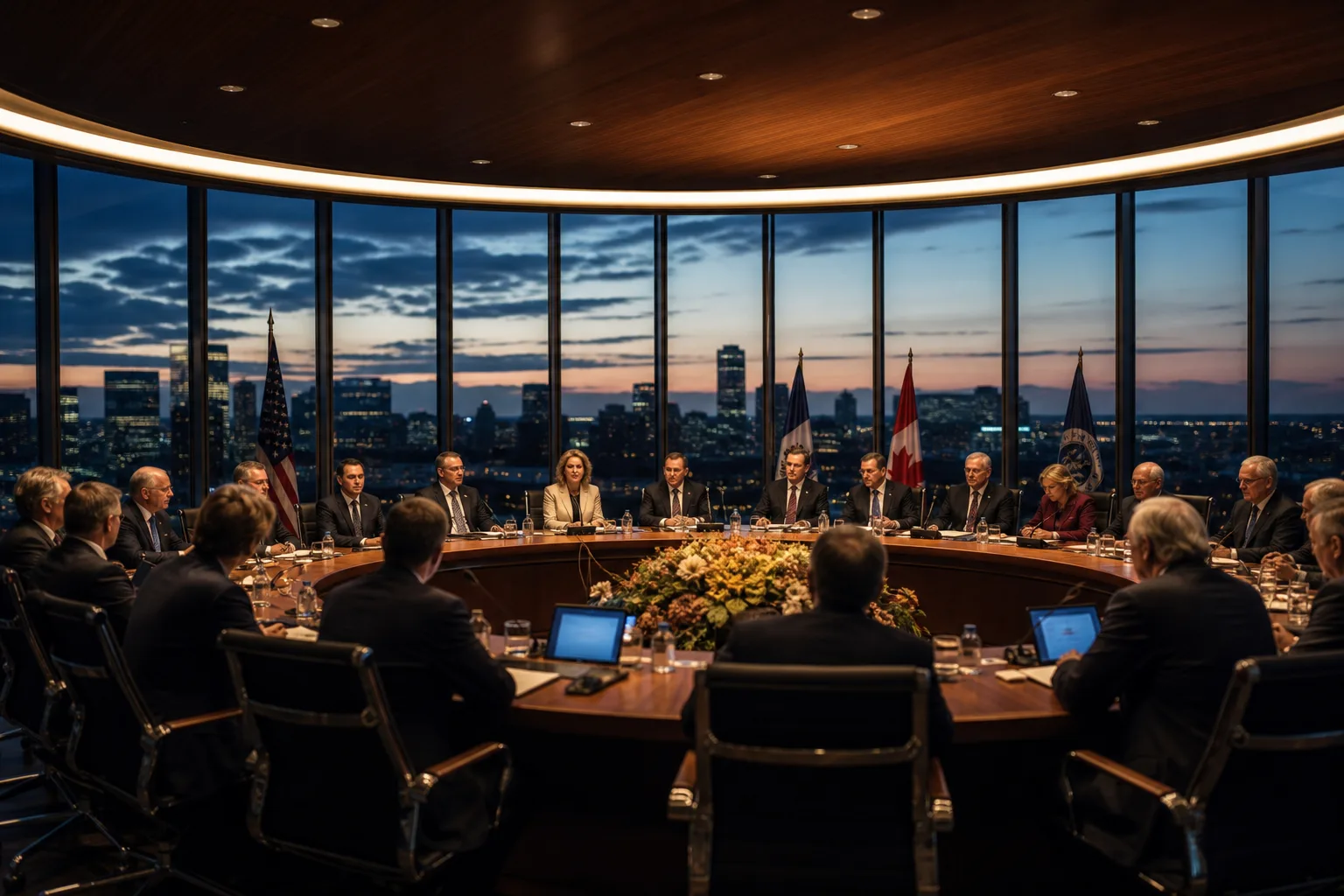
When you think of the world’s emerging hotspots for technology diplomacy, Mongolia probably isn’t the first place that comes to mind. Yet the AI security talks being planned around Ulaanbaatar for 2026 are drawing serious attention from analysts who study the intersection of great-power competition and emerging technology. The question isn’t just what gets said in those rooms — it’s whether anything said there can actually hold.
- The Ulaanbaatar AI security talks in 2026 position Mongolia as an unexpected but strategic neutral ground for great-power dialogue.
- AI security talks are increasingly inseparable from broader geopolitical tensions between the US, China, and Russia.
- Finding common governance frameworks for AI remains the central challenge facing diplomats and technologists heading into 2026.
- The outcome of these negotiations could shape international AI policy and set precedents for future multilateral tech agreements.
Table of Contents
Why Ulaanbaatar? The Logic of Neutral Ground
Mongolia’s capital sits physically and politically between Russia and China, two countries that between them account for an enormous share of global AI development and military technology investment. At the same time, Mongolia has carefully cultivated what it calls its ‘third neighbour’ policy — building meaningful diplomatic and economic ties with the United States, Japan, South Korea, and European partners. That balancing act, which might look like awkward fence-sitting in other contexts, turns out to be a genuine asset when you need a venue where all sides can show up without losing face.
This is not entirely new territory for Ulaanbaatar. The city has previously hosted dialogue formats that brought together actors who wouldn’t easily sit across a table in Washington, Beijing, or Moscow. For the AI security talks envisioned for 2026, that tradition of pragmatic neutrality could prove more valuable than any single nation’s convening power. The European Union has clout and the EU AI Act, but it carries its own regulatory agenda into every room it enters. The US brings resources and technical leadership but deep geopolitical baggage. Mongolia brings neither — and right now, that might be exactly what the conversation needs.
AI Security Talks and the Shadow of Great-Power Rivalry
The substance of any serious AI security talks in 2026 will be shaped — and complicated — by the deteriorating state of US-China relations and the continued isolation of Russia following its invasion of Ukraine. These aren’t just diplomatic inconveniences. They’re structural problems that make multilateral AI governance genuinely hard.
Consider what’s actually on the table. Military AI is perhaps the most urgent issue: autonomous weapons systems, AI-assisted targeting, and the use of machine learning in intelligence operations are all accelerating faster than any international legal framework can track. The United Nations has gestured at this problem through its discussions on Lethal Autonomous Weapons Systems (LAWS), but those talks have moved at a pace that makes continental drift look urgent. Meanwhile, countries are deploying the technology.
Beyond the military dimension, there’s the question of AI in critical infrastructure — energy grids, financial systems, telecommunications networks. Cyberattacks on these systems already represent a serious and growing threat. Add AI-enabled offensive capabilities to that picture and you have a category of risk that no single country can manage alone, but that no country currently trusts others enough to address collectively.
This is exactly the terrain the AI security talks in Ulaanbaatar are meant to navigate. Whether they can is a different matter entirely.
What Common Ground Actually Looks Like
It would be naive to expect any 2026 summit to produce a binding international AI treaty. The history of technology arms control — from the Wassenaar Arrangement on export controls to the failed efforts to regulate cyberweapons — suggests that getting major powers to sign enforceable commitments on emerging technology is extraordinarily difficult. The US and China can’t even agree on a definition of ‘AI risk,’ let alone a shared regulatory architecture.
But ‘no treaty’ doesn’t mean ‘no progress.’ There’s a meaningful difference between the maximalist outcome (a legally binding multilateral agreement) and the minimalist outcome (shared principles, communication channels, and crisis hotlines). The Hotline Agreement between Washington and Moscow didn’t prevent every Cold War crisis — but it probably helped prevent some of them from going nuclear. Advocates of the Ulaanbaatar process are essentially arguing for something in that spirit: not a solution, but an infrastructure for managing the problem.
The AI security talks framework also exists within a broader ecosystem of emerging governance efforts. A number of national AI safety institutes have been quietly building bilateral relationships with counterparts in other countries. Several multilateral processes have produced sets of guiding AI principles. The OECD has its own AI principles framework. None of these is sufficient on its own, and none has produced the kind of binding commitments that would actually constrain state behaviour. But they represent the scaffolding on which something more durable might eventually be built.
The Role of Technology Companies
One dynamic that any honest analysis of the AI security talks has to reckon with is the role of private companies. The most capable AI systems in the world are built by Google DeepMind, OpenAI, Anthropic, Meta, and a handful of Chinese firms including Baidu, Alibaba, and the rapidly ascending DeepSeek. These are not state actors. They don’t sign treaties. They don’t have seats at diplomatic tables in the traditional sense.
Yet their decisions — about what safety measures to implement, what capabilities to develop, what governments to work with — shape the AI landscape as much as anything happening in any foreign ministry. The relationships between leading AI companies and their respective governments, and the question of how AI capabilities intersect with national security priorities, are not peripheral to the diplomatic conversation. They’re central to it.
Any AI security talks that don’t meaningfully engage the private sector risk producing agreements that look good on paper but have limited traction in the real world where AI is actually developed and deployed. That’s not a small design challenge — it’s a fundamental tension at the heart of AI governance.
What 2026 Could Realistically Achieve
Realism is probably the right lens here. The AI security talks in Ulaanbaatar won’t end the US-China technology war. They won’t produce a Geneva Convention for autonomous weapons. They won’t resolve the deep disagreements about what AI risks are most urgent or how responsibility for AI harms should be allocated across borders.
What they might do is create a durable forum — one that survives changes of government in Washington, Beijing, or Moscow — where technical experts and policymakers from rival nations can at least talk to each other without it becoming a diplomatic incident. In an era where the US and China have repeatedly had to rebuild communication channels from scratch after they’ve broken down, that kind of institutional continuity has real value.
Mongolia’s geographic and political position gives it a rare opportunity to be more than a passive backdrop for these conversations. If Ulaanbaatar’s government is serious about playing a constructive role in global AI governance — and there are signals that it is — 2026 could mark the beginning of something that outlasts any single summit. The world’s most powerful countries are building AI faster than they’re building the institutions to govern it. Somewhere has to be the room where that gap starts to close. It might as well be Ulaanbaatar.
Frequently Asked Questions
What are the Ulaanbaatar AI security talks about?
The Ulaanbaatar AI security talks are a proposed diplomatic forum exploring how nations — particularly major powers — can find common ground on artificial intelligence governance, military AI use, and emerging technology risks heading into 2026.
Why is Ulaanbaatar chosen as a venue for AI diplomacy?
Mongolia occupies a rare geopolitical position as a neutral state sandwiched between Russia and China, with cultivated ties to Western nations. That neutrality makes Ulaanbaatar an appealing venue when great powers need a low-friction setting for sensitive technology negotiations.
What makes AI governance so difficult to agree on internationally?
Different governments treat AI as a strategic national asset, making transparency and binding commitments politically costly. Disagreements over military applications, data sovereignty, and economic competitiveness mean that even defining shared terminology is a serious diplomatic challenge before any rules can be written.
Could the Ulaanbaatar AI security talks produce a binding agreement?
Expectations are cautious, as multilateral tech forums have historically produced declarations and frameworks rather than enforceable treaties. The talks may generate shared principles, but translating those into binding international law would require sustained political will that has so far proven elusive.