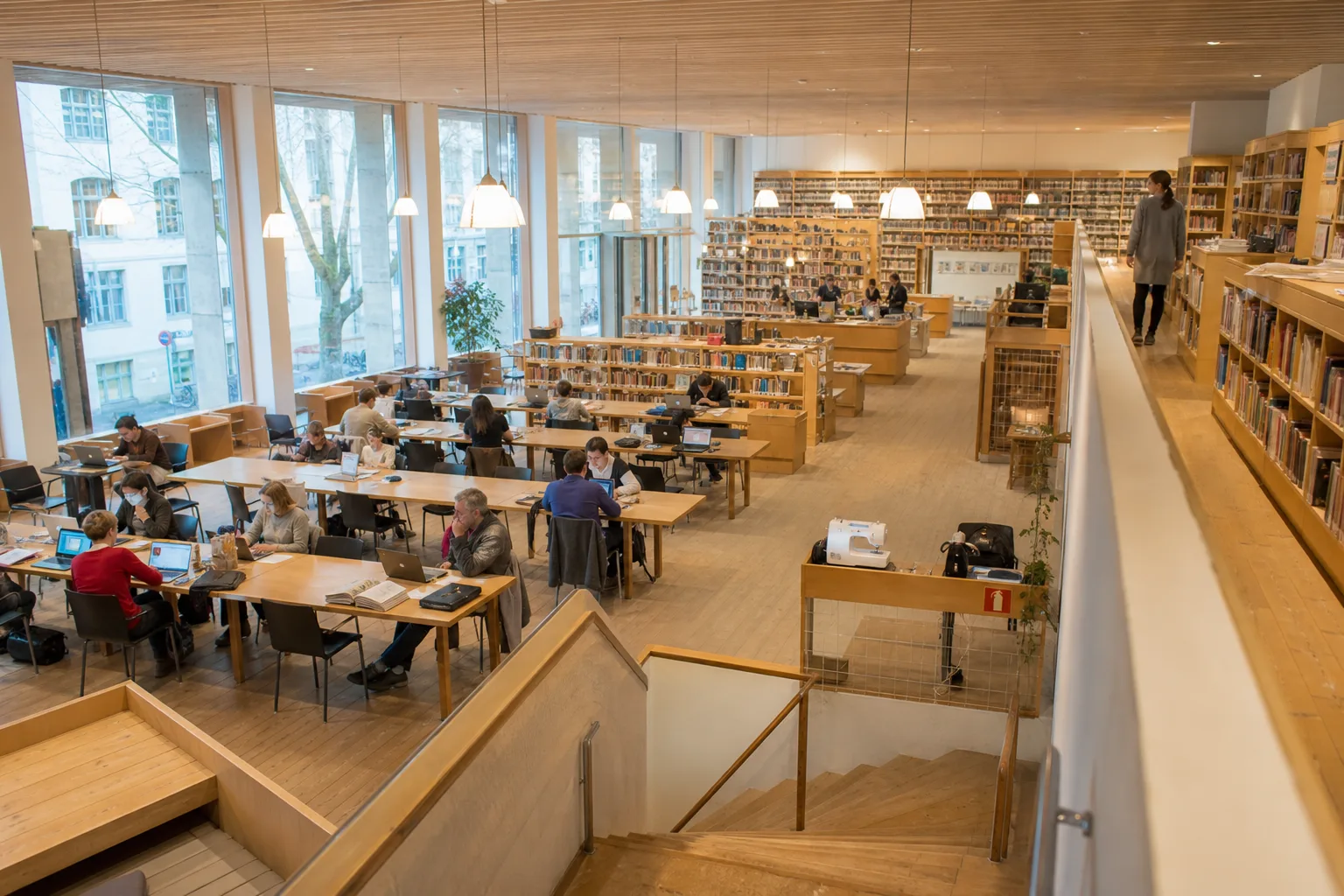
Walk into Oodi — Helsinki’s central library — on almost any weekday morning and you’ll see something that’s become genuinely rare in much of the Western world: a publicly funded space that people are visibly excited to enter. Katri Vänttinen, director of library services for the Finnish capital, describes watching visitors almost run through the doors at 8am. ‘I have tears in my eyes,’ she says. That’s not a line you hear often from a public-sector administrator. It’s a measure of just how differently Finnish public libraries have been conceived compared to the slow-declining institutions many of us in the UK or the US grew up with.
- Finnish public libraries lend far more than books — from sewing machines to podcast studios — and attract 9.1 visits per person per year.
- Finland spends €65.78 per person annually on Finnish public libraries, compared to roughly £10 per person in the UK.
- Under the Finnish Library Act, public libraries are legally required to promote democracy, freedom of expression and active citizenship.
- Cutting library services to save money can trigger a self-fulfilling decline in usage, according to University of Oulu researchers.
Table of Contents
Not Your Grandfather’s Library
Finnish public libraries have been quietly reinventing what a public institution can be. Oodi isn’t a building full of hushed stacks and a strict returns desk. By lunchtime on any given day, every floor is occupied: students working beside panoramic windows overlooking Finland’s parliament, parents in brightly coloured play areas with toddlers, a knitting circle where more experienced members help newcomers with techniques, a middle-aged man recording his first saxophone track in a soundproofed music pod. Outside, a teenage boy has just borrowed a basketball and headed to the court adjacent to the building.
That list of borrowed items is worth dwelling on. According to Vänttinen, the most borrowed ‘items’ in Helsinki’s libraries aren’t physical objects at all — they’re spaces. Free, pre-bookable rooms for meetings, study sessions, political discussions, music rehearsals. Among portable items, board games and console games top the list ahead of books. The lending catalogue across Finnish public libraries — more than 700 locations serving a population of just 5.6 million — includes podcast studios, 3D printers, tennis rackets and swimming pool passes.

This isn’t quirky Scandinavian novelty. Vänttinen traces it directly to Finland’s rural history, when farming communities routinely shared expensive machinery rather than each household buying its own. ‘Today, many people in cities live in small homes, and they might need a sewing machine only once a year,’ she says. ‘So why buy one? People prefer not to spend their own money when they can access a sewing machine for free, funded through their taxes.’ That pragmatic logic has scaled into a national philosophy of public access.
Finnish Public Libraries by the Numbers
The statistics that emerge from Finland’s approach are hard to argue with. The country’s Ministry of Culture and Education reports that Finns use their libraries an average of 9.1 times a year. A government report found that 55% of Finns visit at least once a month. Compare that to the UK, where data analysis puts average visits at around 2.5 per person per year, or the US at 2.4. The EU average sits at roughly 3.5. Finnish public libraries aren’t just ahead of comparable institutions — they’re operating in a different category entirely.
Spending reflects the priority. In 2025, Finland allocated nearly €371 million — approximately $430 million or £321 million — to its public library system. That works out to €65.78 per person. The UK spends roughly £10 per person. The US spends about $45 per person across a total public library budget of $15.2 billion. These aren’t marginal differences. Finland is spending six times more per capita than the UK on a service the UK has been systematically cutting for a decade.

600 Kilometres North: Oulu’s Saari Library
Six hundred kilometres north of Helsinki, in the city of Oulu, the recently refurbished central library Saari tells the same story at a different latitude. Library clerk Chris Stephenson — who spent 20 years working in UK libraries before moving to Finland — describes the scene while loading a microfilm reader for a visitor: a newly retired teacher printing sheet music for his choir, a young man booking a sewing machine slot to hem his jeans, a schoolgirl using a heat press to make a custom T-shirt for a friend’s birthday, a 3D printer humming steadily in the background. A laser cutter sits ready nearby.

Stephenson’s perspective carries particular weight precisely because he’s seen both systems from the inside. ‘I saw many libraries closed down, and communities losing something important,’ he says. That loss is structural. Between 2008 and 2019, 766 public libraries closed across the United States. In the UK, between 2016 and 2023, more than 180 council-run libraries were either shut or handed to volunteer groups to manage — a model that, whatever its local merits, shifts the burden of maintaining public infrastructure onto unpaid community members. Finnish public libraries, by contrast, have continued to grow their offer and their audiences throughout the same period.
The Cutting Paradox
Noora Hirvonen, professor of information studies at the University of Oulu, has a precise diagnosis for what goes wrong when governments start treating libraries as a budget line to trim. ‘We first cut library opening hours and, as a result, library visits drop,’ she says. ‘This is then used as a reason for additional cuts or even closing the library.’ It’s a self-fulfilling cycle — reduced access produces the underuse that then justifies further reduction.
Hirvonen’s argument cuts through a lot of the lazy policy thinking that surrounds public services. Low usage isn’t automatically evidence that a service has no value. It might mean people can’t access it, don’t know about it, or have been slowly conditioned to expect less from it. ‘Usage is not only reflective of the value of the service,’ she says. ‘It’s shaped by things like visibility and availability.’ That’s a framework that applies well beyond libraries — to public transport, health clinics, civic spaces. Finland’s response to low usage is to ask why, and invest in fixing the cause. The UK and US response has often been to cut. Finnish public libraries demonstrate what sustained investment in the answer looks like.

Finnish Public Libraries as Democratic Infrastructure
Here’s where the Finnish model gets genuinely interesting for anyone thinking about the long-term health of democratic societies. Hirvonen describes Finnish public libraries not just as community amenities but as democratic infrastructure — places where professors, unemployed people, and the homeless use the same spaces, access the same resources, and participate in the same public life. ‘They’re places where anyone can access knowledge, meet others and take part in public debate, regardless of income or background,’ she says.
This isn’t a vague aspiration. It’s codified in Finnish law. Under the Finnish Library Act, public libraries carry an explicit mandate to promote democracy, freedom of expression and active citizenship. Several other Nordic countries have comparable legislation. This legal grounding matters because it insulates libraries from purely utilitarian funding arguments. You can’t simply defund a democratic institution when visit numbers dip — not without confronting the law and the values it encodes.
Research emerging from Finland, as well as Norway, Sweden, Denmark and Canada, is building a body of evidence that Finnish public libraries play a meaningful role in social inclusion and civic participation. It’s an argument that reframes the entire question of what a library is for. The metric isn’t books lent per year. It’s the teenager who borrows a basketball, the elderly woman who runs an informal Finnish language class for immigrants, the young man who shortens his jeans on a public sewing machine rather than throwing them out. Each of those interactions represents a person who found something they needed in a public space that cost them nothing directly.
What the Rest of the World Could Learn
It would be too easy to read this as a story about how Finland is exceptional and therefore its model is untransferable. That’s the kind of thinking that has kept the UK and the US closing libraries while Finland opens them. The underlying logic of Finnish public libraries isn’t culturally specific — it’s about what happens when you treat public institutions as platforms for community life rather than warehouses for one category of content.
The practical gap, of course, is money and political will. At six times the UK’s per-capita spend, Finland’s investment level isn’t something any austerity-era council can replicate overnight. But the strategic choices — expanding what libraries lend, keeping them open longer, building them as genuine community hubs rather than book storage facilities — don’t all require six-fold budget increases. Some of them just require a different question: not ‘how do we justify this expense?’ but ‘what happens to the communities that lose it?’
Hirvonen and her colleagues are building the research base to answer that question with data. As that evidence accumulates, the real story of Finnish public libraries may end up being less about sewing machines and saxophone pods, and more about a model of public investment that treats civic participation as something worth funding directly — and measures the results in how well societies hold together, not just how many books move off shelves.
Frequently Asked Questions
What can you borrow from Finnish public libraries besides books?
Finnish public libraries lend items including sewing machines, 3D printers, tennis rackets, board games, console games and swimming pool passes. You can also book free rooms for meetings, music, political discussions or study. Libraries also offer facilities such as podcast studios and spaces for community activities.
How often do Finns use their public libraries compared to other countries?
Finns visit their libraries an average of 9.1 times per year, according to Finland’s Ministry of Culture and Education. That compares to roughly 2.5 visits per person annually in the UK and 2.4 in the US — making Finnish library use nearly four times higher than in either country.
Why do Finnish public libraries have a legal obligation to promote democracy?
Under the Finnish Library Act, public libraries must actively promote democracy, freedom of expression and active citizenship. The thinking is that shared public spaces where anyone — regardless of income or background — can access knowledge and join public debate are foundational to how democratic societies work.
Why have so many UK and US libraries closed in recent years?
Between 2008 and 2019, 766 public libraries closed in the United States. In the UK, more than 180 council-run libraries closed or transferred to volunteer management between 2016 and 2023. Researchers argue this often creates a cycle: cuts reduce opening hours, visits drop, and that decline is then used to justify further cuts.