
The US Senate has voted overwhelmingly to install a CBDC ban into federal law — and in a move that says a lot about how Washington actually works, it got there by hitching a ride on a housing bill. The 85-5 vote to pass the 21st Century Road to Housing Act this week wasn’t really about digital currency at all. But the anti-CBDC clause buried inside it could end up being one of the more consequential pieces of crypto-adjacent legislation the US has passed in years.
- The US Senate passed a CBDC ban through 2030 with an overwhelming 85-5 vote alongside major housing legislation.
- The CBDC ban prevents the Federal Reserve from issuing or developing any central bank digital currency until at least 2030.
- Even after 2030, the Fed would need explicit congressional approval before moving forward with any digital currency.
- Stablecoins that are open, permissionless, and private are carved out from the ban, signalling continued crypto flexibility.
Table of Contents
What the CBDC Ban Actually Says
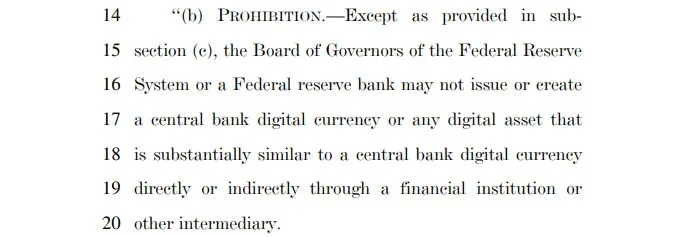
The language in the bill is fairly direct. Under the new provision, the Federal Reserve may not, directly or indirectly, ‘issue or create a central bank digital currency or any digital asset that is substantially similar to a central bank digital currency’ — and that restriction runs until 2030. But here’s where it gets more interesting: even once the clock runs out on the ban, the Fed doesn’t automatically get the green light. Any move toward a CBDC after 2030 would still require explicit authorisation from Congress. That’s a meaningful constraint, not just a five-year timeout.
The bill also draws a clear line around stablecoins. Dollar-denominated currencies that are open, permissionless, and private are carved out entirely from the ban’s scope. That’s a deliberate signal — Washington isn’t trying to kill private digital dollar products, it’s specifically trying to keep the central bank out of the retail payments lane.
How a CBDC Ban Ended Up in a Housing Bill
The political mechanics here are worth understanding. A bipartisan group of House and Senate leaders struck a deal last week to push the housing affordability legislation forward quickly — the US housing supply crisis has been a persistent headache across administrations, and there’s genuine appetite on both sides to do something about it. The CBDC ban, which the Senate had already included when it first passed a version of the bill back in March, became the sweetener that brought House Republicans and the Trump administration fully on board.
That’s classic legislative bundling — attaching a high-priority ideological win to a broadly popular bill in order to smooth its path. Republicans have spent years pushing to block any Federal Reserve digital currency project, and this gave them a concrete, durable result without needing to move a standalone bill through a fractious Congress. Whether you think that’s savvy dealmaking or a sign of how dysfunctional the legislative process has become probably depends on which side of the CBDC ban debate you sit on.

Why Crypto Advocates Have Long Pushed for a CBDC Ban
The crypto industry‘s hostility toward central bank digital currencies isn’t new, and it isn’t hard to understand. The core concern is control. A CBDC issued by the Federal Reserve would give the government real-time visibility into transactions, programmable spending restrictions, and the ability to freeze or withhold funds in ways that cash simply doesn’t allow. For an industry built around the idea of permissionless, censorship-resistant money, that’s an existential threat — or at least a deeply uncomfortable precedent. Proponents of a CBDC ban argue this alone justifies the restriction.
Critics of that position argue that a well-designed CBDC could actually improve financial inclusion, reduce payment friction, and modernise a dollar infrastructure that’s frankly showing its age. The debate is real, and neither side is entirely wrong. But in the current US political climate, the anti-CBDC argument has had significantly more traction — particularly among Republican lawmakers who’ve framed Federal Reserve digital currency as a surveillance tool and a step toward authoritarian monetary control.
CBDC Ban Comes as Global Rivals Accelerate
Here’s the tension the US now has to sit with: while Washington is locking down the Federal Reserve’s ability to experiment with digital currency, much of the rest of the world is moving in the opposite direction. According to the Atlantic Council’s CBDC Tracker, three countries have already officially launched a central bank digital currency, 41 are in active pilot phases, 33 are in development, and 40 more are still in the research stage. That’s a lot of global momentum to be sitting out — and it sharpens the stakes of the US CBDC ban considerably.
China is the most pointed example. Reuters reported in June that Beijing signed up 26 financial institutions to its digital yuan — known as the e-CNY — cross-border payment platform. That’s not a research project anymore. China’s digital currency push is increasingly about internationalising the yuan, reducing dependence on dollar-dominated payment rails like SWIFT, and building an alternative financial infrastructure that operates on Beijing’s terms. The US shutting down Fed experimentation doesn’t stop that clock from ticking.

Defenders of the ban would say that the US doesn’t need a government-issued retail CBDC when it has a thriving private dollar stablecoin ecosystem — Tether and Circle’s USDC already do enormous cross-border volume — and that the risks of handing the Fed that kind of payment surveillance power outweigh the geopolitical upside. It’s a coherent argument. But it also assumes private stablecoins are an adequate substitute for state-level infrastructure decisions, which is a bet that might look very different in ten years’ time.
What Comes Next
The bill now moves to the House, where passage looks likely given the deal already in place between House and Senate leadership. Once it clears the House, it heads to the president’s desk. The administration has been supportive of the crypto-friendly direction of the legislation, so a presidential signature appears to be a formality at this point.

South Carolina has already passed its own state-level bill protecting Bitcoin miners and banning CBDC implementation at the state level — so the federal CBDC ban would be adding federal weight to a restriction that’s already starting to emerge in patchwork form across different jurisdictions. The cumulative effect is a US posture that’s increasingly clear: private crypto, yes; central bank digital dollar, not yet — and possibly not for a long time after 2030 either, given that even post-ban action requires an act of Congress. Whether that posture ages well depends enormously on how the global digital currency landscape looks half a decade from now, and how aggressively China and other CBDC-forward nations reshape international payment systems in the meantime.