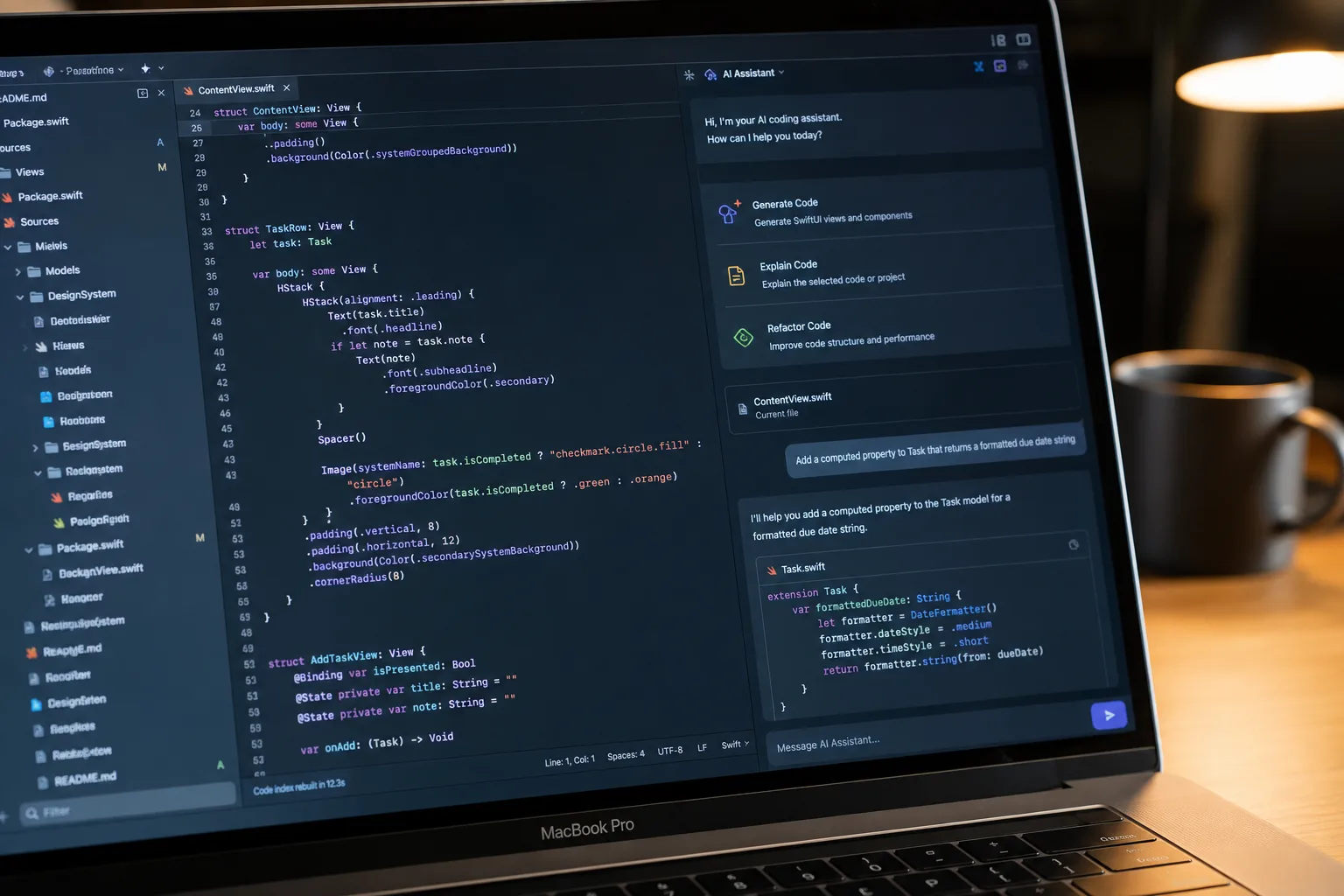
Apple has quietly made a meaningful move in the AI developer-tools race. With the release of Xcode 26.6, the company has officially added Xcode Gemini support to its integrated development environment — bringing Google’s flagship AI model into the IDE alongside the two providers that were already there. For the millions of developers building apps across Apple’s platforms, that means a real choice of AI assistant for the first time.
- Xcode Gemini support officially arrives in the stable Xcode 26.6 release, giving all developers access to Google’s AI model.
- Xcode now offers three AI coding assistants: Google Gemini, Anthropic Claude Agent, and OpenAI Codex.
- The update also enables third-party AI agents via the Agent Client Protocol, opening the IDE to a broader AI ecosystem.
- Xcode 26.6 ships with Swift 6.3.3 and SDKs covering iOS, iPadOS, tvOS, watchOS, visionOS, and macOS 26.5.
Table of Contents
What’s Actually New in Xcode 26.6
On the surface, this looks like a routine point release. It ships with Swift 6.3.3 and updated SDKs for iOS 26.5, iPadOS 26.5, tvOS 26.5, watchOS 26.5, visionOS 26.5, and macOS 26.5 — all fairly expected maintenance work. But the headline feature is the coding assistant expansion. Xcode Gemini support joins Anthropic’s Claude Agent and OpenAI’s Codex, which were already available in earlier versions. Now there are three distinct AI providers sitting inside the same IDE, each with its own strengths and pricing models outside of Apple’s ecosystem.
There’s also something easy to overlook in the release notes: support for the Agent Client Protocol. This open standard lets compatible third-party AI agents plug into Xcode’s coding assistant beyond the three named providers. That’s potentially a bigger deal than Xcode Gemini support itself — it means Apple isn’t trying to lock developers into a curated shortlist of models. It’s building a more open interface, and other AI companies will almost certainly take notice.
Why Xcode Gemini Support Matters Beyond the Obvious
It’d be easy to read this as Apple simply keeping pace — adding Gemini because Claude and Codex were already there, and leaving Google out would’ve looked like a deliberate snub. But the timing and architecture tell a more interesting story. Xcode Gemini support didn’t materialise overnight. Beta users running Xcode 27 had access to Gemini from June 10, roughly two weeks before today’s stable release. Apple was clearly stress-testing the integration before committing it to the general developer population.
That matters because the competitive landscape for AI coding tools has shifted dramatically in the past 18 months. GitHub Copilot — powered by OpenAI — has dominated the category since its launch, but it’s no longer the only serious option. Cursor, a Copilot alternative built on top of VS Code, has attracted a large following by letting developers switch between Claude, GPT-4o, and Gemini on the fly. JetBrains has its own AI assistant. Even the open-source community has rallied around tools like Continue, which supports virtually any model you can self-host.
Apple’s answer to all of this is to bake multi-model support directly into Xcode itself — no third-party IDE required, no subscription to a separate tool. For developers who are already living inside Apple’s ecosystem, that’s a compelling proposition. Why pay for Cursor if Xcode Gemini support lets you query Google’s model natively?
The Three-Model Line-Up: Claude, Codex, and Now Gemini
Each of the three providers brings something different to Xcode Gemini support and the broader coding assistant feature. Anthropic’s Claude Agent has built a strong reputation for reasoning through complex, multi-step problems — the kind of architectural questions that go beyond autocomplete. OpenAI’s Codex, while not the same product as the original Codex model that powered Copilot’s early days, remains deeply trained on code and is particularly fluent in Swift and Objective-C. Google’s Gemini, meanwhile, brings the weight of Google DeepMind’s research behind it, and its long-context window — Gemini 1.5 Pro supports up to one million tokens — makes it genuinely useful for reasoning across large codebases.
The practical question is which one developers will actually reach for. That’s not something Apple can dictate, and it’s not something that will be settled quickly. Different teams will have different preferences, and those preferences will likely be shaped as much by API costs and existing enterprise agreements as by raw capability. A team already paying for Google Cloud services might find Xcode Gemini support the natural default. A startup that’s built its infrastructure around Anthropic might stick with Claude. That’s the whole point of offering a choice.
What the Agent Client Protocol Really Signals
The Agent Client Protocol inclusion is where Apple’s strategy gets more transparent. By supporting an open protocol for AI agents, Apple is effectively future-proofing Xcode’s coding assistant against a landscape it can’t fully predict. New models are arriving constantly — Meta’s Llama family, Mistral, Cohere, and a dozen smaller players are all competitive in specific coding contexts. Locking Xcode into three named providers would’ve felt dated within 12 months.
Instead, any AI provider that implements the protocol can, in theory, plug into Xcode. That’s a smart hedge. It also positions Apple less as an AI gatekeeper and more as an infrastructure layer — a role that suits the company better than trying to maintain direct relationships with every model provider. Microsoft has played a similar game with VS Code’s extension ecosystem, and it’s worked out well for them. Apple appears to be learning from that playbook.
What Comes Next
Xcode 27, currently in beta, already has Xcode Gemini support — which means beta users are essentially previewing whatever comes next in the coding assistant roadmap. Apple hasn’t announced specific plans, but the pattern is clear: the company is treating AI coding assistance as a first-class feature, not an afterthought or a partnership footnote buried in a press release.
The real test will be how deeply integrated Xcode Gemini support becomes with Xcode’s existing capabilities — things like the build system, Instruments, and the Simulator. Right now, the coding assistant is essentially a smart code-writing tool inside the editor. If Apple starts wiring it into debugging workflows, performance analysis, or automated testing, that’s when the competitive gap with VS Code-based tools could close in a meaningful way. That’s the version of Xcode that would genuinely change how Apple developers write software — and based on the pace of recent releases, it doesn’t feel particularly far off.