The iPhone Ultra, if Apple actually ships it as the long-rumored foldable iPhone, will draw a crowd on day one. That much is obvious. Millions of people who have spent years inside iMessage, iCloud Photos, AirPods, Apple Watch, and Mac continuity features have been waiting for a foldable they can buy without abandoning the platform. But the assumption that Apple will stroll in and flatten Samsung’s Galaxy Z Fold business feels lazy.
Samsung has spent years learning the unpleasant parts of foldable phones: hinges, fragile displays, dust, creases, awkward aspect ratios, camera compromises, and software that must behave differently on two screens. It has made mistakes in public, including the original Galaxy Fold’s notorious early durability problems. That was embarrassing, but it also bought Samsung something Apple cannot purchase overnight: practice.
- The iPhone Ultra would arrive with Apple’s ecosystem advantage, but Samsung has years of hard-won experience building book-style foldables.
- For the iPhone Ultra, credible multitasking and reliable app behavior on a larger inner display may matter more than premium industrial design.
- Samsung’s taskbar, flexible windows, and app continuity make the Galaxy Z Fold 8 a more mature work tool today.
- A rumored price above $2,200 could give buyers outside Apple’s ecosystem a practical reason to choose Samsung’s $1,900 foldable.
Table of Contents
Why the iPhone Ultra has a tougher job than it appears
The basic appeal of a book-style foldable is easy to grasp. Closed, it is a phone. Open, it becomes a small tablet that fits in a jacket pocket. The harder question is why anyone should pay nearly two grand for that trick once the novelty wears off.
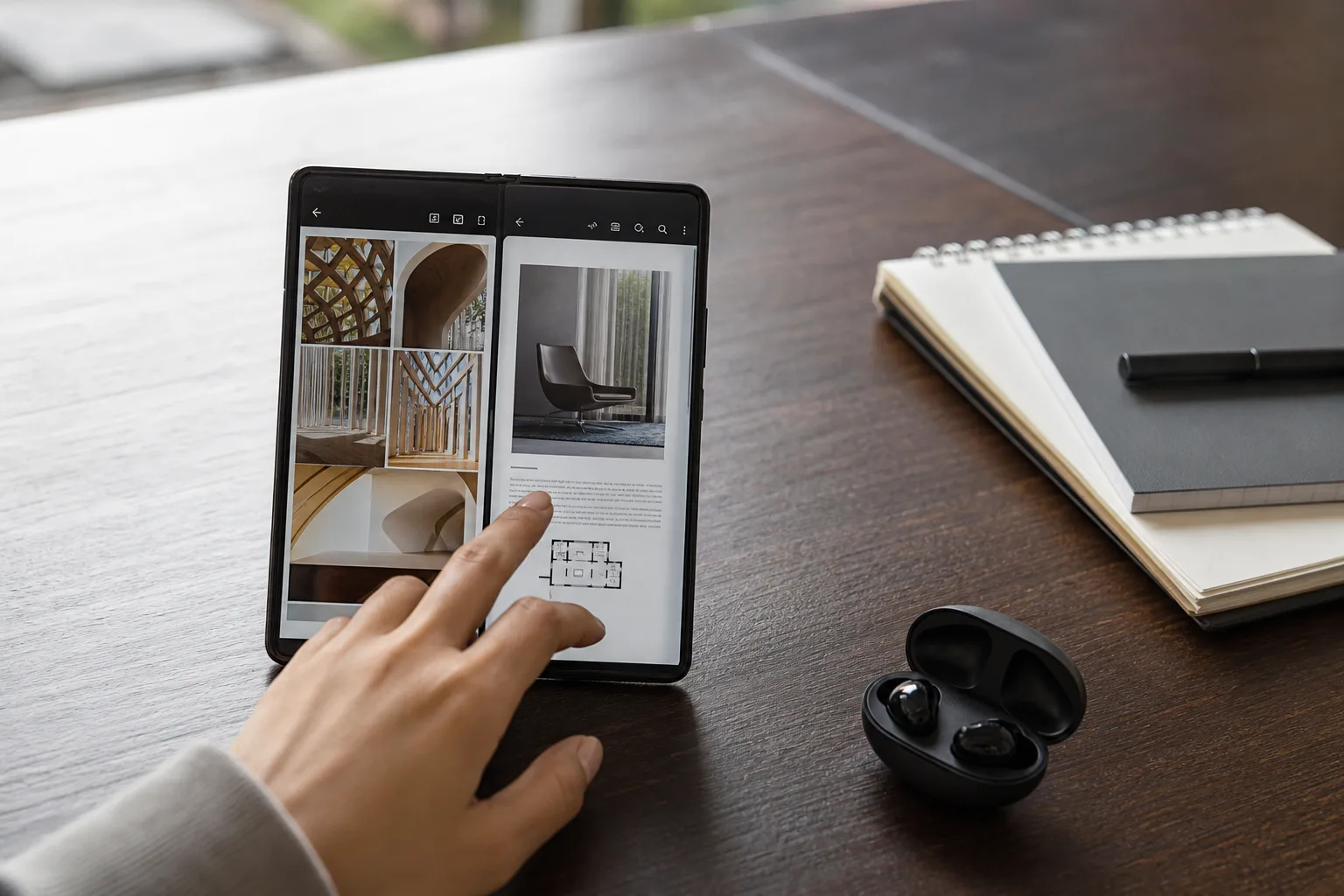
Samsung’s answer has increasingly been productivity. On the Galaxy Z Fold 8, that means a taskbar, persistent app pairs, resizable windows, and the ability to run multiple apps in arrangements that suit the job. Need Slack as a narrow column while reviewing a document and keeping a browser open? Android will let you make that messy little desk of a layout. Frankly, that freedom is the point.
The iPhone Ultra needs an answer just as convincing, and Apple’s current software leaves a real question mark. iPadOS offers Split View-style workflows and window management options, while iOS on the iPhone remains far more rigid. Apple can point to its tablet experience, of course, but moving that approach onto a device that flips between a narrow outer screen and a broad inner panel is not a copy-and-paste job.
Apple’s instinct has often been to limit choice when it believes choice creates confusion. Sometimes that restraint works brilliantly. The original iPhone did not ask users to manage files or endlessly rearrange system settings, and that simplicity helped define the category. But a foldable is not a normal phone. If the iPhone Ultra opens into a larger canvas yet treats it mainly as a bigger place for one app at a time, Apple will have built an expensive media viewer, not a credible work device.
Samsung’s lead is mostly software, not spectacle
Foldable hardware gets the glamorous coverage because everyone can see a hinge. The more durable advantage is what happens after you open the device for the 500th time. Samsung has made that daily experience fairly coherent: apps can continue from the cover display to the inner display, the taskbar keeps frequently used apps within reach, and multitasking can be saved for later rather than rebuilt every time.
That does not mean every Android app is perfect on a foldable. Far from it. Some still look like stretched phone apps wearing an oversized shirt. Samsung and Google have developed tools to make unsupported software fill more of the display, but forced layouts are a workaround, not magic. Still, Android developers have had years to encounter tablets, Chromebooks, Fold devices, and large-screen layouts. That institutional muscle matters.
The iPhone Ultra could benefit from a healthier baseline of iOS app quality, and Apple’s developer rules give it unusually tight control over presentation. Yet the company will have to persuade developers to think beyond the familiar iPhone rectangle. A beautiful inner display means little if an app stubbornly sits in the middle with oceans of unused space around it. Apple has solved developer transitions before, from Retina displays to new screen sizes and Apple silicon. This one may be trickier because it asks developers to support two dramatically different shapes in one device.
Then there is the hinge itself. Samsung’s engineering has steadily improved across generations, though foldables still ask buyers to accept more moving parts and more care than a conventional slab phone. Apple has a deserved reputation for excellent industrial design, and it will not be entering this market as a clueless newcomer. But reliable foldable hardware is closer to building a good suitcase zipper than designing a pretty glass rectangle: it has to work every single day, under pressure, with lint and grit determined to ruin the party.
The iPhone Ultra price could hand Samsung an opening
Price will be more than a footnote. The Galaxy Z Fold 8 is already a premium purchase at around $1,900. Apple has not confirmed the iPhone Ultra, much less its price, but a first-generation foldable from Cupertino landing above $2,200 would surprise nobody. Apple rarely competes by being the affordable alternative, and hinges, specialized displays, and low initial production volumes are not ingredients for a bargain.
That gap would matter most for buyers who are not deeply tied to iOS. Someone choosing between two expensive foldables may reasonably ask whether Apple’s first attempt is worth several hundred dollars more than Samsung’s eighth-generation effort. Carrier promotions can blur the sticker price, yes, but they do not erase it. A $300 difference is a year of cloud storage, a smartwatch, or a lot of coffee.
Samsung also has a practical advantage that rarely makes a keynote slide: it knows how to sell and service foldables at scale. Retail staff understand the pitch. Cases, screen protectors, trade-in programs, and repair processes exist. None of that makes the Galaxy Z Fold 8 sexy, but it makes ownership less intimidating. The iPhone Ultra will have Apple Stores and a formidable support network, but its first wave of buyers could still become unpaid beta testers for a new category inside Apple’s lineup. Remember when Google killed Stadia? Consumers have learned not to confuse a company’s size with a guarantee of long-term commitment.
Apple’s ecosystem is still a serious weapon
None of this means Samsung should get comfortable. Apple’s ecosystem is an enormous advantage, and calling it a walled garden understates the emotional pull. People do not casually leave shared photo libraries, family location sharing, iMessage groups, Apple Watch health history, purchased apps, and years of iCloud backups. The iPhone Ultra would give those users a way to try a new form factor without making a broader digital-life decision.
Apple’s design and marketing machinery will help, too. Samsung has made foldables normal enough that people recognize the category; Apple could make them feel culturally inevitable. That has happened before. The company was late to large phones, smartwatches, and wireless earbuds, then used polish and distribution to reshape the mainstream conversation. Being first is nice. Being the product everyone sees in a café six months later is better.
There is also an intriguing, if unproven, software angle. Apple has pitched Apple Intelligence as a more personal layer across its devices, even though its rollout has been uneven and often overpromised. A larger foldable screen could be a natural place for better contextual search, writing assistance, summaries, and information recall. If Apple can make those tools useful with a person’s own photos, messages, files, and calendar, the iPhone Ultra may have a compelling story that goes beyond bending glass.
My read is that the first Apple foldable will probably be polished, expensive, and wildly desirable to loyal iPhone owners. But desire is not the same thing as dominance. Samsung’s Galaxy Z Fold 8 has a meaningful head start where foldables either earn their price or fail: what you can actually do when the big screen is open. Apple has the audience. Samsung has the reps. The interesting question is whether Cupertino will embrace the controlled chaos that makes a foldable genuinely useful, or sand it down until it behaves like a very costly iPhone with a crease.
Frequently Asked Questions
When could the iPhone Ultra launch?
The source describes the iPhone Ultra as upcoming and rumored, but does not provide a launch date.
Why would iPhone Ultra multitasking matter?
A book-style foldable needs to make productive use of its tablet-sized inner display. Watching video is pleasant, but premium-priced devices also need strong multitasking features such as split views and windowed apps.
Is the Galaxy Z Fold 8 cheaper than a rumored Apple foldable?
The Galaxy Z Fold 8 costs $1,900 in the source comparison. The source speculates that an iPhone Ultra could cost more than $2,200, which would make the Galaxy the less expensive option.