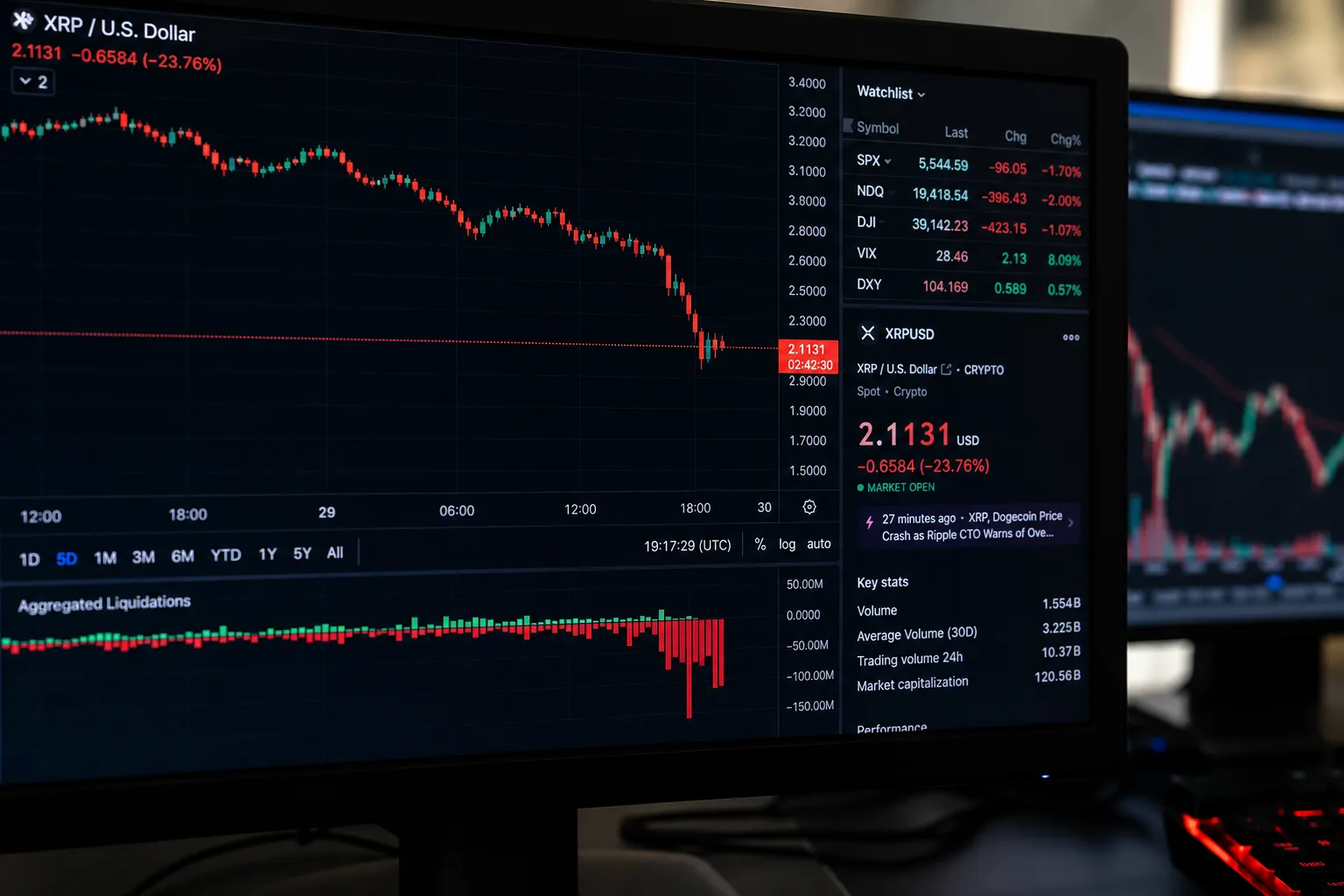
XRP capitulation is no longer a fringe concern whispered in bear-market forums — it’s now measurable, accelerating, and tracking at levels not seen since the brutal crypto winter of 2022. With XRP touching $1.02 on Friday, its weakest price since February, the token is approaching a line that most traders would rather not test.
- XRP capitulation is occurring at its fastest rate since August 2022, with the profit-to-loss ratio falling to just 0.33.
- XRP capitulation has coincided with $9 million in long liquidations in a single day, the largest daily loss since February 5.
- Total XRP futures volume has collapsed by more than 90% compared to the same period last year, signalling fading speculative interest.
- The $1 price level is now a critical line — losing it with weak spot demand could leave the token without meaningful support.
Table of Contents
XRP Capitulation: How Bad Is It, Really?
The clearest signal of how far sentiment has deteriorated comes from Glassnode’s on-chain data. XRP’s 90-day moving average profit-to-loss ratio has dropped to 0.33 — the lowest reading since August 2022. To put that in plain English: for every single unit of profit being realised on-chain, investors are booking roughly three units of losses. That’s not a market in correction mode. That’s a market where holders are capitulating.
A ratio above 1.0 means profitable transactions dominate. Below 1.0, and loss-taking outweighs gains. At 0.33, the imbalance is stark. The last time XRP saw numbers like this was during the depths of the post-Terra/LUNA implosion, when crypto markets were in freefall and retail confidence had largely evaporated. The fact that we’re back here — despite XRP’s strong performance in late 2024 and early 2025 — says a great deal about how quickly the tide has turned.
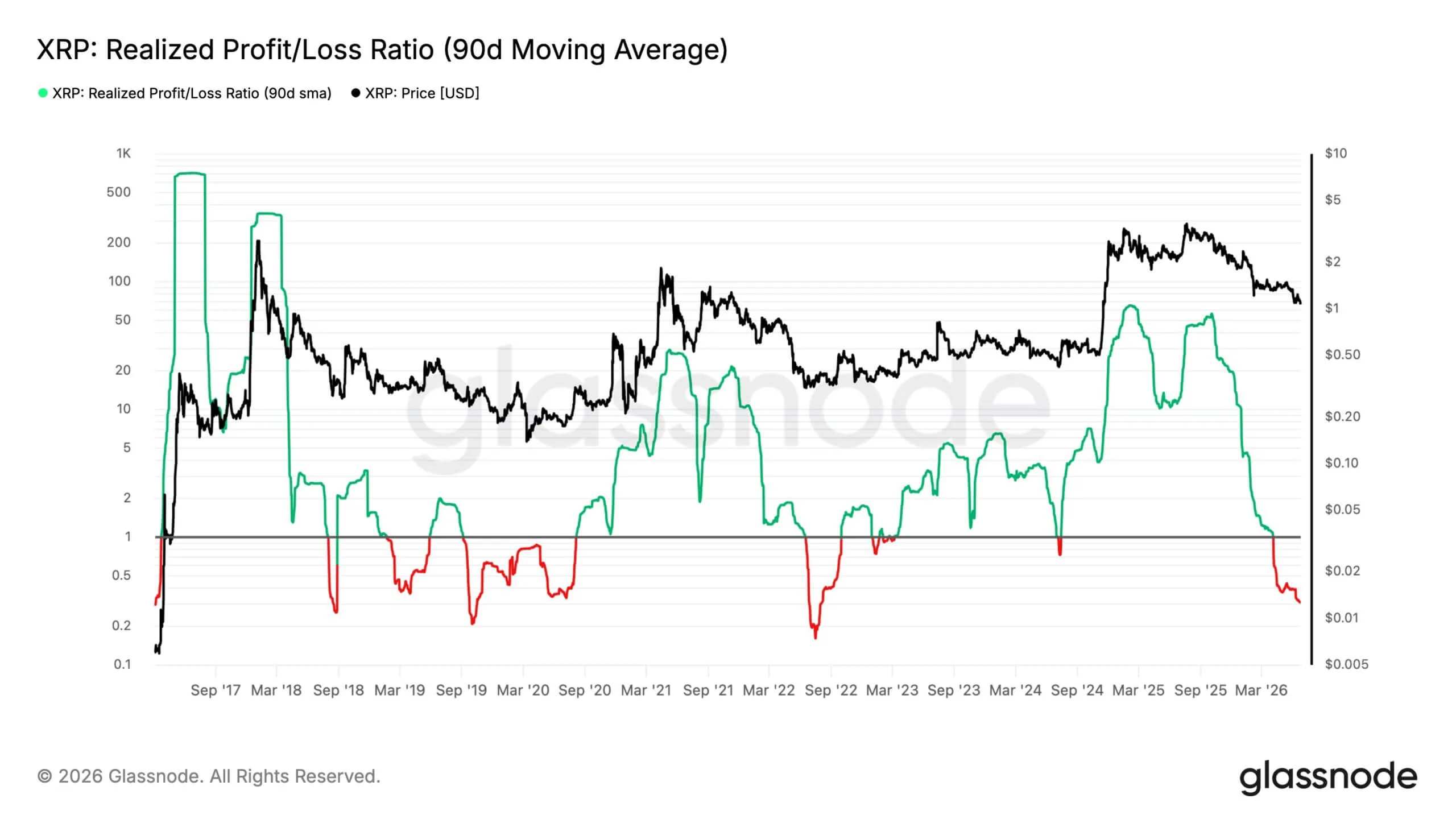
What makes this XRP capitulation particularly uncomfortable for bulls is the feedback loop it creates. As prices fall, more of the token’s circulating supply slips into unrealised loss. Holders who bought at $2, $2.50, or higher are sitting on paper losses, and the temptation to sell into any brief recovery — just to get out close to breakeven — becomes overwhelming. Every attempted rebound risks being smothered by this overhang of underwater holders looking for the exit.
Liquidations Pile On as Leveraged Traders Get Flushed Out
The selling hasn’t been limited to long-term holders either. The leveraged trading community has taken a beating. When XRP dropped toward $1.07 on Wednesday, it triggered roughly $9 million in long liquidations in a single day, according to CryptoQuant — the largest daily wipeout for bullish leveraged traders since February 5th. Binance alone accounted for around $4.5 million of those closed positions.
Long liquidations work like a doom loop in reverse. Falling prices erode the collateral backing leveraged long positions. Once collateral drops below a required threshold, exchanges automatically close the trade, generating fresh sell orders into an already weakening market. When large numbers of positions cluster around similar price levels — as they often do — the cascade can be swift and brutal. This dynamic intensifies XRP capitulation pressure, turning a steady decline into an accelerated flush.
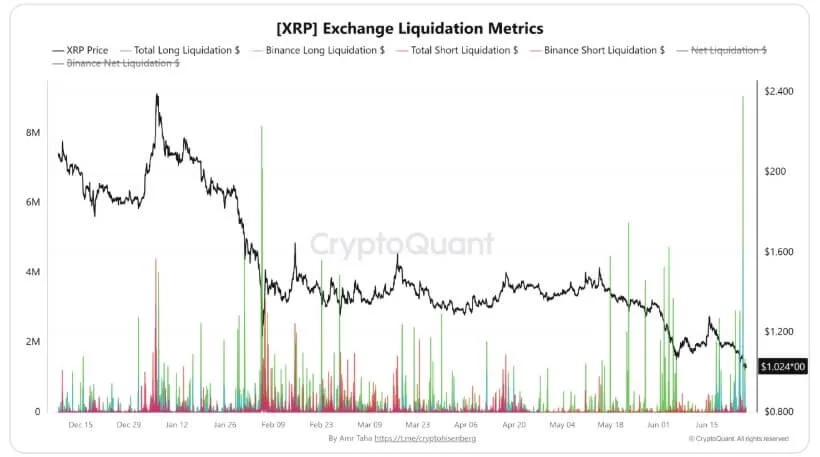
The aftermath of those liquidations is visible in open interest data across the major exchanges. Binance’s XRP open interest fell to approximately $205 million — its lowest since March 22 — while Bybit’s pulled back to around $185 million, a level last seen in early June. The fact that both platforms saw parallel declines rules out exchange-specific explanations. Traders were broadly pulling back from XRP derivatives exposure across the board.
Across all tracked venues, total XRP open interest has settled at around $2.34 billion. Meanwhile, futures turnover has collapsed in a way that’s harder to spin positively: volume has fallen to roughly $2.84 billion, down from more than $30 billion during the comparable window last year. That’s a drop of over 90%. Whatever speculative frenzy propelled XRP to its highs in early 2025 has largely unwound.
What the Shrinking Derivatives Market Actually Tells Us
Open interest and trading volume measure different things, but the fact that both are weak simultaneously tells a coherent story. Open interest reflects how many contracts are still live — how much capital is committed to active positions. Volume reflects how much money is actively moving through the market on a given day. When both shrink together, it means fewer traders are holding positions and fewer still are placing new ones.
There’s a glass-half-full interpretation here: a leaner derivatives market means fewer ticking time bombs in the form of leveraged positions waiting to blow up. A market with less speculative froth is theoretically more stable. But there’s an equally valid pessimistic reading — this level of disengagement suggests traders have stopped believing in a near-term recovery. Capital doesn’t sit on the sidelines out of caution when it sees opportunity. It sits there when it doesn’t. In that sense, the shrinking derivatives market is itself a symptom of XRP capitulation spreading beyond spot holders into the professional trading community.
XRP Capitulation and the Risk-Adjusted Reality
Even for traders who’ve stayed in the game, the numbers aren’t encouraging. CryptoQuant’s risk-adjusted trend indicator for XRP on Binance shows a 30-day Sharpe ratio of minus 0.29. The Sharpe ratio measures returns relative to the volatility required to achieve them — a negative figure means traders are absorbing significant price swings without receiving compensatory gains. In the current environment, XRP is producing losses while still demanding that traders stomach crypto-level volatility. That’s a tough sell.
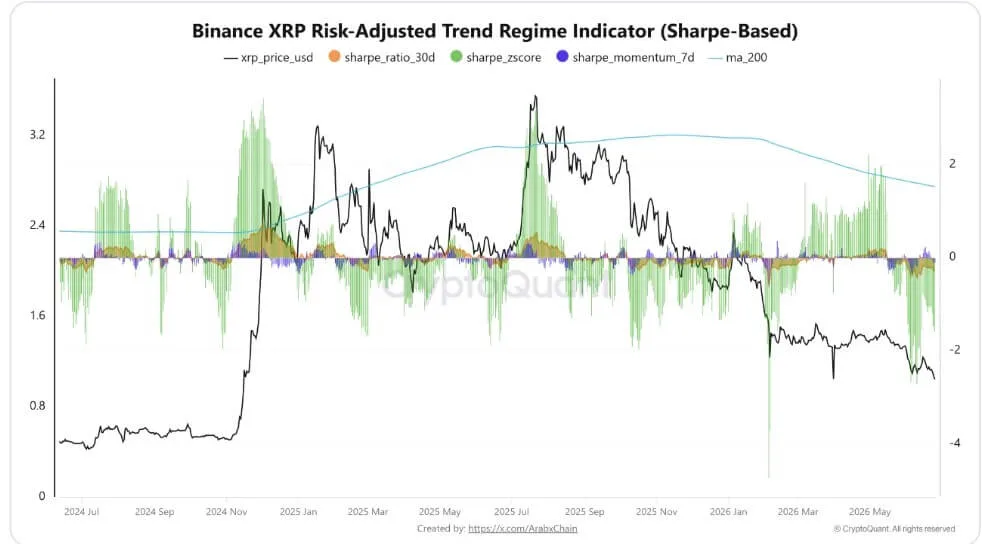
Risk-adjusted metrics matter because they shape institutional and semi-professional trader behaviour. When the Sharpe ratio turns negative, quant-driven funds and algorithmic strategies tend to reduce or eliminate exposure. That further reduces the pool of buyers available to absorb selling, compounding the original problem. For those monitoring XRP capitulation signals, a persistently negative Sharpe ratio is one of the clearest signs that professional capital has stepped away.
Can XRP Hold $1 — and Does Spot Demand Even Matter?
The $1 level isn’t just a round number. After months of price decline, it’s become a psychological anchor — the kind of support level that retail traders fixate on and that gets discussed across every XRP-focused forum, Discord, and Telegram channel. Losing it convincingly could trigger another wave of panic selling from holders who’ve been telling themselves they’d exit at $1 rather than below it. A break below that threshold would represent a new phase of XRP capitulation, potentially drawing in sellers who have so far held firm.
The real question isn’t whether XRP can technically bounce from $1 — it probably can, briefly. The question is whether there’s genuine spot demand to sustain any recovery. Futures-driven markets are inherently fragile because their buying pressure can evaporate in minutes when sentiment shifts. Durable recoveries are built on spot accumulation — investors actually buying and holding the underlying asset. Right now, the data doesn’t suggest that kind of conviction is present at scale.
XRP capitulation episodes, historically, can mark turning points. In mid-2022, the worst of the XRP capitulation eventually helped clear the market and set the stage for the 2023 recovery. But that process took longer than most investors expected, and it required improving macro conditions and a genuine catalyst to get buyers off the sidelines. Right now, with broader crypto sentiment fragile and regulatory clarity still patchy in key markets, XRP may need more than a washed-out derivatives market and a psychologically important price floor to turn the narrative around. Patience — and probably a catalyst — will be required.
Frequently Asked Questions
What does XRP capitulation mean for the token’s price recovery?
XRP capitulation describes holders selling at a loss after an extended decline. While this can help establish a price floor by moving tokens to buyers willing to hold, weak spot demand means rebounds may be short-lived. Investors who bought at higher prices may sell into any rally to cut further losses.
Why is the $1 level so important for XRP right now?
The $1 level has become a psychological and technical reference point after months of declining prices. If XRP breaks below it without strong spot buying to absorb selling pressure, the token could face an accelerated decline with little structural support beneath it.
How much have XRP futures volumes fallen?
XRP futures trading volume has dropped to roughly $2.84 billion, down from more than $30 billion during a comparable period last year — a decline of more than 90%. This reflects how dramatically speculative participation has dried up since XRP attracted heavier trading activity in 2025.
What does a negative Sharpe ratio mean for XRP traders?
A negative Sharpe ratio — currently minus 0.29 for XRP on Binance — means traders are not being adequately compensated for the volatility they’re taking on. In plain terms, the risk of holding XRP is outweighing any potential returns over the past 30 days.