With four months still to go before November, crypto election spending has already blown past its own record. The cryptocurrency industry has poured $189 million into the 2026 US election cycle — more than it spent during the entire 2024 cycle — and the tap is nowhere near being turned off. That’s according to a new report from Public Citizen, the Washington-based consumer advocacy nonprofit, released this week.
- Crypto election spending has reached $189M in the 2026 US cycle, already surpassing the $170M spent across all of 2024.
- Crypto election spending now accounts for roughly 37% of all corporate political contributions tracked so far this cycle.
- Fairshake PAC and MAGA Inc. are the two biggest spenders, deploying $82M and $56M respectively.
- Ripple-backed PACs have also been active in individual congressional primaries, with mixed results on the ground.
Table of Contents
$189 Million and Counting: The Scale of Crypto’s Political Bet
To put that figure in context: crypto election spending now accounts for roughly 37% of all corporate political contributions tracked in this cycle so far. That’s not a rounding error — that’s the industry functionally owning more than a third of the corporate money flowing into American politics right now. The total across all sectors, including big tech and gambling interests, sits at nearly $300 million combined.
The 2024 cycle was already a watershed moment for crypto election spending, with the industry deploying $170 million to back what it broadly described as ‘pro-crypto’ candidates for Congress. It worked — at least by the industry’s own scorecard. The new Congress arrived far more receptive to crypto-friendly legislation, and bills like the CLARITY Act are now moving through the Senate with real momentum. The industry has clearly decided to double down.
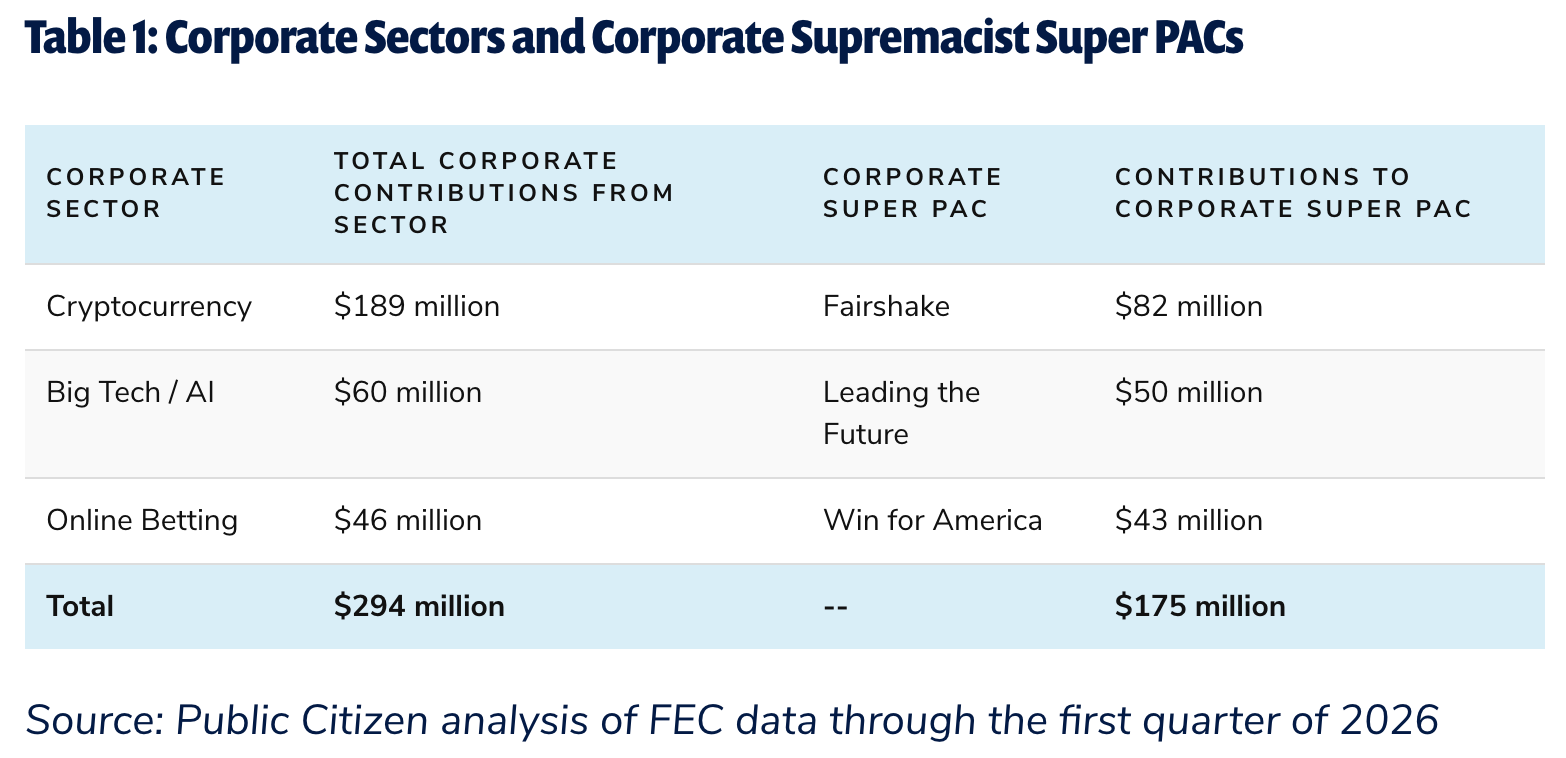
Two PACs dominate the spending picture. Fairshake — the crypto-aligned political action committee backed by Coinbase and Ripple — has spent more than $82 million so far. MAGA Inc., the super PAC largely bankrolled by Crypto.com, has deployed more than $56 million. Together that’s nearly $140 million from just two vehicles, and Fairshake alone reported a $193 million war chest as of January, meaning there’s plenty more ammunition loaded.
How These PACs Actually Operate — and Why That Matters
What makes this crypto election spending strategy genuinely unusual — and worth paying attention to beyond the dollar figures — is the deliberate bipartisan architecture behind it. Public Citizen’s report puts it plainly: these super PACs ‘prioritize the interests of their business backers over either major political party or any candidate.’ Fairshake and its affiliates Defend American Jobs and Protect Progress are explicitly designed to operate in both Democratic and Republican primaries, backing or attacking candidates regardless of party affiliation.
That’s a meaningful structural choice. Most large-scale political spending in the United States gravitates toward one side of the aisle. The crypto industry is playing a different game — one where ideological alignment is irrelevant and regulatory posture is everything. If a Democratic candidate in a swing district is willing to support clearer crypto regulation, Fairshake will spend for them. If a Republican incumbent is hostile to the industry, they’ll spend against. It’s transactional politics at industrial scale, and it’s precisely what makes crypto election spending so structurally distinct from conventional corporate PAC activity.
New entrants are also joining the ecosystem. The Fellowship PAC, backed by investment bank Cantor Fitzgerald, has emerged since 2024 as another entity aligning itself with crypto industry interests. Cantor Fitzgerald has been increasingly visible in digital asset markets — including its involvement in Bitcoin financial products — so its political spending arm fits a broader pattern of Wall Street-adjacent firms deciding that lobbying through PACs is just another line item in the cost of doing business in crypto.
Crypto Election Spending on the Ground: Colorado and New York
The macro numbers are one thing. The ground-level picture — where this crypto election spending is actually being deployed race by race — tells a more interesting story about whether the strategy is working.
Colorado voters headed to the polls this week in primaries for both parties, with the state’s competitive 8th congressional district drawing particular attention. The You Can Push Back Super PAC, backed by Ripple Labs co-founder Chris Larsen, spent $1 million on media supporting Democrat Manny Rutinel. That’s a significant investment for a single House primary — and it’s the latest move from a PAC that has been willing to place big, targeted bets.
The committee’s previous major play was a $3.3 million spend backing Democrat Alex Bores in New York’s 12th Congressional District. That bet didn’t pay off. Bores lost his primary last week to Micah Lasher, who had openly criticised Larsen’s involvement in the race. Lasher turned the outside crypto money into a campaign issue — and it resonated with enough voters to swing the result. That’s a notable datapoint for anyone tracking crypto election spending: PAC cash doesn’t automatically translate into wins, and in some districts, the association may actually be a liability.

The Broader Question: What Is All This Money Buying?
There’s a legitimate argument that the 2024 spending worked precisely because it was concentrated and strategic — the industry didn’t try to buy every race, it targeted specific seats where the margin was thin and the candidate’s position on crypto regulation was the deciding variable. The 2026 crypto election spending strategy appears similar, but at a larger scale and with more institutional infrastructure behind it.
The legislation on the table makes the stakes clear. The CLARITY Act, which would establish a framework for determining whether digital assets are securities or commodities, is the kind of bill the crypto industry has wanted for years. Senate leaders are pushing for a July passage. Having spent two consecutive election cycles reshaping the composition of Congress, the industry is now positioned to collect on that investment in the form of actual law.
Public Citizen’s framing — that these PACs serve their corporate backers above all else — is accurate as a description of how super PACs legally function, but it’s also somewhat obvious. All large-scale political spending serves the interests of whoever is writing the cheques. What distinguishes the crypto industry’s approach is the sophistication of the execution: the bipartisan architecture, the willingness to spend in primaries (not just general elections), and the speed with which it has scaled from a relatively marginal political player in 2020 to the dominant force in corporate political spending by 2026.
Whether voters in competitive districts ultimately embrace or reject candidates backed by crypto PAC money — as New York’s 12th district just demonstrated is entirely possible — will be one of the more interesting subplots to watch between now and November. The industry is betting that regulatory outcomes matter more to it than any individual election loss. With crypto election spending already at $189 million and months of campaigning still ahead, it’s a bet placed with considerable conviction.