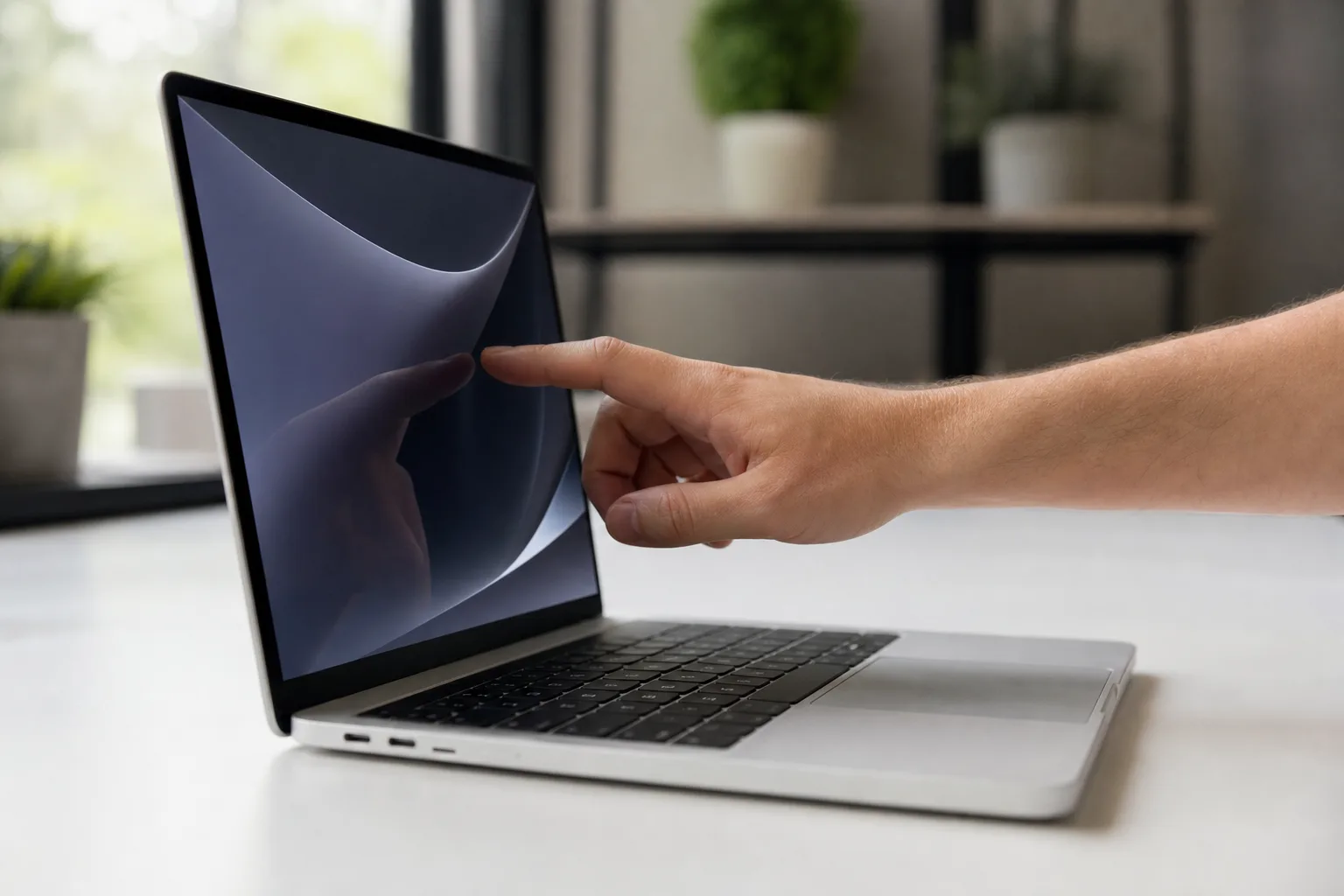
Apple’s long-rumoured touchscreen MacBook is finally starting to take shape — and it won’t be sitting around waiting for next-generation silicon to arrive. According to Bloomberg’s Mark Gurman, the first touch-enabled MacBook models will ship with M5 Pro and M5 Max chips, the same high-end silicon Apple introduced earlier this year. That means we could be looking at a late 2026 or early 2027 launch, and Apple isn’t planning to hold the product back for a more powerful chip generation.
- Apple’s touchscreen MacBook will launch with M5 Pro and M5 Max chips, skipping the M6 generation entirely.
- The touchscreen MacBook is expected to arrive between late 2026 and early 2027, per Bloomberg’s Mark Gurman.
- The new MacBook will bring Dynamic Island, an OLED display, and a redesigned chassis to the Mac lineup.
- An M7-powered version of the touchscreen MacBook is already in advanced testing and could land by late 2027.
Table of Contents
Why the Touchscreen MacBook Is Skipping M6
This is the detail that’ll raise eyebrows among chip-watchers. Apple appears to be bypassing the M6 Pro and M6 Max entirely — at least for this product. That’s not as strange as it sounds. Apple has form here: the chip roadmap and the product roadmap don’t always march in lockstep. The company has previously launched major new product designs on slightly older silicon when the timing made sense, letting the hardware story carry the moment rather than leaning solely on raw performance numbers.
What it does tell you is that Apple is confident the M5 Pro and M5 Max are more than capable enough to power whatever experience it’s building here. And given how substantial the leap from M4 to M5 was, that confidence isn’t misplaced. These aren’t chips that need apologising for.
Gurman — whose track record on Apple hardware is about as reliable as it gets — has previously reported that both 14-inch and 16-inch touchscreen MacBook models are in the pipeline. The expected window of late 2026 to early 2027 holds, and there’s nothing in his latest reporting to suggest that’s slipped. If anything, the chip clarification makes the timeline feel more concrete, not less.
The Touchscreen MacBook’s Bigger Design Ambitions
Touch support is only part of the story. The touchscreen MacBook is reportedly coming with a broader set of changes that would make it the most visually and functionally distinct MacBook in years.
First, there’s Dynamic Island. Apple introduced the feature on the iPhone 14 Pro in 2022 as a way to turn the camera cutout into an interactive UI element — surfacing notifications, timers, music controls, and live activities in a way that felt genuinely clever rather than gimmicky. Bringing that to the Mac is a significant move. It suggests Apple sees Dynamic Island as a platform-level design language, not just a phone-specific workaround for a hardware constraint. How it’ll translate to a MacBook display without a Face ID sensor array is one of the more interesting open questions right now.
Second, and arguably more exciting for display nerds: OLED. The current MacBook Pro lineup uses mini-LED panels with ProMotion — they’re excellent, but OLED would bring deeper blacks, better contrast, and potentially improved power efficiency in certain workloads. Apple has been cautious about putting OLED into MacBooks, partly due to burn-in concerns and partly because the mini-LED panels have been genuinely impressive. But the MacBook Pro has always been Apple’s showcase for display technology, and OLED feels like the logical next step.
Then there’s what Gurman describes as “an updated industrial design.” That’s vague by design — sources rarely hand over specific dimensions or material details — but it strongly implies this isn’t just a software feature bolted onto an existing chassis. Apple is rebuilding the MacBook’s physical form around touch interaction, which brings its own engineering challenges. Touch targets, palm rejection, hinge dynamics, thermal management — all of it gets more complicated when the display becomes an input surface.
The M7 Follow-Up Is Already in Testing
Here’s what makes this story more than just a launch timeline update: Gurman reports that an M7-powered version of the touchscreen MacBook is already in advanced testing and could arrive by the end of 2027. That’s a remarkably short refresh cycle if it holds, suggesting Apple wants to keep the product line moving quickly once it’s established.
The broader M7 picture is also coming into focus. Apple is expected to introduce the base M7 chip in early 2027, with M7 Pro and M7 Max following a few months later. The M7 Ultra — the chip that powers Mac Pro and high-end Mac Studio configurations — is reportedly targeting a 2028 debut. It’s a well-paced cadence, and it means the touchscreen MacBook could be getting one of Apple’s fastest silicon updates in recent memory, going from M5 to M7 in roughly a year.
For buyers, that’s actually useful context. If you’re the kind of person who times your purchases around chip generations, the M5 launch is a reasonable entry point — not a compromise. The M7 version will be faster, almost certainly, but ‘wait for the next chip’ is a game that never ends with Apple.
What This Means for the Broader Mac Lineup
Apple has resisted putting a touchscreen on the Mac for years, and not without reason. macOS was built around the cursor, the trackpad, and keyboard shortcuts — not finger-first interaction. The company has always pushed back on the idea that touch belongs on a laptop display, famously arguing that reaching up to tap a vertical screen is ergonomically uncomfortable over time.
Something has clearly shifted. The most plausible explanation is the iPad Pro with Apple Silicon — specifically the M4 iPad Pro — which has proven that Apple can build hardware capable of genuine laptop-level compute. The gap between iPad and Mac has narrowed to the point where a touch-native Mac starts to make more sense, particularly for creative professionals who already switch between Apple Pencil on iPad and keyboard-and-trackpad on Mac.
There’s also the competitive reality. Microsoft’s Surface lineup has carried touch-enabled displays for over a decade. Plenty of Windows laptops offer touch natively. Apple has held the line longer than almost anyone expected, and when it finally moves, it’s doing so with OLED, Dynamic Island, and a new chassis — not a half-hearted checkbox feature.
The touchscreen MacBook, whenever it arrives, is shaping up to be one of the more consequential Mac releases in recent memory. Not because touch on a laptop is inherently transformative — the Windows world has shown that adoption can be underwhelming even when the hardware is good — but because of what it signals about where Apple thinks the Mac needs to go next. Combine that with OLED, a fresh design language, and a chip roadmap that keeps refreshing the product annually, and this starts to look less like a feature update and more like a new chapter for the MacBook entirely.