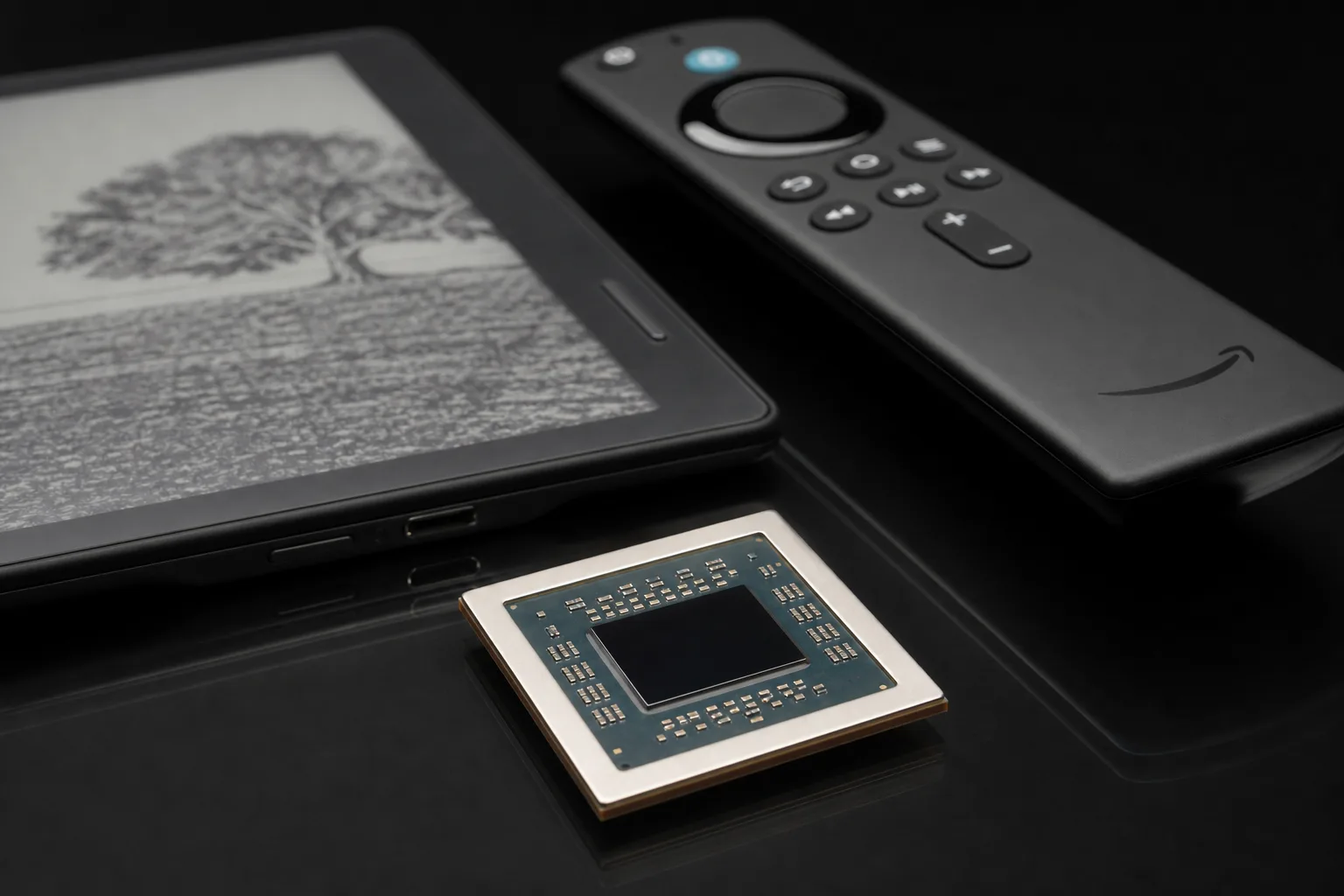
Amazon custom chips are coming — and if analyst Ming-Chi Kuo is right, they could quietly reshape every gadget Amazon sells, from the Kindle on your nightstand to the Ring camera above your front door. The plan is ambitious, the timeline is 2027, and the implications stretch well beyond Amazon’s own product line.
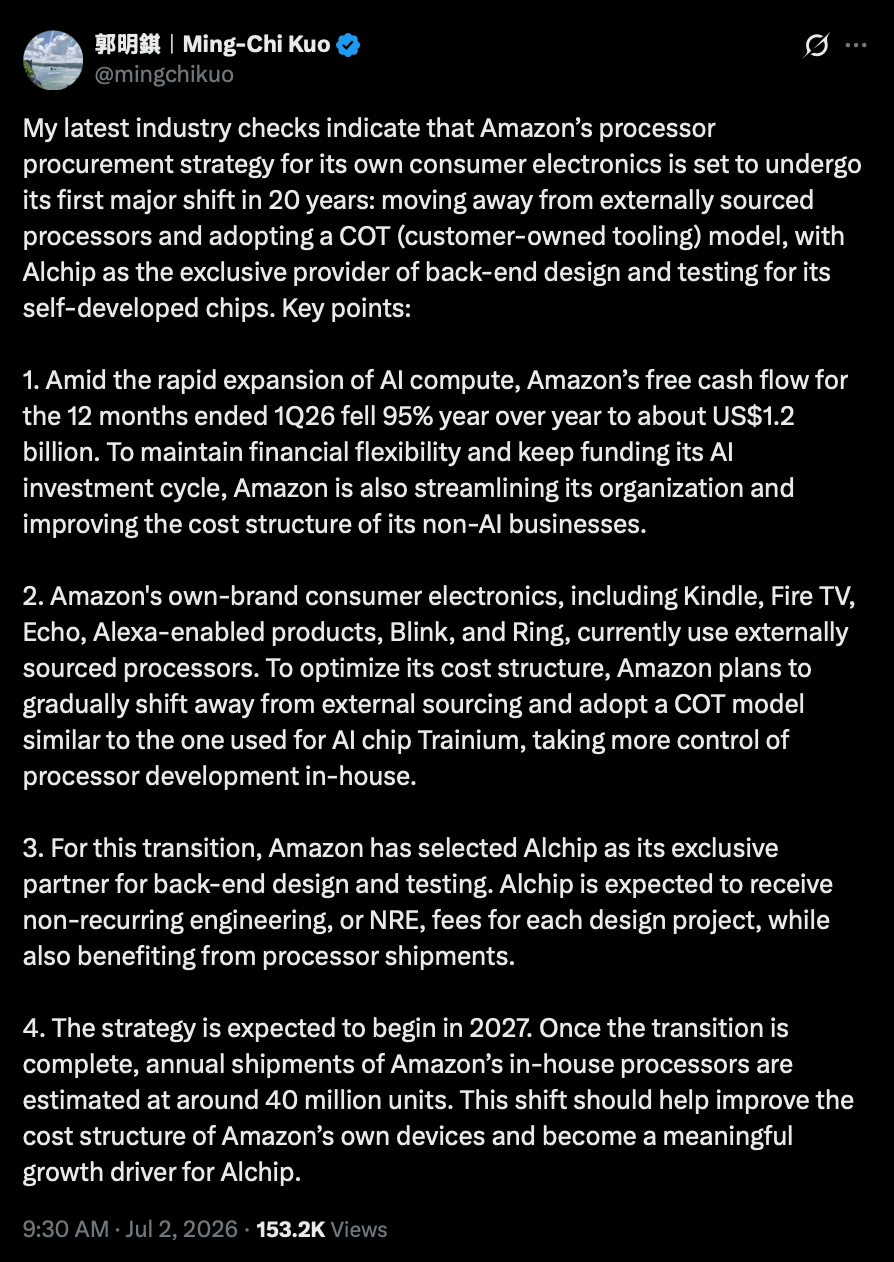
- Amazon custom chips are planned for Kindle, Fire TV, Echo, and Ring devices, with the transition starting in 2027.
- Amazon custom chips could be shipped at a rate of 40 million units annually once the strategy is fully operational.
- Analyst Ming-Chi Kuo says Alchip will serve as Amazon’s exclusive back-end design and testing partner.
- MediaTek and other third-party suppliers risk losing significant business if Amazon follows through on the shift.
Table of Contents
What Amazon Is Actually Planning
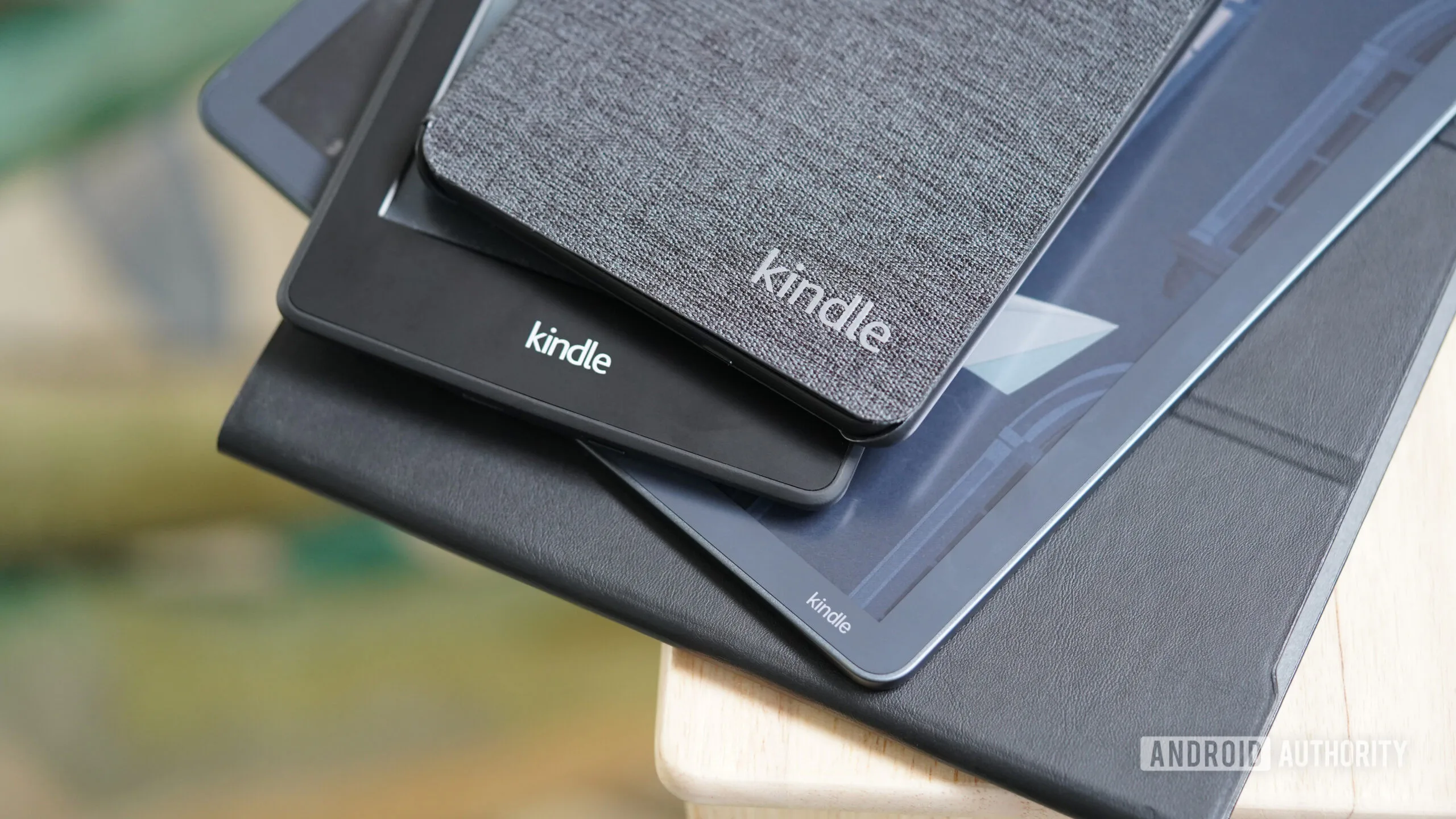
According to Kuo, one of the most closely followed analysts in consumer hardware, Amazon is preparing to shift away from off-the-shelf processors sourced from third-party chipmakers and begin designing its own silicon. The scope is broad. We’re talking Kindle e-readers, Fire TV streaming devices, Echo smart speakers, and Ring security cameras — the full consumer hardware stack that Amazon has spent years building into a low-margin, high-volume business.
The company has reportedly chosen Alchip, a Taiwanese chip design firm, as its exclusive partner for back-end design and testing. Amazon will own the strategic direction, but Alchip will do the heavy lifting of turning those designs into chips you can actually manufacture at scale. Once the programme is fully operational, Amazon custom chips are expected to ship at roughly 40 million in-house processors per year. That’s not a pilot project — that’s a fundamental change in how the company builds its devices.
Amazon Custom Chips: Following a Well-Worn Path
This isn’t a novel idea. The custom silicon playbook has been running for years among the biggest names in tech, and the results speak for themselves. Apple’s decision to design its own A-series chips transformed the iPhone into the performance benchmark for the entire smartphone industry. Its M-series chips later did the same for the Mac, decimating Intel’s relevance in that product line almost overnight. Google followed with its Tensor chips for the Pixel line, allowing it to run on-device AI processing in ways that generic Qualcomm silicon simply couldn’t match as efficiently. Even Microsoft has been developing its own AI accelerator chips as part of its Azure infrastructure build-out.
Amazon isn’t new to custom silicon either — it’s been designing chips for its cloud business for years. Its Graviton processors power a substantial chunk of AWS infrastructure, and its Trainium and Inferentia chips are purpose-built for AI training and inference workloads. The Amazon custom chips Kuo is describing take that same philosophy and apply it downstream, to the consumer devices sitting in millions of homes.
The AI Angle Changes Everything
There’s a financial reality driving this that goes beyond hardware pride. Amazon has been spending at a staggering pace on AI infrastructure — data centres, model development, and the integration of AI across AWS and its consumer services. That spending creates pressure to find efficiency gains wherever possible.
Amazon custom chips are one of the cleaner ways to do it. When you design a chip specifically for your own software and your own use cases, you stop paying a margin to an outside supplier for capabilities you may not need and start optimising precisely for the workloads you do run. For Amazon, those workloads increasingly involve Alexa responding faster, Fire TV recommending content more intelligently, and Kindle potentially handling more sophisticated AI-driven features down the line. A processor purpose-built for those tasks will almost always be more efficient — and cheaper to run at scale — than a general-purpose chip bought from MediaTek or whoever else is currently supplying Amazon’s device teams.
This is also about the future of Alexa. Amazon has been overhauling its AI assistant, trying to close the gap with more capable large language model-powered competitors. If Alexa is going to do more sophisticated reasoning on-device — reducing latency and protecting privacy — Amazon needs hardware it controls completely. Waiting for a third-party chipmaker to add the right capabilities on their own schedule is a strategic liability. Amazon custom chips designed in-house would eliminate that dependency entirely.
Who Loses When Amazon Brings Chips In-House
Kuo’s findings were picked up by analyst Jukan, who pointed out the obvious downstream consequence: the companies currently selling chips to Amazon have a serious problem if this transition goes ahead. MediaTek is the name most frequently cited as a supplier at risk. It’s a significant chunk of business — 40 million units annually is not a rounding error in the chip industry — and losing a customer of Amazon’s scale would be a real blow.
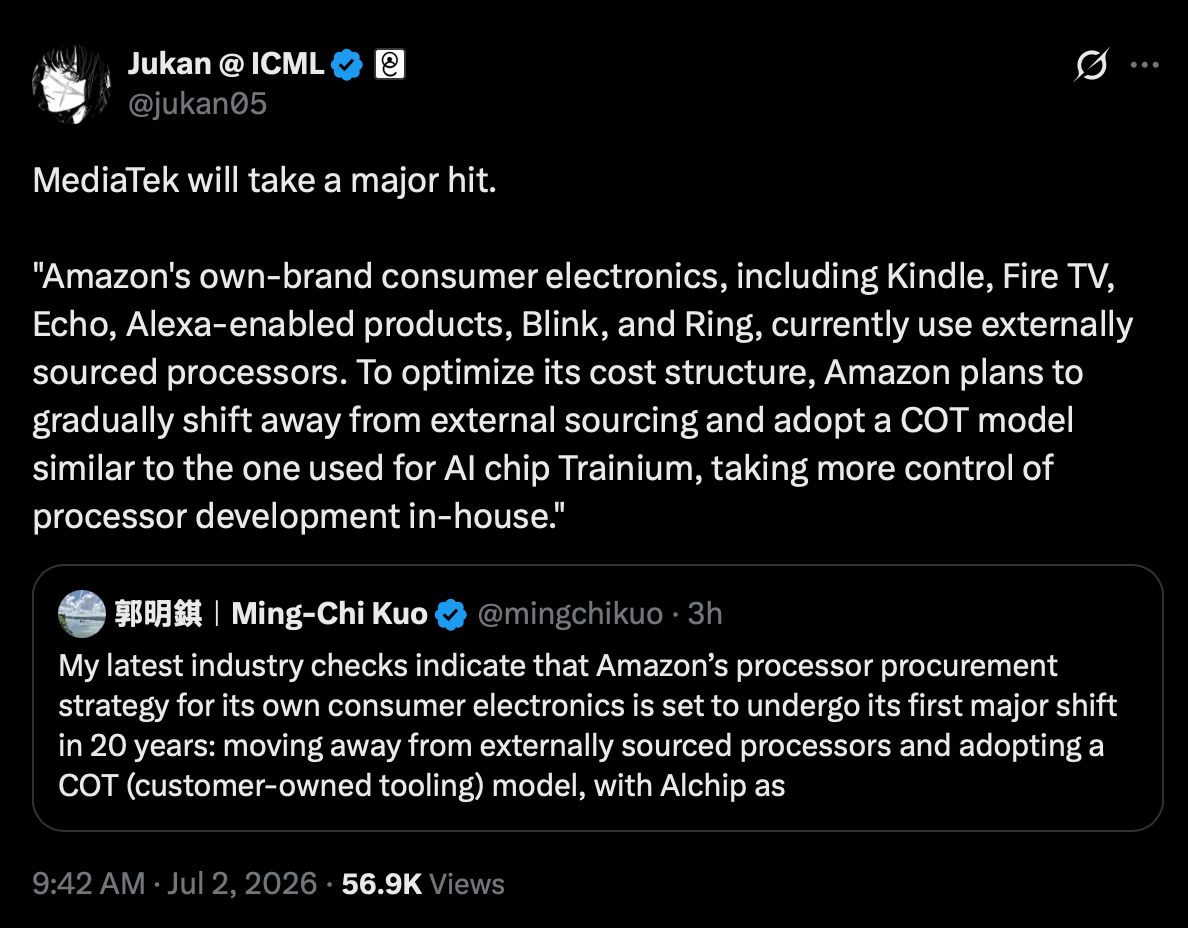
MediaTek has been diversifying aggressively, pushing into automotive chips, Wi-Fi 7 silicon, and AI-optimised mobile processors. But the consumer IoT and streaming device segment remains core business, and Amazon has historically been one of the more price-sensitive, volume-heavy buyers in that space. If Amazon custom chips replace MediaTek’s components across the device lineup, finding a replacement buyer for that volume won’t be easy.
The broader chip industry has seen this pattern repeat enough times now that it should be expected. As large platform companies grow their device businesses to sufficient scale, the economics of custom silicon tip in their favour. Amazon has reached that scale. The only real question was when, not whether.
What This Means for You as an Amazon Device Owner
In the short term — almost nothing. A 2027 start date means Amazon custom chips won’t land in retail products until at least 2028, and possibly later depending on how cleanly the design and manufacturing process goes. These transitions are rarely smooth on the first pass.
Over time, though, the potential is real. Apple’s silicon transition showed that vertical integration of hardware and software can produce genuinely meaningful gains in both performance and battery efficiency. Amazon’s devices have historically been ‘good enough’ — priced aggressively and built to a margin. Amazon custom chips could change the ceiling on what a £40 Fire TV stick or a Kindle Paperwhite can actually do, especially as AI features become a bigger part of the pitch.
Whether Amazon executes as cleanly as Apple is another matter entirely. Apple spent years building deep chip design expertise before it cut ties with Intel. Amazon custom chips for consumer devices are less complex than what Apple designs, which helps — but underestimating the difficulty of this transition would be a mistake. Alchip brings credibility as a design partner, having worked with major fabless chip companies, but the proof will be in what ships.
The bigger picture is this: custom silicon is no longer a differentiator reserved for the very top tier of tech. It’s becoming table stakes for any company running a serious hardware business at scale. Amazon joining that club in earnest by 2027 signals how permanently the industry’s centre of gravity has shifted — away from standard suppliers and toward platforms that want to own the full stack, right down to the transistor level.