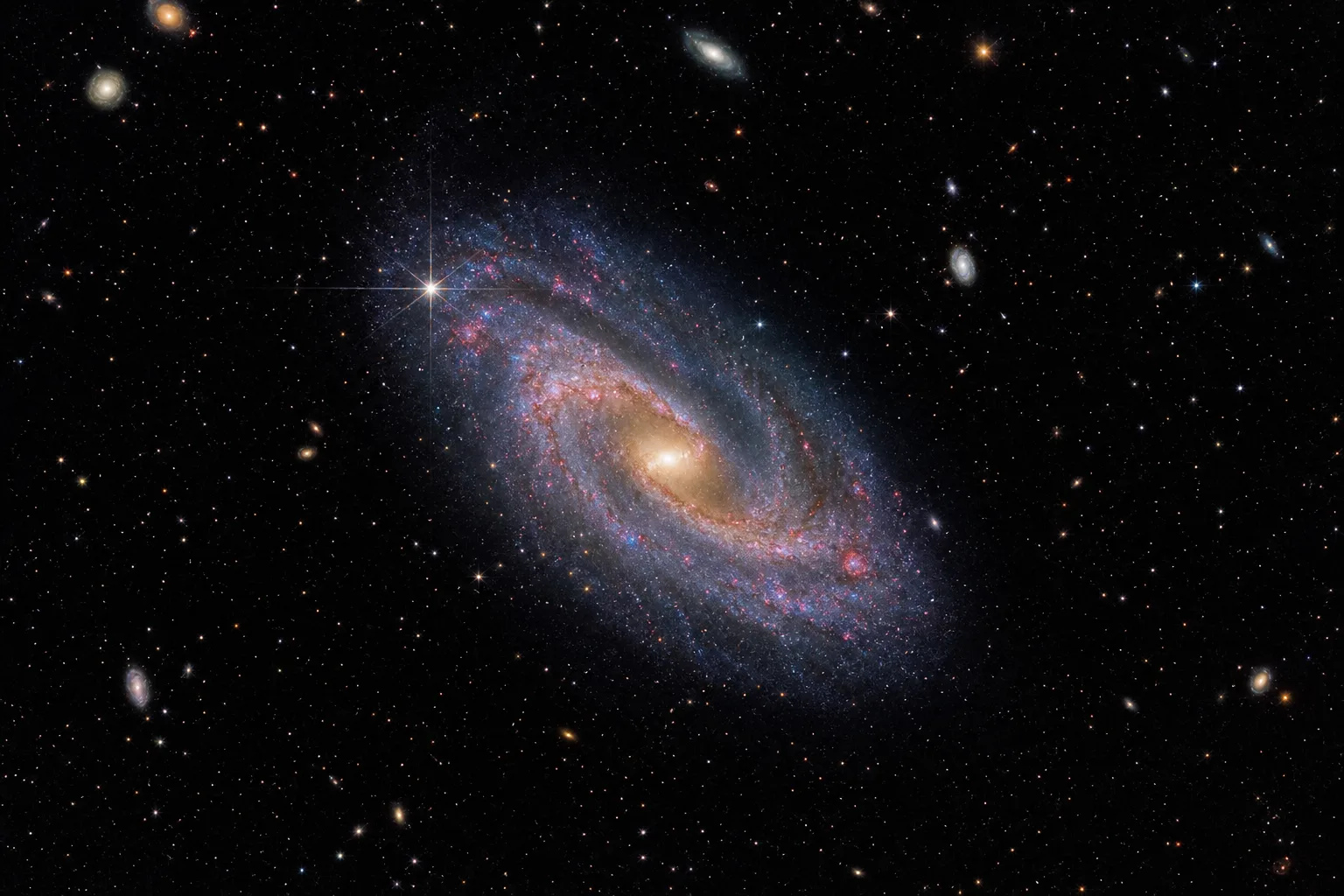
The James Webb Space Telescope has done it again. An international team of astronomers has announced the discovery of a new, massive barred spiral galaxy — designated M1149-BSG-z5 — observed at a point in cosmic history when the universe was barely out of its infancy. The finding, detailed in a preprint posted to arXiv on June 23, is the kind of result that makes cosmologists sit up straight and revisit their models.
- JWST has identified a new barred spiral galaxy designated M1149-BSG-z5, observed when the universe was still in its early stages.
- The barred spiral galaxy is described as massive, raising serious questions about how large structured galaxies formed so early in cosmic history.
- The discovery was detailed in a preprint paper published June 23 on arXiv by an international team of astronomers.
- Finding mature galactic structures this early pushes back the timeline for when bars and spiral arms can develop in galaxies.
Table of Contents
What Is M1149-BSG-z5?
The galaxy’s designation tells you a lot right away. ‘z5’ refers to its approximate redshift — a measure of how much the universe has expanded since the light we’re now detecting was first emitted. At redshift 5, we’re looking at a galaxy that existed in the very early universe, when the cosmos was still in its infancy. That’s not just old. That’s cosmologically ancient.
What makes M1149-BSG-z5 genuinely striking isn’t just its age, though. It’s the type of galaxy it appears to be. A barred spiral galaxy — like our own Milky Way — features a central bar of stars cutting across its core, with spiral arms sweeping outward from either end. It’s a structure that implies a high degree of dynamical organisation. Stars, gas, and dark matter have all settled into a coherent, rotating disc. That kind of order typically takes time to develop. A lot of time.

Why a Barred Spiral Galaxy This Early Is a Big Deal
Here’s where things get interesting from a theoretical standpoint. The standard model of galaxy formation — broadly speaking, the Lambda-CDM framework — suggests that galaxies grow hierarchically. Small structures form first, merge, and gradually build up into the large, well-ordered systems we see in the local universe today. Bars, in particular, are thought to require a fairly mature, kinematically ‘cool’ disc to form and persist. Disc galaxies at high redshift are typically more turbulent, more gas-rich, and more irregular than their nearby counterparts.
Finding a massive barred spiral galaxy at z=5 therefore puts real pressure on that picture. It’s not the first time JWST has pushed back the clock on galactic order — since its first science observations in 2022, the telescope has repeatedly identified surprisingly mature structures at unexpectedly high redshifts. But each new example sharpens the tension with theory. Either bars can form faster than we thought, or some galaxies are assembling their mass far more efficiently than our current simulations allow, or both.
It’s worth thinking about what ‘massive’ means in this context, too. The source material describes M1149-BSG-z5 as a massive barred spiral galaxy, which in astrophysics typically implies a stellar mass of at least tens of billions of solar masses. Building that much stellar mass so early in cosmic history requires an extraordinarily high rate of star formation — far beyond what most early-universe galaxies are thought to sustain for extended periods. If confirmed through peer review, this galaxy’s mass alone would be a significant data point.

JWST’s Role: Why This Discovery Was Only Possible Now
The Hubble Space Telescope spent decades transforming our understanding of the cosmos, but it was fundamentally limited when it came to the very early universe. At high redshifts, the ultraviolet and optical light emitted by young stars gets stretched all the way into the infrared by cosmic expansion. Hubble’s infrared capabilities were modest. JWST’s were built specifically for this.
JWST’s Near Infrared Camera (NIRCam) and Mid-Infrared Instrument (MIRI) can resolve structural details in distant galaxies that were simply invisible to previous observatories. That’s what allowed the international team to not only detect M1149-BSG-z5, but to identify it as a barred spiral galaxy rather than a generic blob of light. The bar, the arms — that morphological detail is the real prize here. Without JWST’s resolution and sensitivity, this would have been just another faint smudge in a deep-field image.
The telescope has been operating at its Lagrange 2 point — roughly 1.5 million kilometres from Earth — since it reached operational status in 2022, and the pace of significant discoveries has been relentless. From NASA’s James Webb Space Telescope mission page, the scope of the instrument’s ambitions is clear: probing the first light in the universe, characterising exoplanet atmospheres, and mapping the formation of stars and galaxies across cosmic time. M1149-BSG-z5 sits squarely in that third bucket.
The Broader Picture: JWST Keeps Rewriting Cosmic History
It would be tempting to treat M1149-BSG-z5 as an isolated surprise, but it fits into a pattern that’s been emerging since JWST’s early data releases. In 2022 and 2023, the telescope identified several galaxy candidates at redshifts above 10 — potentially existing within just 300–400 million years of the Big Bang — that appeared to have stellar masses far exceeding theoretical predictions. Some of those early candidates were revised downward after more careful spectroscopic analysis, but others held up. The general trend has been consistent: early galaxies are more massive, more structured, and more diverse than pre-JWST models anticipated.

The discovery of a barred spiral galaxy at z=5 adds morphological complexity to that list. It’s one thing to find unexpected mass. It’s another to find unexpected order — a galaxy that has already sorted itself into a rotating, barred disc system that wouldn’t look entirely out of place in the nearby universe. That’s a harder thing to explain away.
Astrophysicists are already working to adapt simulations like IllustrisTNG and EAGLE to accommodate these findings, though no single modification has yet produced a fully satisfying match to what JWST is showing us. The honest answer, at this stage, is that the data is outrunning the theory — which is exactly the kind of productive crisis that drives a field forward. Each confirmed barred spiral galaxy at high redshift adds another data point that simulations must eventually account for.
What Comes Next
The paper describing M1149-BSG-z5 was uploaded to arXiv on June 23, meaning it hasn’t yet cleared formal peer review. That’s standard practice in astrophysics — sharing results early allows the community to scrutinise the methodology, check the photometric redshift estimates, and debate the morphological classification before the paper goes through the journal process. It’s a system that accelerates science, even if it occasionally produces headlines that need walking back later.
Spectroscopic confirmation of the redshift will be a key next step. Photometric redshifts — derived from how a galaxy’s brightness varies across different filter bands — are a good first estimate, but they carry uncertainty. A spectroscopic observation pinning down the exact redshift would cement M1149-BSG-z5’s place in the record books. JWST is more than capable of providing that follow-up data, and given the scientific interest this discovery is likely to generate, it’s a safe bet that telescope time will be sought.
If the redshift and the mass estimates hold up, M1149-BSG-z5 will become one of the most important early-universe barred spiral galaxy discoveries of the decade — a concrete, visually striking example of the cosmos doing something it wasn’t supposed to be able to do yet. Pinning down the precise structure and mass of this barred spiral galaxy through follow-up spectroscopy will be a priority for the team. And for astronomers, that’s precisely the kind of result worth getting excited about.
Frequently Asked Questions
What makes this barred spiral galaxy discovery significant?
M1149-BSG-z5 is significant because it appears to be a massive, well-structured barred spiral galaxy existing in the early universe. That’s far earlier than most models predicted such ordered, large-scale galactic structures could form, which challenges current galaxy evolution theory.
What is a barred spiral galaxy and how does it differ from other galaxies?
A barred spiral galaxy has a central bar-shaped region of stars from which spiral arms extend outward — our own Milky Way is one. Unlike elliptical or irregular galaxies, this structure implies a high degree of rotational order and dynamical maturity, which takes considerable time to develop.
How does JWST detect galaxies from the early universe?
JWST’s infrared instruments can observe light that has been stretched — or redshifted — over billions of years of cosmic expansion. This lets it peer back to when the universe was very young, enabling discoveries like M1149-BSG-z5.
Where can I read the full research paper on this discovery?
The finding was published as a preprint on arXiv on June 23 by an international team of astronomers. Preprints are not yet peer-reviewed but are standard practice in astrophysics for sharing findings quickly with the broader scientific community.