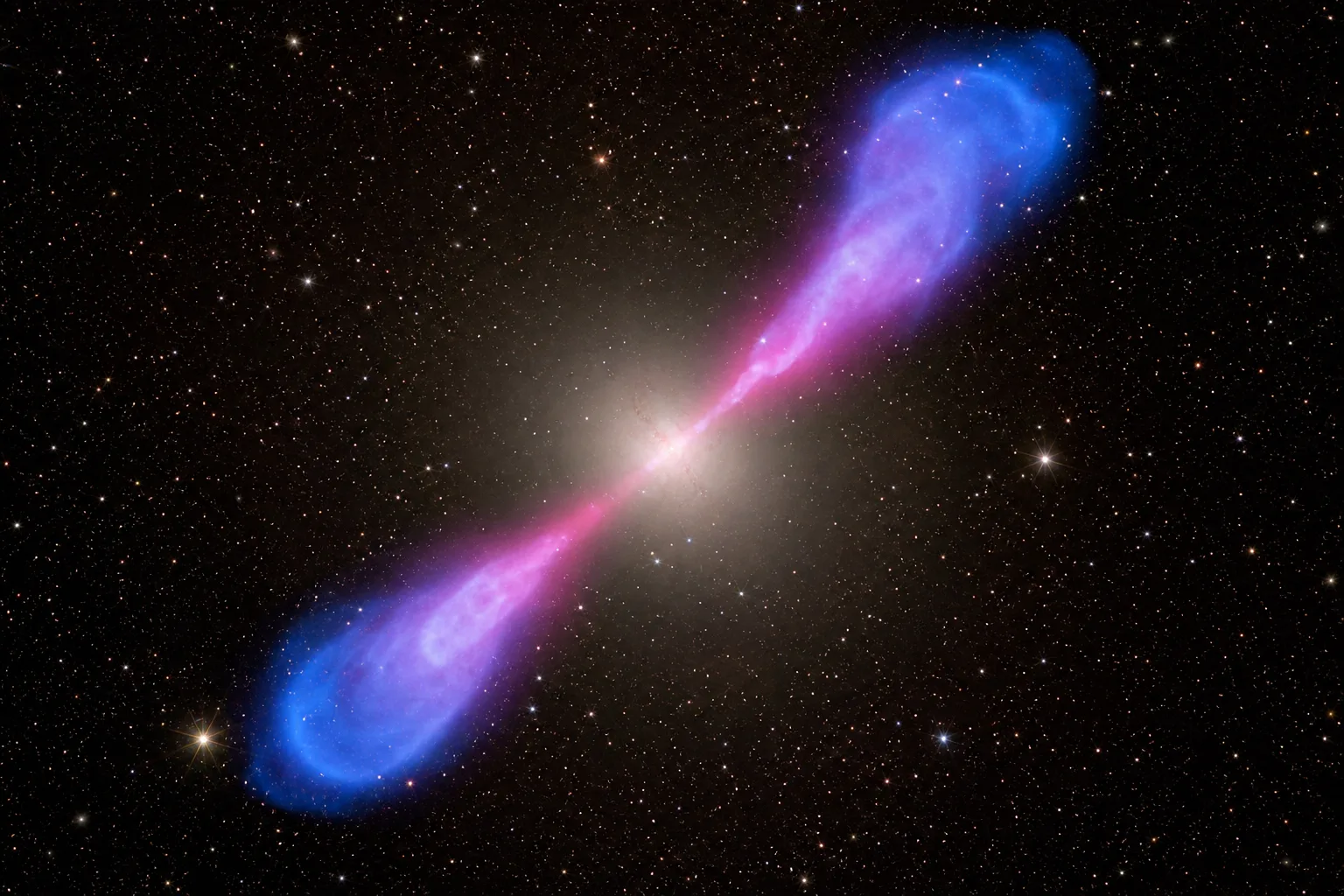
A black hole radio outburst deep in the heart of a distant galaxy has been glowing brightly in radio wavelengths for several years — something astronomers have simply never seen before. The galaxy in question, catalogued as SDSS J110546.07+145202.4, is now the subject of serious scientific attention, and for good reason: what’s happening there doesn’t fit the established playbook for this type of event.
- A black hole radio outburst in galaxy SDSS J110546 has lasted several years, far outlasting any previously known equivalent.
- This black hole radio outburst exhibits unusual physical properties that researchers are still working to characterise.
- Most radio transients near galactic centers fade within days or weeks, making this multi-year signal entirely without precedent.
- The discovery opens a new observational window into extreme physics around supermassive black holes at cosmic distances.
Table of Contents
What Is a Black Hole Radio Outburst, and Why Do They Normally Disappear?
Radio transients — short-lived bursts of radio radiation — are a well-documented, if still poorly understood, feature of the universe. When they originate near the supermassive black holes that anchor the centers of most large galaxies, they’re typically the product of violent, high-energy processes: the collapse of massive stars, the merging of compact objects, or sudden surges in the rate at which material is being swallowed by the black hole itself. The operative word, historically, has been ‘short-lived.’ These events tend to flare up fast and fade within days or weeks — spectacular but fleeting.
That’s what makes the black hole radio outburst in SDSS J110546 so disorienting for researchers. Instead of fading, it has continued shining very brightly in radio light for several years. No known source in this category has done that before. The event sits in a class of one.
The Early Universe Connection
Perhaps the most striking detail isn’t the duration — it’s what the signal itself appears to be telling us. The physical properties of this black hole radio outburst are still being studied and characterised by researchers. That’s an extraordinary situation, and it deserves unpacking.
The early universe — the first few hundred million to billion years after the Big Bang — was a fundamentally different place. Matter was denser, radiation fields were more intense, and the environments around the first generation of supermassive black holes were almost certainly far more extreme than what we see in the relatively settled cosmos today. Observing those conditions directly is largely impossible; we can look back in time using telescopes, but the earliest epochs are partially obscured by the fog of the recombination era, and the objects involved are incredibly distant and faint.
What SDSS J110546 appears to offer is something rarer: a nearby-ish system that seems to be recreating or preserving extreme physical conditions in a detectable way. Think of it as a living fossil — a system whose inner workings echo a much earlier phase of cosmic history. If the connection holds up under scrutiny, it could give astronomers a far more accessible test-bed for studying early-universe physics than anything currently available.
Black Hole Radio Outburst Science: The Bigger Picture
To appreciate why this matters, it helps to understand how little we actually know about the environments immediately surrounding supermassive black holes — particularly during the kinds of transient events that briefly light them up. Most of our data on radio transients comes from events that are already fading by the time we notice them. Follow-up observations are always racing against the clock, and the physics being probed are among the most extreme in nature: gravity so intense that our standard models strain at the seams, magnetic fields strong enough to accelerate particles to near-light speeds, and plasma dynamics that are still only partially understood.
A black hole radio outburst that sticks around for years is, paradoxically, a much better scientific target. It gives research teams time to mount multi-wavelength observing campaigns, coordinate between different telescope arrays, and build up the kind of rich dataset that single-epoch observations can never produce. The fact that this particular outburst carries unusual signatures adds another layer of value — it’s not just a curiosity, it’s potentially a Rosetta Stone for understanding an entire era of cosmic history.
Radio astronomy has undergone something of a renaissance over the past decade. Facilities like the Square Kilometre Array Observatory (SKAO), currently under construction in South Africa and Australia, are specifically designed to catch and characterise transient events at radio wavelengths with unprecedented sensitivity. The field of time-domain radio astronomy — tracking how the radio sky changes over time — has exploded in productivity thanks to instruments like MeerKAT and the Australian Square Kilometre Array Pathfinder (ASKAP), both of which have been prolific transient hunters.
It’s entirely possible that the persistent black hole radio outburst in SDSS J110546 was waiting to be found for years before the right instrument, pointed at the right patch of sky with enough patience, finally caught it. That raises an uncomfortable but important question: how many other sources like this are sitting undetected in archival radio survey data, overlooked precisely because the search strategies were tuned to find things that disappear quickly?
What Comes Next for This Discovery
The identification of SDSS J110546 as a first-of-its-kind source is really the beginning of the scientific work, not the end of it. Researchers will want to understand the energy budget of the outburst — how much total energy has been released, and over what timescale. They’ll want to characterise the spectral properties of the radio emission in detail, looking for signatures that distinguish between competing physical explanations: is this a jet? A wind? An accretion disk instability that somehow became self-sustaining? Something else entirely?
The unusual physical properties angle will also demand rigorous investigation. Claiming that a local system mirrors the physics of the infant cosmos is a bold assertion, and the community will rightly want to see that case made carefully and with substantial observational backing. But if it does hold up, the implications stretch well beyond this single galaxy. It would suggest that extreme, early-universe-like conditions can spontaneously reassert themselves in modern galactic environments — an idea that would reshape how we think about the lifecycle of active galactic nuclei and the history of black hole growth across cosmic time.
As next-generation radio facilities come online and our ability to monitor the time-variable radio sky improves by orders of magnitude, it’s a safe bet that SDSS J110546 won’t remain alone in its category for long. The real question is whether the explanation that eventually emerges is one we already have a framework for — or something that forces the textbooks open again.
Frequently Asked Questions
What makes this black hole radio outburst different from other radio transients?
Most radio transients linked to galactic centers burn out within days or weeks. The outburst from SDSS J110546 has persisted for several years at high brightness — making it the first known source of its kind and far outside the norm for this class of phenomenon.
What does ‘properties of the early universe’ mean in this context?
The source does not address properties of the early universe in connection with this phenomenon.
Where is the galaxy SDSS J110546 located?
SDSS J110546.07+145202.4 is a galaxy with a supermassive black hole at its center. The designation encodes its precise coordinates on the sky, though further location details are not specified in the source.
How do supermassive black holes produce radio transients?
Radio transients associated with galactic centers originate in the vicinity of supermassive black holes and result from processes that take place under extreme physical conditions. The source does not detail the specific mechanisms involved.