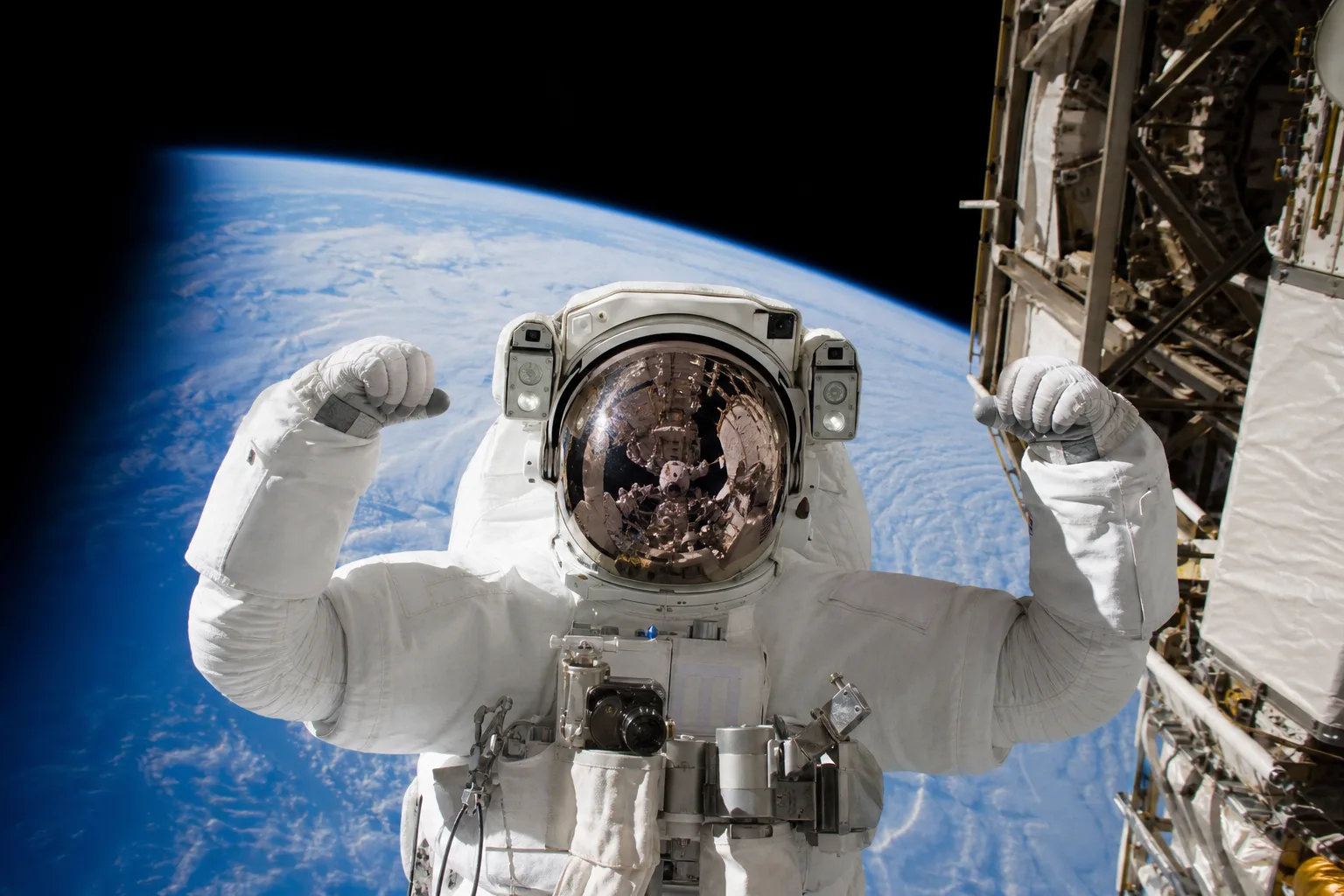
A photograph taken 250 miles above Earth during a NASA spacewalk on June 30 is doing the rounds online — and it’s not hard to see why. Astronaut Chris Williams, arms raised in a classic Muscle Beach pose, grins through his helmet visor at the camera while the curve of Earth hangs silently in the background. It’s the kind of image that stops you mid-scroll. But behind the humor is a story about serious hardware, real physical endurance, and a robotic arm that’s been quietly holding the space station together for a quarter of a century.
- NASA spacewalk veterans Chris Williams and Jessica Meir spent 7 hours 20 minutes outside the ISS on June 30.
- The NASA spacewalk mission involved replacing a faulty wrist joint on the 25-year-old Canadarm2 robotic arm.
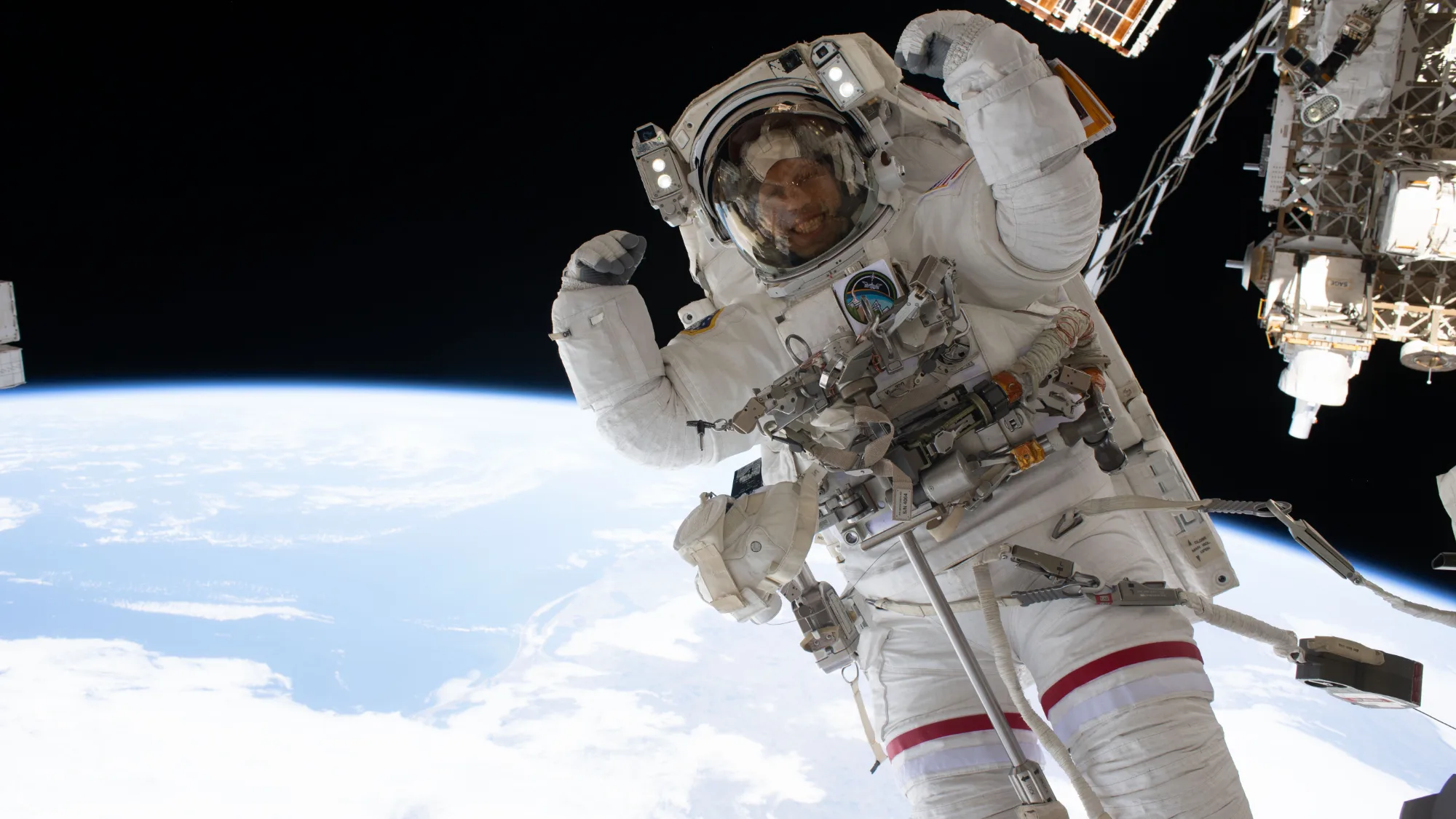
- Williams flexed for a photo mid-EVA, grinning through his helmet with Earth glowing hundreds of miles below.
- The old wrist joint will be returned to Earth and refurbished as a potential backup component for future use.
Table of Contents
The NASA Spacewalk That Needed to Happen
Williams and fellow astronaut Jessica Meir weren’t out there for the view. The NASA spacewalk had a clear mechanical objective: replace a faulty wrist joint on Canadarm2, the iconic robotic arm built by the Canadian Space Agency that has been attached to the ISS since 2001. That’s over 25 years of continuous operation in one of the most hostile environments imaginable — extreme temperature swings, constant radiation exposure, and no easy access for a technician with a wrench.
The joint had been malfunctioning, and a broken Canadarm2 isn’t a minor inconvenience. The arm is essential for berthing visiting spacecraft, relocating equipment, and supporting astronauts during EVAs. Lose it, and station operations get significantly harder. So the repair was mission-critical, not optional.
The replaced joint won’t be thrown away, either. NASA plans to return it to Earth for refurbishment, keeping it available as a backup in case a future component fails. That kind of long-term thinking reflects how the agency manages aging ISS hardware — nothing goes to waste when the cost of replacement involves a launch manifest and an EVA crew.
Seven Hours in the Void
The full EVA clocked in at 7 hours and 20 minutes. To people who haven’t followed human spaceflight closely, that number might not land with the weight it deserves. A NASA spacewalk isn’t like stepping outside in cold weather. Astronauts spend hours in pre-breathe protocols before they even exit the airlock, purging nitrogen from their blood to prevent decompression sickness. Then they work — using heavily gloved hands, with limited tactile feedback, in a pressurized suit that resists every movement — on precise mechanical tasks while floating in vacuum, tethered to a structure orbiting at roughly 17,500 miles per hour.
For Williams, this was his second NASA spacewalk. For Meir, it was her fifth — a reminder that she’s one of NASA’s most experienced active EVA astronauts. Meir is a highly seasoned spacewalker who clearly knows her way around the outside of the station. She’s also the one who snapped the now-viral flex photo, which says something about the kind of working dynamic the two have built.
The Photo That Puts It All in Perspective
There’s something genuinely disarming about the Williams flex image. Astronauts are carefully trained to project competence and professionalism — and they should be, given what’s at stake. So when one of them clowns for the camera mid-EVA, it cuts through the institutional gravity of the whole enterprise. Williams isn’t just performing confidence; he looks like he’s having a good time, which, given the circumstances, is either a testament to his preparation or a sign of serious mental fortitude. Probably both.
What makes the photo work visually is the contrast. The bulky white spacesuit, the raised arms, the grin through the visor — and then below him, that impossible blue-and-white arc of the planet. No backdrop a photographer could stage on Earth comes close. It’s an accidental masterpiece, really, taken on the fly during a maintenance job that most people on Earth will never hear about.
Photos like this matter beyond the ‘likes.’ They do real work for NASA’s public engagement mission. The agency has long understood that human faces and human moments are what make the abstract concept of space exploration feel tangible to a general audience. A flexing astronaut with Earth in the background is worth more than any press release about wrist joint tolerances.
Canadarm2 at 25 — A Piece of Hardware That Refuses to Quit
It’s worth stepping back and appreciating just how long Canadarm2 has been running. The arm was launched aboard Space Shuttle Endeavour in April 2001 on mission STS-100, and it’s been working ever since. According to the Canadian Space Agency, Canadarm2 is a 17-metre articulated robotic system capable of moving large payloads, supporting astronauts, and capturing visiting vehicles. It’s been involved in assembling the station itself, relocating hardware, and assisting in dozens of NASA spacewalk operations over its lifetime.
The fact that it still needs human intervention to replace mechanical components is a feature, not a flaw. The ISS was designed with modularity and serviceability in mind — you can swap out failing parts rather than replacing entire systems. That design philosophy has kept the station operational well beyond its original projected lifespan, and it’s the same logic that’s driving NASA’s thinking about future long-duration platforms, whether that’s a commercial successor to the ISS or eventually something in lunar orbit.
What It Actually Takes to Do This Job
The Williams flex photo is charming precisely because it inverts expectations. But every NASA spacewalk demands relentless physical and cognitive work. Hand-over-hand movement along the station’s exterior burns significant energy. Fine motor tasks — the kind required to remove and install a wrist joint — are exhausting when you’re fighting suit pressure with every grip. Suit gloves are so stiff that astronauts frequently return from EVAs with bruised and torn fingernails. Some have described the hand fatigue alone as one of the hardest parts of the job.
Williams’ bicep flex, then, is genuinely earned. He and Meir spent the better part of a working day doing precision mechanical labor in a vacuum while wearing what is essentially a one-person spacecraft. The pose is playful — but the muscles behind it did real work to get that repair done.
As the ISS edges toward its planned deorbit in the early 2030s, moments like this one — a photo that’s equal parts human and extraordinary — are a reminder of what the program has always been about at its core. Not just science and logistics, but people doing difficult things in impossible places, and occasionally finding time to smile about it.