

Four years in, the James Webb Space Telescope is still finding ways to make every previous instrument feel a little underpowered. To mark its anniversary this July, NASA chose to point JWST at one of the sky’s most dramatic crime scenes: Centaurus A, a galaxy 11 million light-years away that’s still wearing the scars of a collision that happened roughly 2 billion years ago.
- The James Webb Space Telescope turns four years old, marking a major milestone in modern observational astronomy.
- NASA released new James Webb Space Telescope images of Centaurus A, a galaxy shaped by a collision 2 billion years ago.
- JWST’s infrared instruments pierced through dense dust to reveal fast-moving gas jets and a warped molecular hydrogen disk.
- An unexplained S-shaped structure in the MIRI image of Centaurus A remains one of astronomy’s active open questions.
Table of Contents
A Galaxy Shaped by Violence
Centaurus A doesn’t look like a typical galaxy because it isn’t one — not anymore. Its peculiar, warped structure is the direct result of two galaxies slamming into each other long before multicellular life existed on Earth. That merger did more than just distort the galaxy’s shape. It flooded the system with gas and dust, handing Centaurus A the raw ingredients for furious star formation and simultaneously feeding its central supermassive black hole with an almost obscene amount of material to consume.
The result is what astronomers call an active galactic nucleus, or AGN — a violently energetic core where the black hole is actively devouring matter and blasting powerful jets of plasma outward at enormous speed. Centaurus A is one of the brightest radio sources in the entire sky, which has made it a long-standing target for astronomers. But seeing into its core has always been the problem.
Where Hubble Stopped and JWST Begins
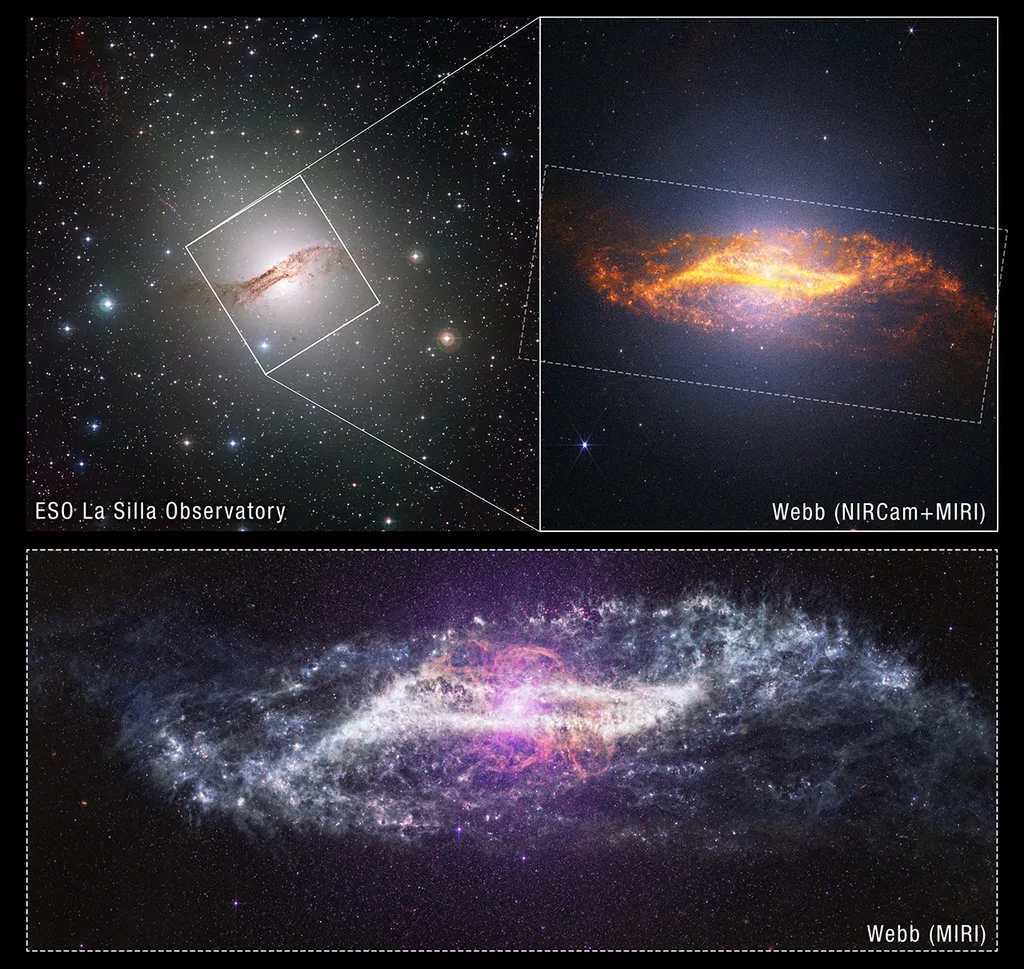
The James Webb Space Telescope‘s strength here is straightforward: infrared light passes through dust in ways that visible light simply can’t. Centaurus A’s core is smothered in thick lanes of gas and dust — beautiful in photographs, but essentially opaque to the Hubble Space Telescope, which operated primarily in visible wavelengths. Hubble could see the galaxy’s broader structure, but the heart of the action was hidden.
Spitzer, NASA’s now-retired infrared space telescope, made earlier inroads. It could identify large-scale infrared structures in Centaurus A, but its resolving power wasn’t fine enough to distinguish individual stars or trace precise gas dynamics. Think of it like moving from a blurry weather radar to a high-definition satellite map — same general picture, completely different level of detail.
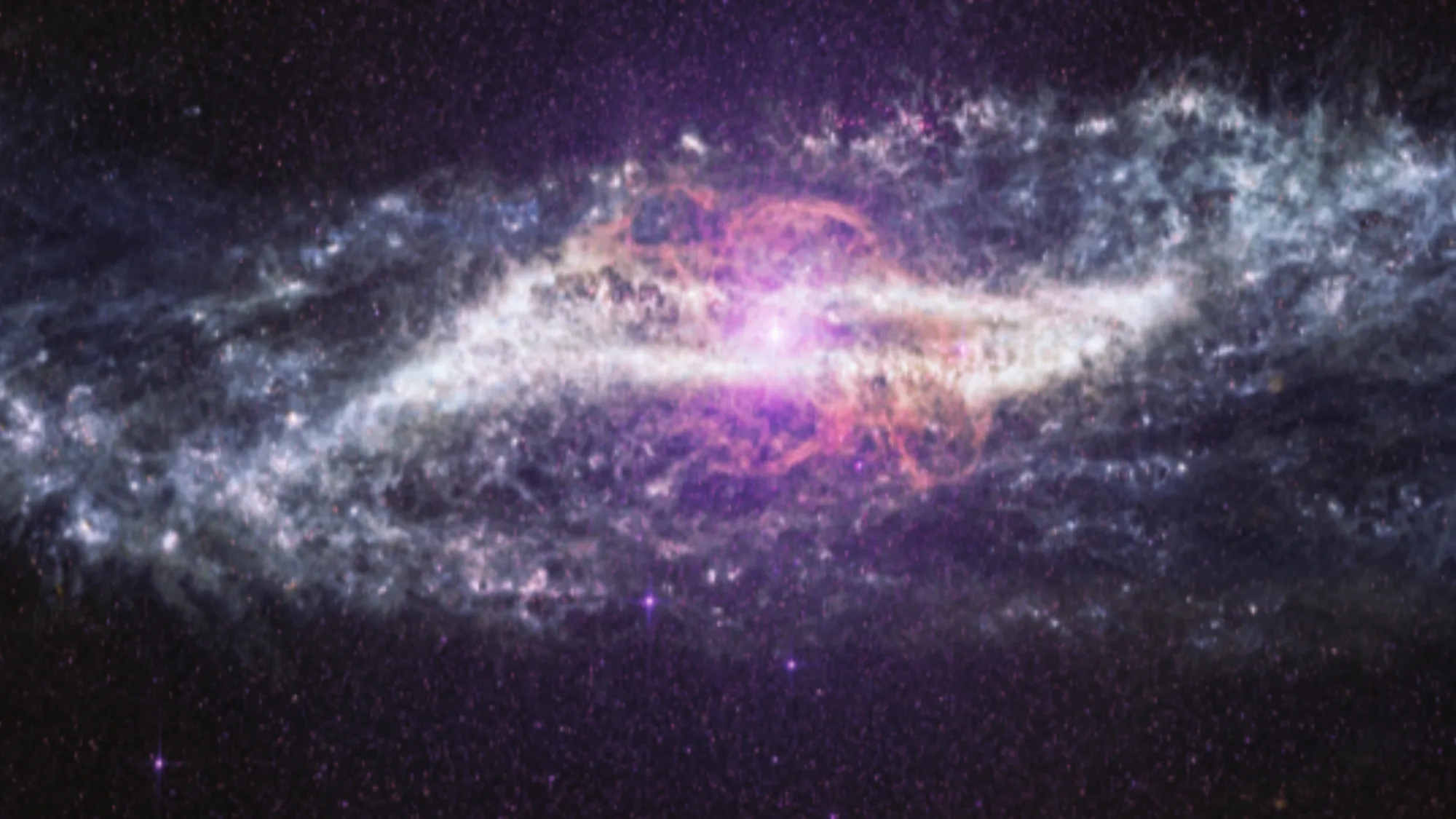
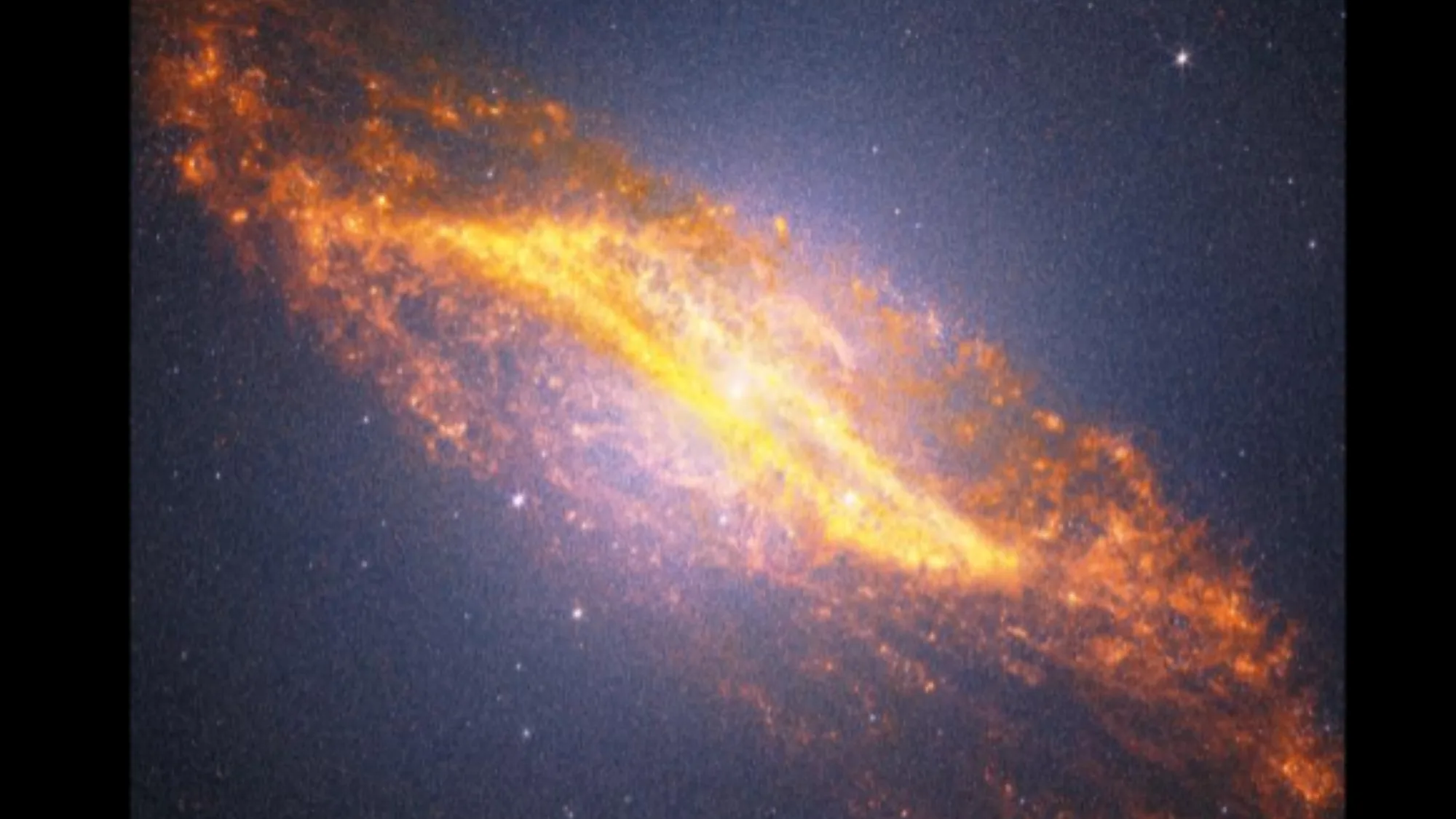
JWST changes that entirely. Using its MIRI (Mid-Infrared Instrument) and NIRCam (Near-Infrared Camera) in combination, the James Webb Space Telescope has produced imagery of Centaurus A that no previous observatory could match. Glowing stellar nurseries — regions where new stars are actively being born — are now visible in striking clarity, their turbulent gas and dust lit up in infrared wavelengths. Fast-moving ionized gas, shunted outward by the black hole’s prodigious energy output, can be tracked with a precision that simply wasn’t possible before.
The James Webb Space Telescope Uncovers New Mysteries Too
Not everything JWST found in Centaurus A comes with a tidy explanation — which is arguably the more exciting part. In the MIRI imagery, there’s a curious S-shaped structure embedded in the galaxy’s inner regions. Nobody knows what formed it or whether Centaurus A’s hyperactive black hole had anything to do with its creation. It’s a reminder that more powerful instruments don’t just answer questions; they generate new ones.
The James Webb Space Telescope also detected warmer molecular hydrogen in a warped, rotating disk near the galaxy’s core. That data paints a vivid picture of a feedback loop in action: the supermassive black hole compresses surrounding gas, which triggers bursts of star formation — but the same energetic outflows can just as easily sweep a galaxy clean of its star-forming material, effectively strangling future stellar birth. Astronomers call this process ‘quenching,’ and watching it unfold in real time in Centaurus A is precisely the kind of evidence needed to understand how galaxies across the universe age and die.
Building a Richer Cosmic History
Shawn Domagal-Goldman, division director of Astrophysics at NASA Headquarters in Washington, framed the anniversary well:

