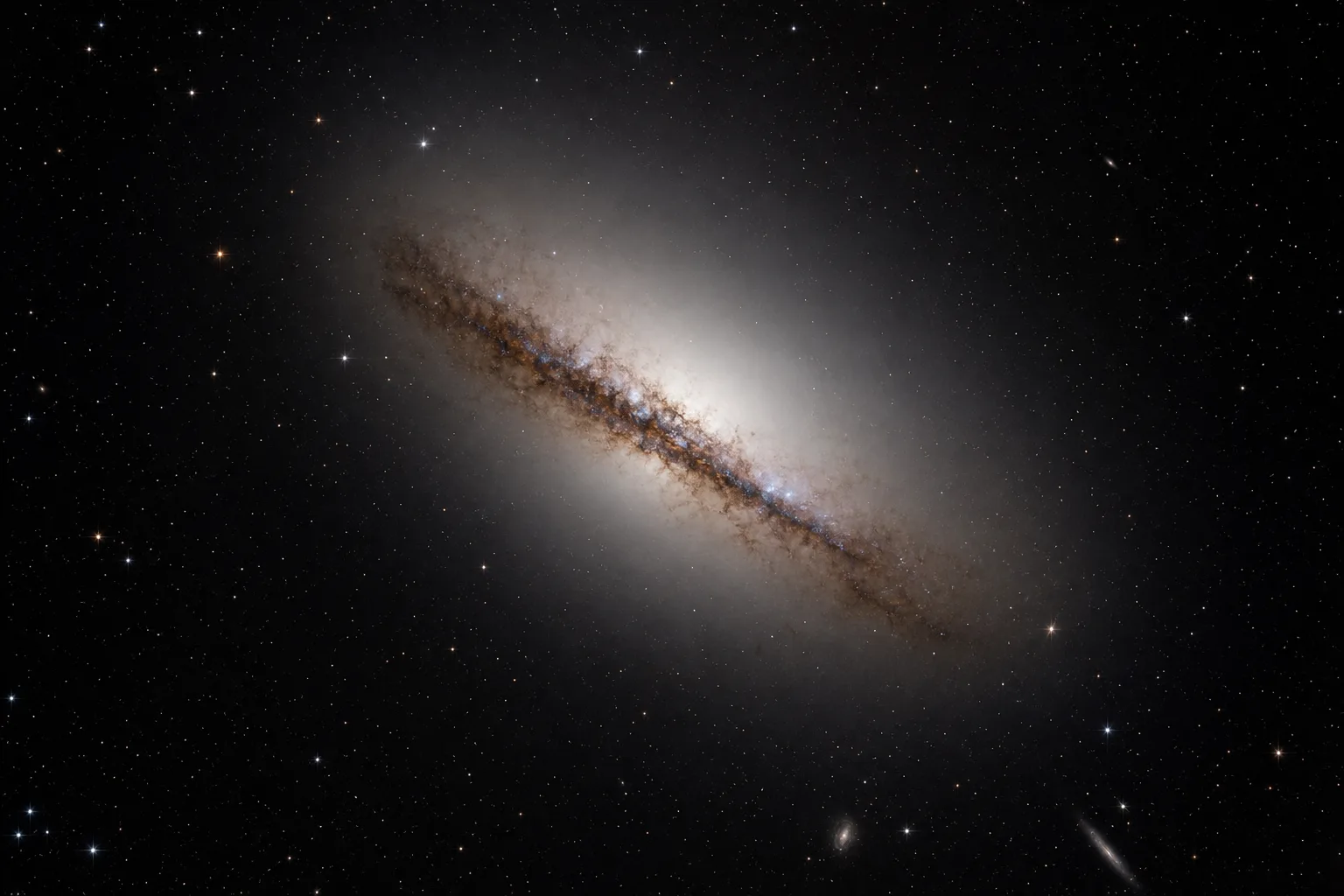
When most people picture galaxy mergers, they imagine something spectacular — two vast spiral arms tangled together, tidal debris flung across millions of light-years, a cosmic car crash frozen in deep time. The reality, it turns out, is often far less obvious. Some of the most significant merger events in the universe’s history are hiding inside galaxies that look, at first glance, almost unremarkable. Centaurus A might be the most important example of that phenomenon we currently have access to.
- Galaxy mergers don’t always produce dramatic visual signatures — Centaurus A is a leading example of that deception.
- Centaurus A, just 11 million light-years away, shows how galaxy mergers can hide in plain sight despite being extensively studied.
- The galaxy’s unusually high star formation rate is now understood as a direct consequence of a past collision event.
- Astronomers are using Centaurus A as a reference case to rethink how common and how subtle galaxy mergers truly are.
Table of Contents
Galaxy Mergers Don’t Always Look the Way You’d Expect
The assumption that galaxy mergers produce easily readable visual chaos is one astronomers have been quietly revising for years. Yes, some collisions produce the iconic imagery you’ve seen on NASA press releases — the Antennae Galaxies, the Mice Galaxies, two systems in the middle of a slow-motion collision with their structures pulled apart like taffy. But those are the obvious cases, caught mid-act. What happens after the dust — sometimes literally — settles is a different story entirely.
Galaxy mergers that occurred billions of years ago, or even more recently in cosmic terms, can leave behind a galaxy that has largely ‘relaxed’ into a new equilibrium. The gravitational chaos subsides. Stars find new orbits. The merged system begins to resemble something calmer, something that doesn’t immediately scream ‘collision.’ This is where the science gets genuinely tricky, because without looking at the right indicators, you could study one of these galaxies for decades and never fully appreciate what it went through.
Centaurus A: A Familiar Face with a Violent Past
That’s essentially what happened with Centaurus A. Also catalogued as NGC 5128, this galaxy sits roughly 11 million light-years from Earth — close enough, by extragalactic standards, to study in extraordinary detail. It’s the fifth-brightest galaxy in the sky, a perennial favourite for amateur astronomers with decent equipment, and a well-worn target for professional observatories across every wavelength from radio to X-ray.
And yet, despite all that attention, its merger history has taken considerable time and effort to piece together. Centaurus A isn’t a spiral galaxy. It’s not a clean elliptical either. It has a prominent dust lane cutting across its core — a feature that makes it visually distinctive but also somewhat anomalous. That dust lane, it’s now understood, is a remnant of the galaxy collision that helped make Centaurus A what it is today: a starburst galaxy, actively producing new stars at a rate far higher than a ‘typical’ galaxy of its size and type.
The starburst activity is the tell. When galaxies collide, the gravitational interaction compresses enormous clouds of gas and dust, triggering rapid, intense bursts of star formation. The compressed interstellar medium essentially gets a shock to the system, and the result is a spike in stellar birth rates that can persist for hundreds of millions of years after the merger itself. In Centaurus A, that process is visibly underway, and it points directly back to the collision event buried in its past.
Why This Matters Beyond One Galaxy
Centaurus A isn’t just an interesting individual case — it’s a reference point for a much broader question in observational astronomy: how many galaxy mergers are we missing? If one of the most scrutinised galaxies in the southern sky took this long to have its merger history properly characterised, what does that say about galaxies that are further away, fainter, and far harder to study in detail?
The implications are significant. Current models of galaxy evolution — including the widely accepted hierarchical structure formation model, which holds that large galaxies grow by absorbing smaller ones over cosmic time — depend on accurate counts of how often mergers occur and what signatures they leave behind. If the observable signatures are subtler than previously assumed, our merger rate estimates could be off. That would have downstream effects on how we model everything from dark matter distribution to the evolution of supermassive black holes at galactic centres.
Centaurus A, for its part, hosts a particularly active supermassive black hole — it’s one of the closest examples of an active galactic nucleus we have access to. The energetic jets blasting out from its core are a direct product of that black hole’s feeding activity, and that feeding is itself connected to the gas supply enriched by the merger. Everything is linked.
The Tools That Are Changing What We Can See
Part of why galaxy mergers were harder to detect in the past comes down to the limitations of the tools available. Optical telescopes, however powerful, only tell part of the story. The dust lanes that are often the most obvious merger remnants actively obscure optical light. Radio and infrared observations cut through that dust, revealing structure that visible-light imaging misses entirely.
The James Webb Space Telescope, now producing science at a pace that’s genuinely hard to keep up with, is particularly well-suited to this kind of work. Its infrared capabilities allow it to peer through dusty regions that fogged up Hubble’s view. Combined with data from facilities like ALMA — the Atacama Large Millimeter Array in Chile — astronomers now have a multi-dimensional picture of galaxies like Centaurus A that simply wasn’t possible even fifteen years ago.
Machine learning is also starting to play a role. Surveys like the Legacy Survey of Space and Time, set to run on the Vera C. Rubin Observatory, will image billions of galaxies. No human team can manually classify that volume of data. Algorithms trained to recognise subtle merger signatures — asymmetries in brightness profiles, disturbed outer envelopes, unusual colour gradients — are becoming essential tools for finding the collisions that don’t announce themselves loudly.
What Centaurus A Is Still Teaching Us
There’s something telling about the fact that a galaxy as well-studied as Centaurus A is still yielding new insights. It’s a reminder that familiarity in astronomy doesn’t equal complete understanding. We’ve been pointing telescopes at this galaxy for generations, and we’re still refining the picture of what it is and how it got that way.
The broader lesson for galaxy mergers as a field is that the catalogue of ‘obvious’ mergers — the dramatic, tangled pairs caught mid-collision — probably represents only a fraction of the true merger population. The aftermath, the settled, quiet, post-collision galaxy going about its business with elevated star formation and a telling dust lane, is where a huge part of the story lives. And those galaxies look a lot like Centaurus A. They look, from a distance, almost normal. The science of galaxy mergers is increasingly about learning to read the quieter evidence — and recognising that the universe’s most transformative events don’t always leave obvious scars.
Frequently Asked Questions
What makes galaxy mergers difficult to identify?
Galaxy mergers don’t always produce the dramatic tidal tails and distorted shapes astronomers traditionally look for. In some cases, like Centaurus A, the aftermath settles into a structure that looks almost ordinary, making the violent collision history easy to miss without deep multi-wavelength observation.
Why is Centaurus A important for studying galaxy mergers?
Centaurus A is one of the closest and brightest galaxies in the sky, making it an ideal laboratory. Its rapid star formation and unusual dust lane are now attributed to a past merger event, offering astronomers a nearby, detailed example of what post-merger galaxies can look like.
What is a starburst galaxy?
A starburst galaxy is one undergoing an exceptionally high rate of star formation compared to a typical galaxy. This burst of stellar activity is often triggered by a gravitational interaction or merger with another galaxy, which compresses gas clouds and ignites new star formation across the galaxy.
How far away is Centaurus A from Earth?
Centaurus A, also catalogued as NGC 5128, sits approximately 11 million light-years from Earth. Despite that distance, it’s the fifth-brightest galaxy visible in the sky, which is why it’s been a target for both amateur and professional astronomers for decades.