
Real world asset tokenization has quietly become one of the most consequential trends in finance — and it’s moving faster than most people outside crypto circles realize. The total on-chain value of tokenized real-world assets hit $32.22 billion by the end of June 2025, up from roughly $11.8 billion just a year earlier. That’s nearly a three-fold increase in twelve months. Fold in stablecoins — which are, at their core, tokenized fiat — and the broader tokenized market clears $328.8 billion.
- Real world asset tokenization has nearly tripled in value over one year, reaching $32.22 billion in on-chain value by mid-2025.
- US Treasuries dominate real world asset tokenization at $15 billion, led by BlackRock’s BUIDL fund and Franklin Templeton’s BENJI token.
- The DTCC is piloting tokenized securities trading with over 50 major financial firms, including Goldman Sachs and JPMorgan.
- Geopolitical tensions in early 2026 drove a ninefold surge in weekend volumes on on-chain commodity perpetuals, stress-testing tokenized gold markets.
Table of Contents
Why Real World Asset Tokenization Is Suddenly Serious
For years, putting traditional financial assets on a blockchain was a compelling pitch that never quite materialized at scale. The infrastructure wasn’t there, the regulation was murky, and the institutional appetite was tepid at best. That’s changed. The number of total RWA asset holders has grown to 937,928 — up 13% in a single month, according to data from RWA.xyz. These aren’t retail crypto speculators chasing yield on meme tokens. Increasingly, they’re asset managers, corporate treasurers, and institutional desks that want the efficiency of blockchain settlement without abandoning familiar asset classes. Real world asset tokenization is now attracting capital from some of the largest institutions in finance.
Standard Chartered’s head of digital assets research, Geoff Kendrick, recently put a number on where this could go. His research note projects that assets in DeFi could reach $2.7 trillion by 2030. Right now, only about 10% of tokenized RWAs are actually being used within DeFi protocols. Kendrick sees that rising to 30% — which would represent a 37-fold increase from current levels. That’s an aggressive forecast, but it’s not detached from reality when you look at what’s happening in specific asset categories.
US Treasuries: The Anchor of Real World Asset Tokenization
At $15 billion, US Treasury products are the single largest category in real world asset tokenization — and it’s not particularly close. The appeal is straightforward: Treasuries are familiar, liquid, low-risk, and yield-bearing. That last part matters more than it might seem. Stablecoins, which dominate the tokenized asset landscape by volume, don’t generate yield for holders. Tokenized Treasuries do.
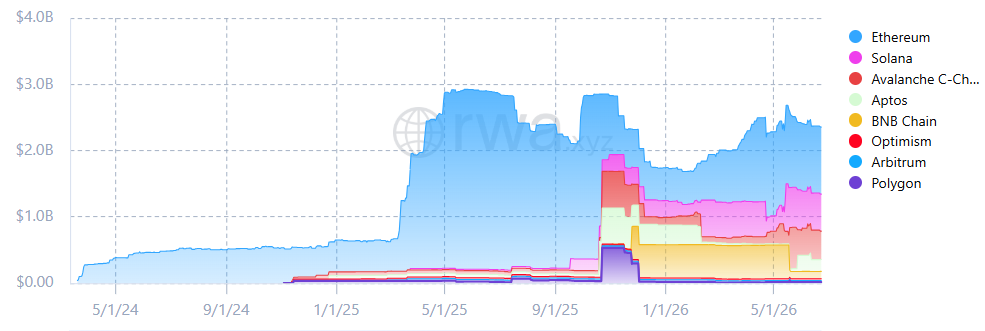
BlackRock’s BUIDL fund is the marquee product here. Launched in March 2024, it crossed $2.9 billion in total asset value by June 2025 before pulling back to around $2.23 billion — partly due to capital reallocation and intensifying competition between platforms. It’s distributed over $100 million in dividends and operates across eight chains: Ethereum, Solana, Polygon, Avalanche, Arbitrum, Optimism, Aptos, and BNB Chain. That multi-chain footprint isn’t just a technical detail; it’s a deliberate strategy to reach wherever institutional liquidity happens to be sitting.
The more interesting development came in February 2026, when Uniswap Labs and asset tokenization firm Securitize announced that BUIDL shares could be traded on UniswapX. It’s a restricted market — not everyone can participate — but the symbolism matters enormously. A regulated, institutional-grade tokenized fund landing on a decentralized exchange is the kind of bridge between TradFi and DeFi that’s been theorized for years. Carlos Domingo, CEO of Securitize, summed it up: ‘This is the unlock we’ve been working toward: bringing the trust and regulatory standards of traditional finance to the speed and openness for which DeFi is known.’
Franklin Templeton’s OnChain US Government Money Fund, represented by the BENJI token, has reached $2.44 billion across nine chains. Other significant Treasury products include Circle’s USYC at $3.1 billion, Ondo Finance’s suite at $3.7 billion, and WisdomTree’s WTGXX at $764 million. The competition in this space is real, and it’s compressing margins — which is good for buyers.
Private Credit: Higher Yield, Growing Fast
Private credit — loans originated and held by non-bank lenders — is the second-largest category in real world asset tokenization at $6.2 billion. The pitch is similar to Treasuries but with a twist: yields are higher, reflecting the additional risk. Historically, the trade-off was brutal illiquidity. Private credit positions could lock up capital for years with no realistic exit.
Tokenization changes that equation. A position in a tokenized private credit pool can be transferred on-chain, posted as collateral, or redeemed in ways that were simply impossible before. For corporate treasurers or asset managers who need flexibility, that’s a meaningful upgrade. Maple Finance and Stokr each command roughly 22% of the tokenized private credit market, putting them in a near-tied lead in a space that’s attracting serious institutional attention. Real world asset tokenization in the credit sector is proving that illiquidity is a problem blockchain infrastructure can genuinely solve.
Stocks and ETFs: Small Now, About to Get Much Bigger
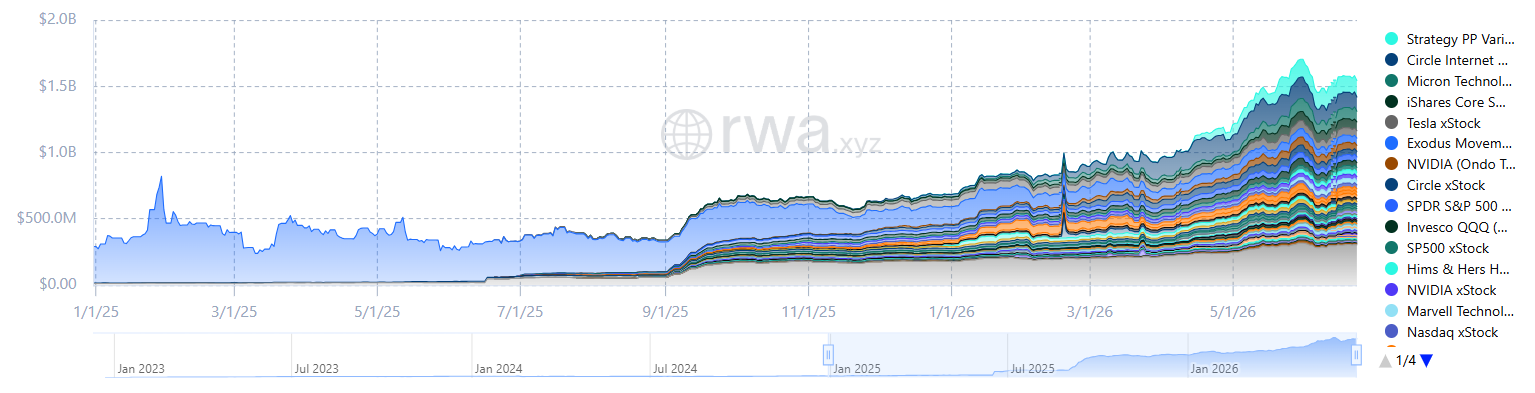
Tokenized equities are still a modest slice of the overall real world asset tokenization pie — $2.19 billion as of mid-2025 — but the growth rate is eye-catching. Values jumped nearly 50% in a single month, and the sector is about to receive a very significant catalyst.
In May 2025, the Depository Trust & Clearing Corporation (DTCC) — which clears and settles essentially all US stock trades and custodies over $114 trillion in securities — announced plans to pilot tokenized securities trading. The pilot assets include Russell 1000 equities, major index ETFs, and US Treasuries. More than 50 financial institutions signed on, including BlackRock, Goldman Sachs, JPMorgan, Citigroup, Bank of America, Morgan Stanley, Circle, Ondo Finance, and Ripple Prime. A full commercial launch is possible by October 2025.
When the DTCC moves, the entire US financial market moves with it. This isn’t a startup experiment — it’s the central nervous system of American capital markets testing whether blockchain settlement can replace its legacy systems. If the pilot succeeds, the $2.19 billion tokenized equity market could look very different by year-end.
Ondo Finance is already positioning itself for that future. It holds roughly 60% of the tokenized equity market through its Global Markets platform. In March 2026, it partnered with Franklin Templeton to tokenize five ETFs, and in April it teamed up with Broadridge Financial Solutions to let holders of tokenized stocks and ETFs submit voting preferences for the underlying shares — solving one of the trickiest governance problems in the space. Each of these partnerships advances real world asset tokenization further into the mainstream of institutional finance.
Gold and Commodities: A Stress Test Nobody Planned For
Tokenized gold has been around long enough to feel established. Paxos’s PAXG and Tether’s XAUT have traded for years. But 2026 gave the entire tokenized commodities space something no stress test in a lab could replicate: a live geopolitical crisis during market hours when traditional markets were closed.
When the US and Israel launched strikes on Iran in early 2026, Wall Street trading desks needed to price gold, oil, and other risk-off assets immediately. Traditional exchanges were dark. On-chain perpetual futures platforms were not. Desks that had previously viewed on-chain commodity markets as a curiosity suddenly found themselves using them as the only available pricing venue. Weekend volumes on on-chain commodity perpetuals have surged ninefold since the start of 2026. On-chain perpetual futures for commodities now represent more than 67% of builder-deployed contracts on decentralized exchanges.
That’s a remarkable number. It suggests that real world asset tokenization in the commodities space isn’t just a niche experiment — it’s filling a genuine gap that traditional market infrastructure can’t cover. Markets that never close have a structural advantage when crises don’t follow business hours.
Tokenized commodities peaked at $5.8 billion in March 2026 and have since pulled back to $4.7 billion, with gold making up the majority of that. Tokenized gold volumes are increasingly correlated with movements in traditional gold markets — a sign of maturation, and of genuine price discovery happening on-chain.
What Comes Next
The $32 billion figure for real world asset tokenization is large in absolute terms but still trivial relative to the size of global capital markets. US Treasuries alone represent a $27 trillion market. Real estate is orders of magnitude larger. Private credit globally is estimated at over $2 trillion. The tokenized versions of these asset classes are, right now, rounding errors.
But the infrastructure is being built at pace. The DTCC pilot, the BUIDL-on-Uniswap integration, Ondo’s ETF partnerships, and the organic growth in on-chain commodity markets all point toward a market that’s graduating from proof-of-concept to actual utility. The geopolitical stress test of early 2026 may turn out to be the moment when institutional finance quietly accepted that on-chain markets aren’t going away — and started planning around them rather than past them. As real world asset tokenization matures, Kendrick’s $2.7 trillion projection for 2030 once looked ambitious. It’s starting to look like a baseline.
Frequently Asked Questions
What is real world asset tokenization and how does it work?
Real world asset tokenization converts ownership rights in physical or financial assets — like Treasury bonds, real estate, or gold — into digital tokens on a blockchain. These tokens can be traded, used as collateral, or held in wallets, making traditionally illiquid assets far more accessible and transferable.
Which real world assets are being tokenized the most right now?
US Treasuries lead the market at $15 billion in on-chain value, followed by private credit at $6.2 billion, commodities at $4.7 billion, and stocks and ETFs at $2.19 billion. Private credit and equities are currently growing the fastest in percentage terms.
How big could the tokenized asset market get by 2030?
Standard Chartered’s head of digital assets research Geoff Kendrick predicts assets in DeFi could reach $2.7 trillion by 2030, driven by a rise in tokenized RWA usage in DeFi from roughly 10% today to around 30% — a 37-fold increase from current levels.
Is tokenized real world asset trading available on decentralized exchanges?
Yes. In February 2026, Uniswap Labs and Securitize announced that shares in BlackRock’s BUIDL fund could be traded on UniswapX, marking a significant step toward institutional-grade assets appearing on decentralized platforms.
What role did geopolitical events play in tokenized commodity growth?
When US–Iran tensions escalated in early 2026, traditional markets were closed but on-chain commodity markets weren’t. Wall Street desks used on-chain perpetual futures to price gold and oil during off-hours, pushing weekend volumes on these platforms up ninefold since the start of 2026.