
Bitcoin price is holding its ground above $62,000, but the floor beneath it is getting shakier. Renewed military exchanges between the United States and Iran have disrupted traffic through the Strait of Hormuz, sent Brent crude surging toward $80, and handed macro traders a fresh reason to reassess the Federal Reserve’s rate path — all in the space of 48 hours.
- Bitcoin price is holding above $62,000 despite renewed US-Iran hostilities that disrupted Strait of Hormuz tanker traffic.
- Bitcoin price faces headwinds as Brent crude’s 5.2% surge toward $80 revives inflation fears and complicates Fed rate-cut expectations.
- Only one tanker was spotted moving through the Strait on Thursday, compared to a daily average of 34 crossings after the ceasefire.
- Saxo Bank’s Ole Hansen warned that the geopolitical risk premium was removed from oil markets too early after the ceasefire.
Table of Contents
What’s Happening in the Strait — and Why Bitcoin Price Cares
The Strait of Hormuz is the world’s single most important chokepoint for energy exports. About 20% of global oil supply moves through its narrow waters, alongside vast quantities of liquefied natural gas. When traffic stalls there, markets don’t wait around for confirmation — they price in the risk immediately.
That’s exactly what happened this week. US forces carried out strikes on Iranian targets for a second consecutive day after Washington said commercial vessels had been attacked while transiting the waterway. Iranian media reported explosions along the country’s southern coast and on Iranian-controlled islands in the Gulf. Iran’s health ministry confirmed 14 deaths over the two nights of fighting. President Trump, posting on Truth Social, framed the strikes as retaliation and warned Tehran that any further action would bring a stronger response.

The market reaction was immediate. Brent crude settled 5.2% higher on Wednesday at $78.02 a barrel — its highest close since June 19 — briefly crossing the $80 mark during the session. US crude moved in lockstep. Bond markets reflected renewed concern that elevated energy costs could keep inflation stickier than policymakers hoped. For Bitcoin price, that combination is exactly the kind of macro headwind that interrupts momentum.
Tanker Traffic Has Nearly Stopped
The numbers coming out of shipping data firms tell a stark story. According to Bloomberg, citing Kpler tracking data, only a single tanker was detected moving through the Strait on Thursday. Traffic in the corridor closer to Oman — typically used by vessels trying to stay out of Iranian-controlled waters — was completely absent. Four oil and LNG tankers turned back rather than attempt the crossing, including three empty LNG carriers bound for Qatar’s Ras Laffan export terminal, one of the world’s largest LNG facilities.
To put that in context: in the three weeks following the US-Iran ceasefire, the Strait was seeing an average of 34 commodity vessel crossings per day. On Wednesday, just 14 made the journey. By Thursday, it was essentially one. Even without a formal closure of the waterway, that kind of traffic collapse has real consequences — shipowners start rerouting, insurance premiums spike, and buyers scramble for alternative cargoes. Each of those responses tightens energy markets further.
Ole Hansen, head of commodity strategy at Saxo Bank, put it plainly: ‘The disruption is a reminder that the Strait never fully reopened and that the recent removal of the geopolitical risk premium may have been premature.’ That’s a pointed observation. When the ceasefire was struck last month, oil prices eased as traders breathed a sigh of relief and started pricing in smoother Persian Gulf flows. This week’s escalation is forcing a reassessment of those assumptions.
Bitcoin Price Caught Between Support and Rate Risk
Here’s the core problem for Bitcoin price right now. The digital asset is only just finding its footing after a difficult June — a period marked by weaker institutional fund inflows, rising exchange supply, and tighter overall liquidity. It hasn’t yet built the kind of sustained demand base that would make the recovery less sensitive to macro disruptions. So when oil spikes and rate expectations shift, Bitcoin feels it faster than it might in a healthier market environment.
The mechanism is straightforward. Higher crude prices push up transportation and production costs across the economy, feeding inflation expectations. Elevated inflation expectations push bond yields higher. Rising yields reduce the probability that the Federal Reserve will cut rates anytime soon. And a ‘higher-for-longer’ interest rate environment is one of the least friendly backdrops imaginable for speculative assets — which Bitcoin, whatever its long-term merits, still behaves like in the short run.

Markets had been edging toward the view that softer inflation data and a weakening US labour market would eventually give the Fed enough cover to ease. That narrative isn’t dead, but it’s taken a hit. Reuters reported that short-dated yields rose in response to Brent’s advance, with traders pricing in more tightening risk from major central banks. Hansen acknowledged the tension: while higher oil raises the risk of persistent inflation, recent softness in US jobs data could still restrain the Fed from moving aggressively toward another rate increase. It’s a genuinely uncertain picture.
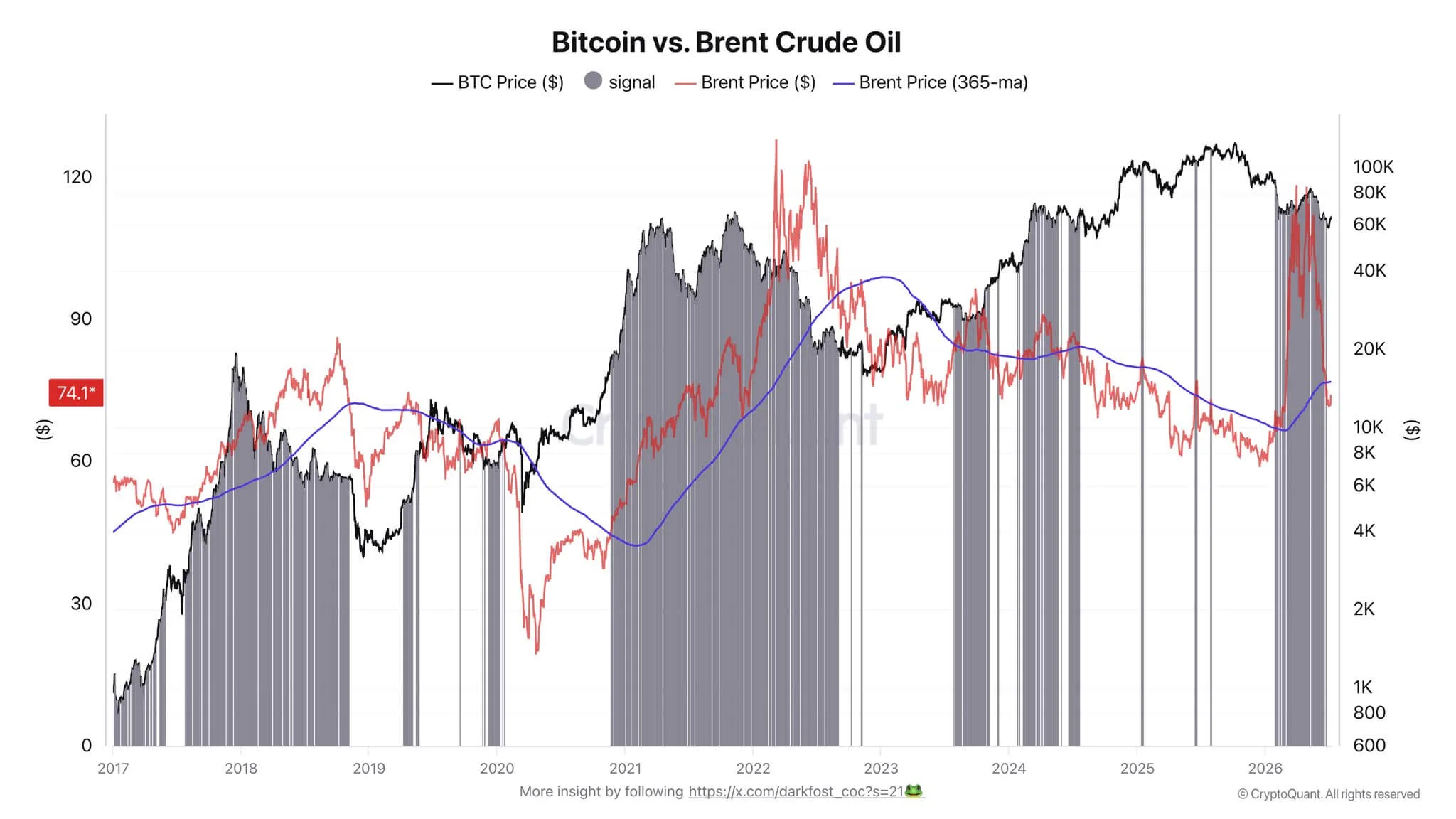
CryptoQuant analysts added another layer of historical context, noting that Brent crude moving above its annual average has typically coincided with tougher conditions for Bitcoin. That’s not a deterministic relationship — there are plenty of confounding variables — but it’s a pattern worth tracking. Right now, Brent is flirting with exactly that threshold.
Can the $60,000 Floor Hold?
Despite all of this, Bitcoin price hasn’t broken down. Trading near $63,000 on Thursday, it’s held above the $60,000 level that traders have treated as a critical line in the sand since last month’s selloff. Sellers haven’t forced a deeper break, which is, in its own way, a meaningful signal. The question is whether that resilience reflects genuine buying conviction or simply a lack of aggressive selling pressure — two very different things with very different implications for what comes next.
There are scenarios here that cut both ways. If tanker traffic recovers quickly and crude retreats from the $80 area, the inflation-and-Fed narrative loses its edge, risk appetite returns, and Bitcoin has a cleaner runway. If the US-Iran situation escalates further — or if energy prices stay elevated long enough to show up in the next round of inflation data — the Fed trade becomes Bitcoin’s biggest obstacle going into the back half of the year.
What’s clear is that Bitcoin price is no longer trading in a vacuum. The correlation between macro conditions and crypto performance has been a recurring theme throughout 2024, and this week’s events reinforce that the two can’t be cleanly separated. Geopolitics, energy markets, central bank policy, and digital asset prices are all pulling on the same rope — and right now, the direction of that pull is very much in question.