


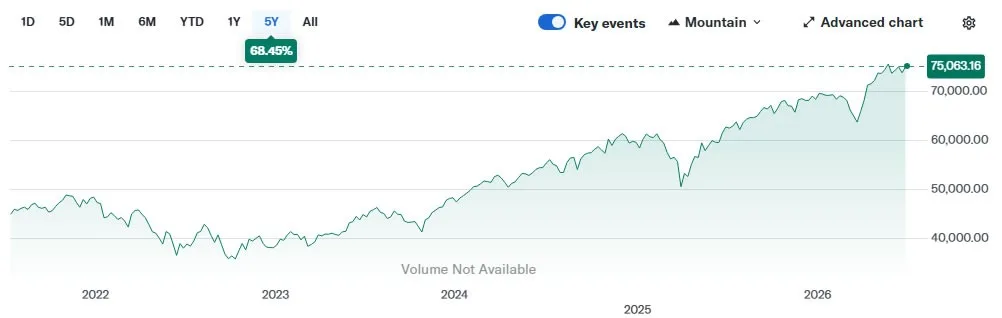
The phrase ‘too big to fail’ was once reserved for banks. Now, some analysts are applying it to the entire US stock market — and the implications for crypto could be significant. Talk of a Fed crypto boost is growing louder as experts warn that a major equity correction might force the Federal Reserve into territory it has never entered before: buying stock ETFs to prop up a $75 trillion market.
- A Fed crypto boost is likely if the central bank intervenes in equities, as expanded liquidity historically drives Bitcoin uptrends.
- Analysts say a Fed crypto boost mirrors the 2021 cycle, where rate cuts and balance-sheet expansion pushed capital into high-beta assets.
- Bloomberg ETF analyst Eric Balchunas believes the Fed buying equity ETFs in a major downturn could become standard practice going forward.
- Despite inflation constraints, analysts note the Fed has multiple tools beyond money-printing that could still catalyse a crypto rally.
Table of Contents
A $75 Trillion Market That Can’t Be Allowed to Fall
The numbers are staggering. The US equity market has grown by 68% over the past five years and has added roughly $6 trillion in market value so far this year, according to the Wilshire 5000 Total Market Index. That kind of growth is extraordinary — and it cuts both ways. The bigger the market gets, the more catastrophic any serious correction becomes, and the stronger the incentive for policymakers to intervene. Many observers tracking a potential Fed crypto boost see this dynamic as the foundational trigger.
Eric Balchunas, Bloomberg’s ETF expert, made a striking prediction this week: in the next major downturn, there’s a ‘good chance the Fed will buy equity ETFs to support the market, and it will be common practice going forward.’ That’s not a fringe take from a crypto enthusiast — it’s a mainstream financial analyst saying the rules of the game may be about to change permanently.
What makes Balchunas’s view credible is the precedent already on the books. In 2020, when COVID-19 froze credit markets almost overnight, the Fed did something unprecedented: it bought corporate bond ETFs to act as buyer of last resort, ultimately acquiring $8.7 billion worth of them. The move helped limit economic damage and restored market confidence faster than most expected. Balchunas’s argument is that the next crisis simply scales that playbook up — from bonds to stocks. A Fed crypto boost could follow from exactly that kind of escalation.
There’s also international context here. China and Japan’s central banks already use indirect equity ETF purchases — channelled through authorised intermediaries — to stabilise their domestic markets. The US would be catching up, not pioneering.
Why a Fed Crypto Boost Is More Than Speculation
Here’s where the story gets interesting for crypto markets. The logic behind a potential Fed crypto boost isn’t that Bitcoin would receive any direct support — it obviously wouldn’t. The argument is subtler and more structural than that.
Alvin Kan, chief operating officer of Bitget Wallet, put it clearly: ‘Once the Fed steps in — rate cuts, balance-sheet expansion, even targeted ETF purchases — crypto has historically entered a medium-to-long-term uptrend, similar to what we saw in 2021, as risk appetite returns and capital rotates back into high-beta assets.’ This is precisely the mechanism that makes a Fed crypto boost a credible thesis rather than wishful thinking.
That 2021 comparison is apt. When the Fed flooded the system with liquidity following the pandemic shock, Bitcoin went from around $10,000 in late 2020 to nearly $69,000 by November 2021. It wasn’t a coincidence. Loose monetary conditions push investors up the risk curve, and crypto sits at the far end of that curve. A repeat of that liquidity expansion — even a partial one — could have a similar directional effect.
Tim Sun, senior researcher at HashKey Group, frames the connection in macro terms. Crypto’s pricing, he argues, ‘remains fundamentally tied to US dollar liquidity, real interest rates, and equity market risk sentiment.’ When those conditions improve — when policy signals that a floor exists under risk assets — the risk premium investors demand for volatile assets compresses. Bitcoin and mainstream crypto tokens, in that environment, are ‘poised to benefit significantly from improving liquidity expectations and a broader revival in risk appetite,’ Sun told Cointelegraph. That improving backdrop is the essence of the Fed crypto boost argument.
In plain terms: the Fed doesn’t need to care about crypto at all for crypto to benefit enormously from what the Fed does.
The Political Pressure No One Is Talking About Enough
Balchunas raised a point that often gets buried in macro analysis but is arguably the most important driver here: 58% of Americans own stocks. That’s not a Wall Street statistic — that’s pension funds, 401(k)s, retail brokerage accounts, and retirement savings for tens of millions of ordinary households. A prolonged bear market doesn’t just hurt hedge funds. It wipes out retirement security for a significant share of the electorate.
‘The political pressure to keep stocks out of a prolonged bear market is going to be very powerful,’ Balchunas said. That’s almost certainly an understatement. Any administration facing an election cycle in the middle of an equity collapse would face enormous pressure to act — and the Fed, while nominally independent, doesn’t operate in a political vacuum. That same pressure is one reason the Fed crypto boost scenario is taken seriously by macro strategists.

HashKey’s Tim Sun spells out what a severe bear market actually means beyond portfolio losses: it ‘would directly shock consumer spending, compromise pension stability, stall corporate credit expansion, and dent tax revenues.’ That’s not a financial crisis — that’s a social one. And governments facing that kind of pressure historically find ways to respond, conventional or otherwise.
The Inflation Complication
None of this is without friction. Jeff Mei, the operating chief of BTSE, offers a useful counterpoint: with inflation still elevated, it’s genuinely ‘difficult to see the Fed printing more money to stimulate’ in a downturn. The Fed’s credibility as an inflation-fighter — rebuilt painfully over 2022 and 2023 — would take a serious hit if it pivoted to stimulus the moment equities wobbled.
But Mei also notes the Fed ‘has other tools it can deploy to take action’ — and this matters. Targeted ETF purchases aren’t the same as quantitative easing. Lending facilities, regulatory adjustments, and coordinated fiscal policy with the Treasury are all options that don’t require the Fed to explicitly ‘print money.’ The Fed crypto boost scenario doesn’t depend on a return to zero interest rates — it just needs a meaningful signal that the central bank stands behind risk assets.
Kan’s view is that such a structural backstop, even implicitly, ‘supports a more resilient macro backdrop, and that’s ultimately bullish for crypto’s role as a growth and diversification asset in a world of expanding global liquidity.’ Each of these policy pathways, taken together, reinforces why a Fed crypto boost remains a live possibility even in an inflationary environment.
What This Means for Crypto Investors Right Now
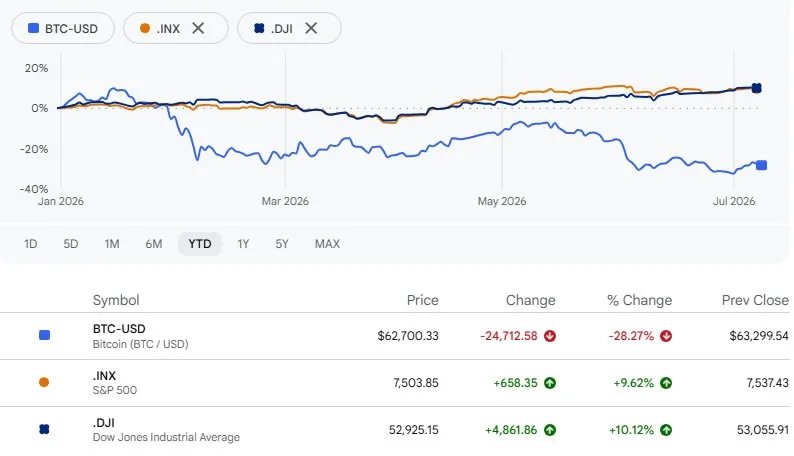
It’s worth being honest about where Bitcoin and crypto actually stand today. Despite the bullish macro thesis, Bitcoin has underperformed US equity markets so far this year — a fact that should temper some of the more excited projections. The Fed crypto boost narrative is a forward-looking argument about what happens when conditions deteriorate enough to force intervention, not a description of what’s happening today.

The warnings from figures like Peter Schiff — a longtime bear who has argued that years of rapid market growth are setting up a major correction — are also worth filing away. Schiff has been wrong about timing repeatedly, but the structural concern about overextended valuations isn’t unique to him. If a correction does come, the severity and duration will determine whether the Fed actually crosses the ETF-purchasing threshold or tries to manage the damage through more conventional tools.
What the current conversation signals, though, is a broader shift in how analysts and institutional observers are thinking about the relationship between central bank policy and crypto markets. The old binary — ‘risk-off means sell crypto’ — is giving way to something more conditional: risk-off triggers intervention, intervention expands liquidity, and liquidity eventually finds its way into Bitcoin. The chain of events is longer and less certain than crypto bulls sometimes admit, but the directional logic is increasingly hard to dismiss.
If the Fed does eventually step in — whether through ETF purchases, rate cuts, or balance-sheet expansion — crypto won’t be the intended beneficiary. But markets rarely care about intentions. Capital flows to wherever the return looks best once the fear premium fades. And in an environment where the world’s most powerful central bank is explicitly backstopping risk, high-beta assets like Bitcoin have historically been among the first to respond. That, in essence, is the Fed crypto boost thesis — and it grows harder to ignore with every passing policy debate.
Frequently Asked Questions
How would a Fed crypto boost actually work in practice?
If the Fed expands its balance sheet or cuts rates to backstop equities, dollar liquidity increases across all risk assets. Crypto, being a high-beta asset class, tends to attract capital inflows as investor risk appetite recovers — a dynamic analysts compare to what was seen in 2021.
Has the Federal Reserve ever bought ETFs before?
Yes. During the COVID-19 pandemic in 2020, the Fed purchased approximately $8.7 billion worth of corporate bond ETFs to act as a buyer of last resort and restore liquidity to frozen credit markets — a move that was unprecedented at the time.
Does high inflation prevent the Fed from stimulating markets?
It complicates things. BTSE’s operating chief Jeff Mei says it’s difficult to see the Fed printing money outright while inflation remains elevated, but he notes the central bank has other tools it can deploy to take action.
Why is the US stock market considered too big to fail?
The US equity market is valued at roughly $75 trillion and has grown 68% over five years. With 58% of Americans owning stocks — tying retirement savings and consumer wealth to market performance — the political pressure to prevent a prolonged bear market is enormous.

