

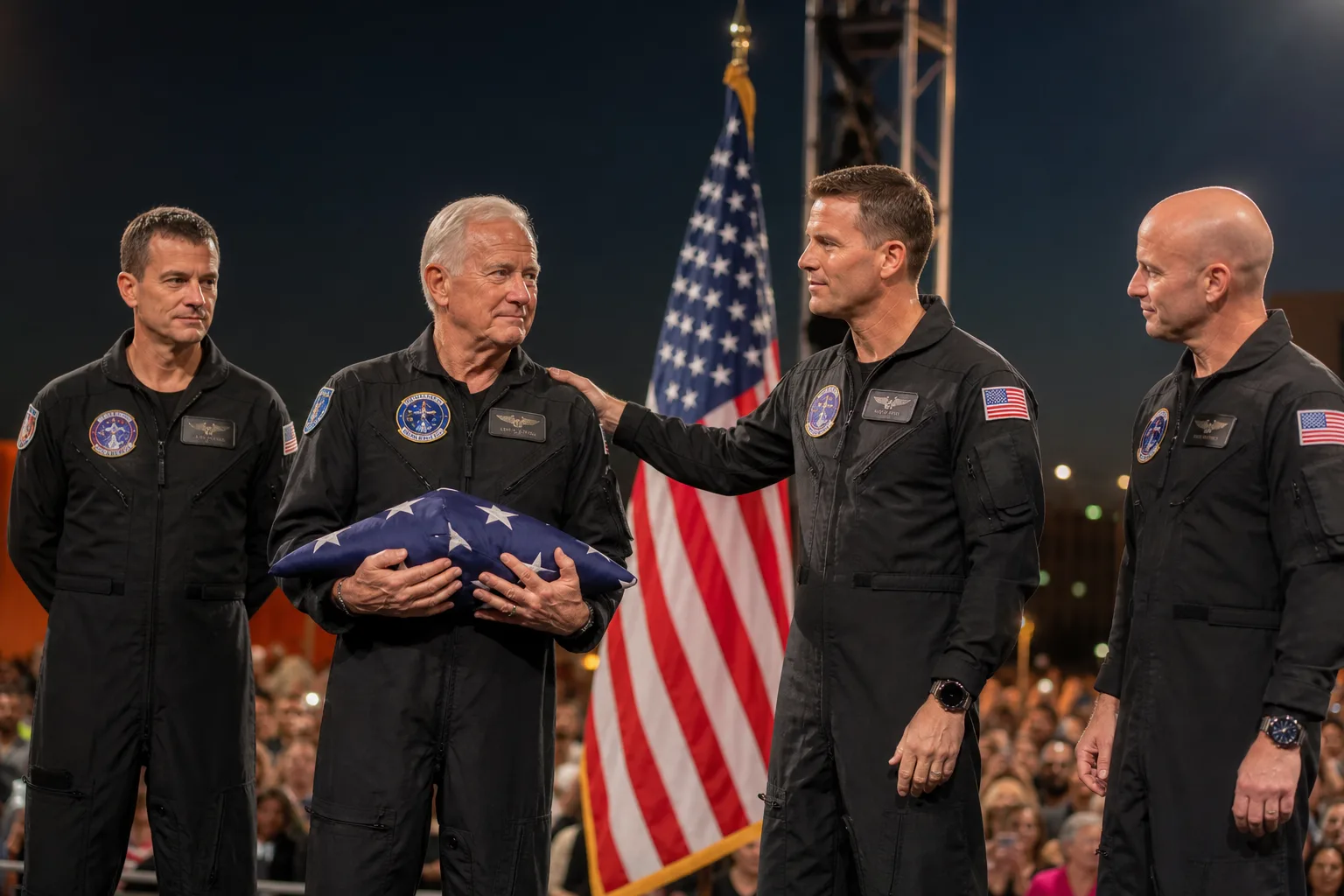
The Artemis moon mission has a flag. That might sound like a small detail — but on the night of July 4, in front of some of the most historically charged banners in American history, it became one of the most resonant moments NASA’s return-to-the-moon program has had since the Orion capsule splashed down in April. During the America 250 celebrations in Washington, D.C., a US Capitol flag was presented to the crew of Artemis II with a direct instruction: plant it on the moon.
- The Artemis moon mission crew received a US Capitol flag from Trump on July 4, to be planted on the lunar surface.
- Apollo 17 astronaut Jack Schmitt accepted the flag, symbolically bridging the Apollo era and the Artemis moon mission.
- NASA is targeting Artemis III for mid-to-late 2027, with Artemis IV set to be the first crewed lunar landing in 2028.
- Artemis II flew further from Earth than any crewed spaceflight in history during its April 10-day mission around the moon.
Table of Contents
A Ceremony Built Around History
Trump’s keynote address on the National Mall was dense with symbolism. The stage was flanked by a remarkable collection of American flags — the oldest known surviving example from 1777, the flag that draped Abraham Lincoln’s casket, and one carried by Lewis and Clark during their 1803 expedition. These weren’t props. They were a deliberate framing device, and the Artemis moon mission crew was placed squarely within that tradition.
What made the moment land, though, was who handed the flag over. US Air Force Maj. Kaitlyn Tinkham carried the folded Capitol flag onto the stage and passed it to Apollo 17 astronaut Jack Schmitt — one of the last two humans to have walked on the lunar surface, back in December 1972. Standing next to Schmitt was Artemis II commander Reid Wiseman, who put a hand on the older astronaut’s shoulder as both men held the weight of what the flag represented. It was the kind of unscripted, quietly powerful image that no press team could manufacture.
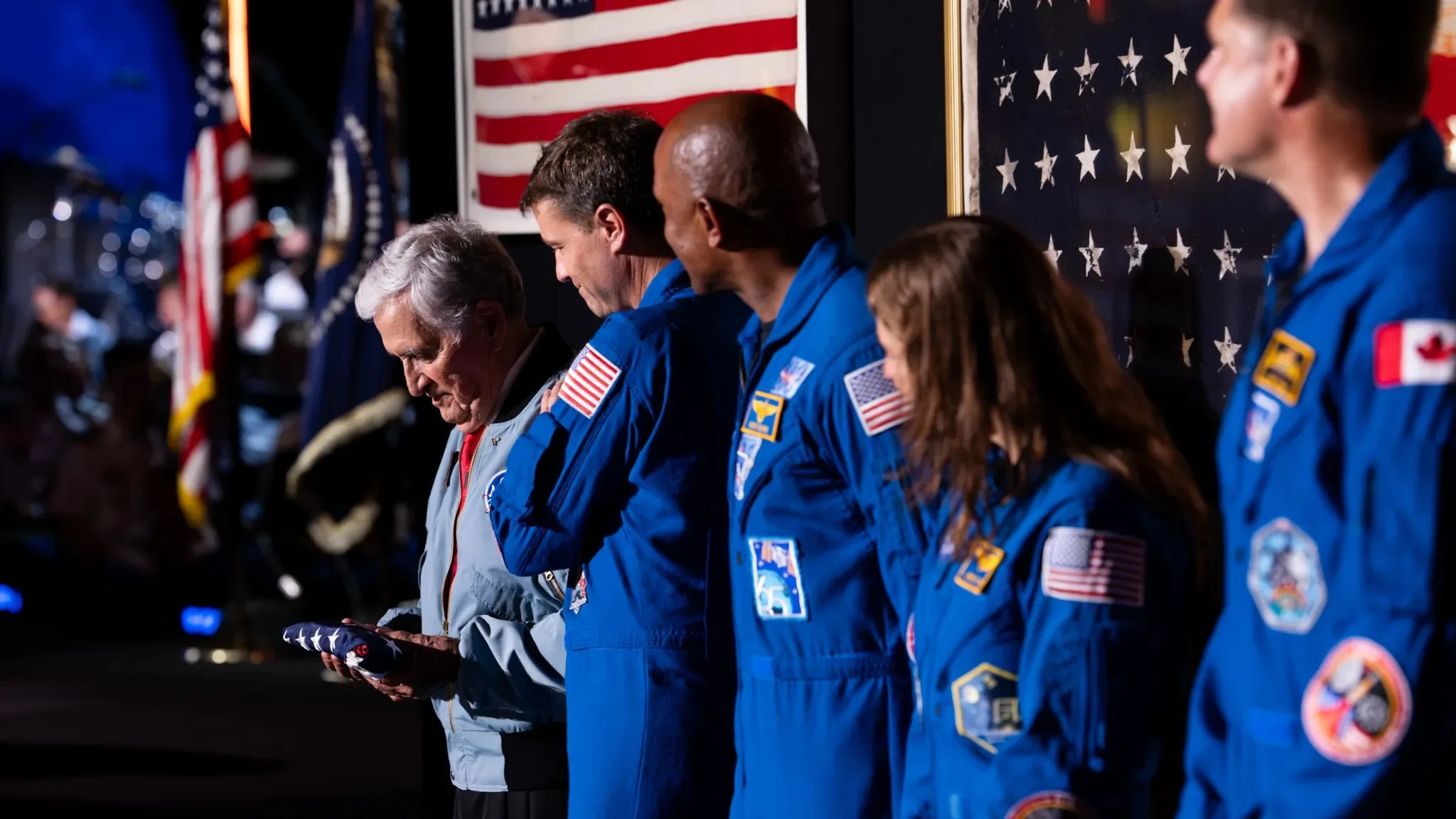
‘Within 66 years of inventing the airplane, Americans planted our flag on the moon,’ Trump told the crowd. ‘Just three months ago, we sent American astronauts back to the far side of the moon, and this time they flew further from Earth than anyone has ever flown before.’ He then told the audience he had ‘a special gift for these patriots’ before Tinkham appeared with the flag. ‘This morning, on America’s 250th birthday, a new flag was flown above the United States Capitol,’ Trump said. ‘Tonight I present it to you, to soon be planted by American astronauts on their upcoming return to the moon.’
What the Artemis Moon Mission Has Already Done
It’s easy to lose track of just how significant the Artemis moon mission’s second flight actually was. The crew — Wiseman, NASA astronauts Victor Glover and Christina Koch, and Canadian Space Agency astronaut Jeremy Hansen — launched aboard NASA’s Orion spacecraft on April 1 and spent 10 days in space, looping around the far side of the moon. No crewed spaceflight in history had gone further from Earth. Not Apollo. Not the International Space Station. Nothing.
The mission captivated a public that, frankly, had grown somewhat accustomed to the slow, years-long cadence of Artemis development. After repeated delays to the uncrewed Artemis I test flight and then the timeline for a crewed mission, actually seeing four astronauts flying around the moon — live, with real-time updates — was a jolt. Splashdown drew a large audience across NASA’s streams and broadcast partners. For a space agency that sometimes struggles to cut through the noise, it was a reminder of what human spaceflight can still do to people.
Hansen, notably, has since announced his retirement from the Canadian Space Agency’s astronaut corps. His career arc — from fighter pilot to the person who flew further from Earth than any Canadian in history — is the kind of thing that tends to inspire the next generation of applicants. That matters for the long game of building an international lunar programme.
The Artemis Moon Mission Road Ahead: 2027, 2028, and Beyond
With the ceremonial moment now captured in photographs and video that will be replayed for decades, the practical question is: what comes next? The Artemis moon mission schedule, as it currently stands, is ambitious — and NASA knows better than most that schedules in this programme have a way of shifting.
Artemis III is currently targeted for mid-to-late 2027. Crucially, this won’t be a lunar landing — it’s an Orion mission to low Earth orbit designed to validate rendezvous and docking operations with the programme’s two commercial lunar lander vehicles: SpaceX’s Starship and Blue Origin’s Blue Moon. Getting two of the most complex spacecraft ever built to meet reliably in orbit before anyone commits a crew to a lunar descent is exactly the kind of cautious sequencing that spaceflight engineers insist on, even when it frustrates people expecting faster progress.
Artemis IV, scheduled for 2028, is the first mission slated to put astronauts back on the lunar surface for the first time since Schmitt and Gene Cernan climbed back into the Apollo 17 lunar module in 1972. No crew has been named for Artemis IV yet — but whoever those astronauts are, the flag they’ll plant is already in NASA’s possession. The Artemis moon mission has moved from concept to counted-down hardware, and that’s a small but real step forward.
Why This Moment Is Bigger Than the Optics
There’s a cynical read of the July 4 ceremony: a president using NASA astronauts as set dressing during a patriotic spectacle. That’s not entirely wrong. Political pageantry and space exploration have been intertwined since Kennedy’s Rice University speech in 1962, and there’s nothing new about presidents wrapping themselves in rocket imagery.
But the substance here is real. The Artemis moon mission is the most credible attempt to return humans to the moon since the Apollo programme ended — and it’s happening in a genuinely different context. The commercial partnerships with SpaceX and Blue Origin mean the programme isn’t purely a NASA-government endeavour. The international crew structure, with Hansen representing Canada’s long-standing partnership with NASA, signals that the Artemis moon mission isn’t framed as a purely American flag-planting exercise in the geopolitical sense either, even if the rhetoric on stage leaned heavily in that direction.
Schmitt’s presence on that stage also carries a quiet urgency. He and Cernan were meant to be the first of many. Instead, no human has returned to the moon in over 50 years. The handoff of a flag from the last man to leave the lunar surface to the crew preparing to go back wasn’t just good television. It was a reminder that this has already taken far longer than anyone expected — and that the window to close that gap, with people who were actually there still alive to see it, is not indefinite.
Whether NASA hits 2028 or slips another year or two, the Artemis moon mission is now moving with more momentum than it’s had at any point since Artemis I lifted off in November 2022. A flag has been assigned. A crew has flown. The hardware is being built. The next chapter of human lunar exploration isn’t a distant aspiration anymore — it’s an engineering and logistics problem, which is exactly where NASA tends to do its best work.
Frequently Asked Questions
What is the Artemis moon mission trying to accomplish?
NASA’s Artemis program aims to return astronauts to the lunar surface and eventually establish a permanent base on the moon. Artemis II was the first crewed mission, and Artemis IV is slated to deliver astronauts to the surface in 2028.
Who were the Artemis II crew members at the July 4 ceremony?
The four-person Artemis II crew consists of commander Reid Wiseman, NASA astronauts Victor Glover and Christina Koch, and Canadian Space Agency astronaut Jeremy Hansen, who recently announced his retirement.
When will the flag be planted on the moon?
No crew has been officially announced for Artemis IV, the mission slated to actually land on the lunar surface, currently scheduled for 2028. The flag presented on July 4 will travel to the moon aboard that mission.
How far did the Artemis moon mission travel from Earth?
The Artemis II crew flew further from Earth than any crewed spaceflight in history during their 10-day mission in April, looping around the far side of the moon aboard NASA’s Orion spacecraft before splashing down safely.

