

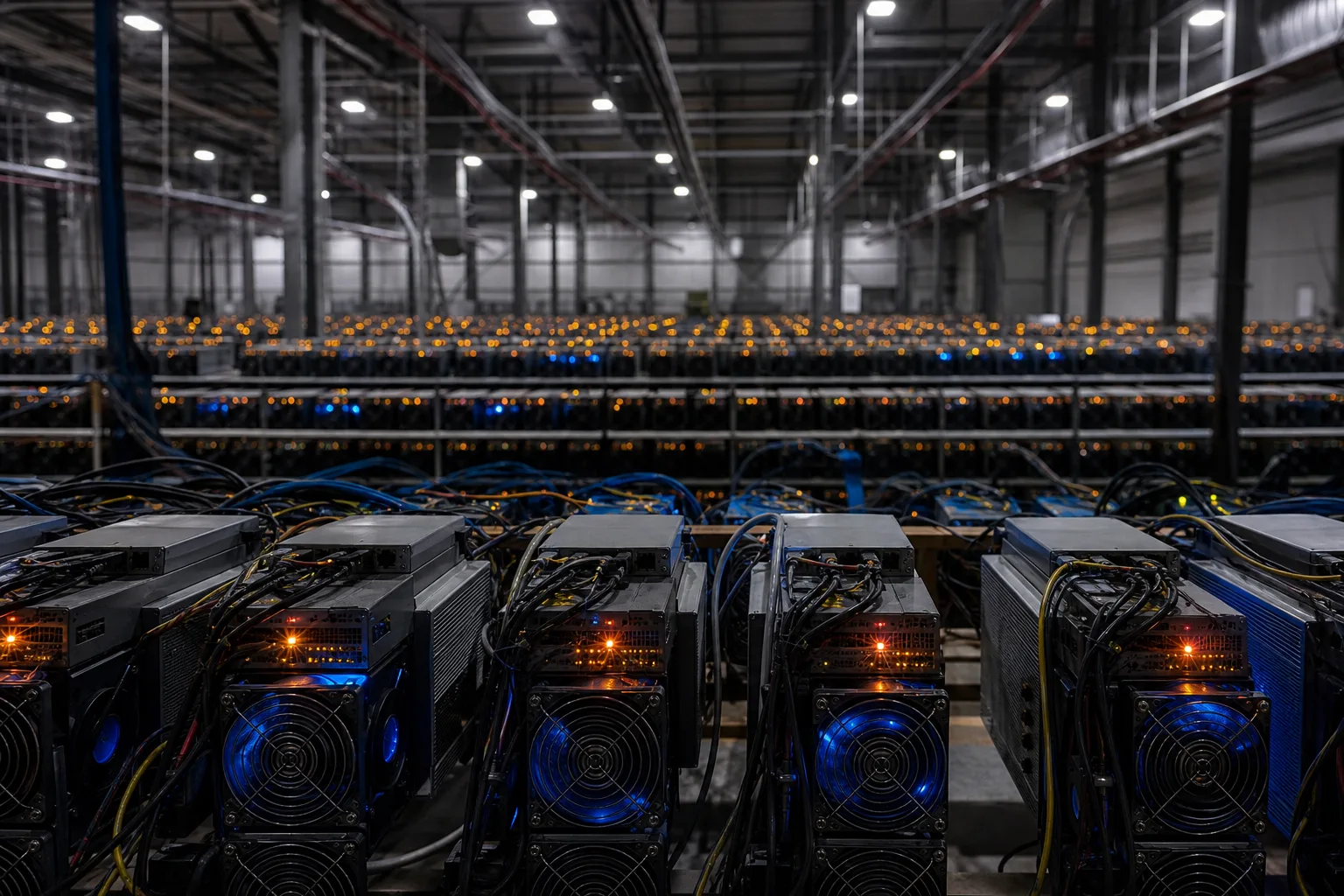
The bitcoin mining pools landscape in 2026 looks almost unrecognisable compared to just three or four years ago. Post-halving economics, relentlessly climbing network difficulty, and tightening margins have squeezed the industry hard — and the clearest sign of that pressure is the extraordinary concentration of hashrate into the hands of a tiny number of pool operators.
- Bitcoin mining pools are more concentrated than ever, with just four pools controlling over 70% of network hashrate in 2026.
- The largest bitcoin mining pools are increasingly optimised for institutional clients, leaving independent and mid-size miners underserved.
- Foundry Digital leads with roughly 31% of network hashrate, built almost entirely for large-scale corporate operators.
- Pools like EMCD are filling the gap with lower fees and direct client support for miners who don’t meet institutional thresholds.
Table of Contents
Four Bitcoin Mining Pools Now Own the Network
According to data from miningpoolstats.stream, as of late June 2026, just four pools — Foundry Digital, AntPool, ViaBTC, and F2Pool — account for more than 70% of Bitcoin’s total hashrate. That number alone should stop anyone interested in the health of the network in their tracks. Bitcoin was designed as a decentralised system, and at its core, that decentralisation depends on no small group being able to exert undue influence over block production. When four companies control nearly three quarters of the compute, that foundational principle starts to look fragile.
But there’s a second, less-discussed consequence of this concentration that’s arguably more immediately relevant to the average miner: the bitcoin mining pools with the most hashrate have systematically reoriented themselves around institutional clients. The result is a two-tier market where large operators get custom terms, dedicated support, and preferential fee structures — while everyone else navigates systems that weren’t built for them.
Breaking Down Who Controls What
Foundry Digital sits at the top of the table with roughly 31% of network hashrate — a remarkable position for a pool that didn’t even exist a decade ago. Backed by Digital Currency Group and headquartered in the United States, Foundry has built its entire operation around institutional-grade compliance. Strict KYC requirements, regulatory focus, and fee structures negotiated privately based on hashrate volume define the Foundry experience. For publicly traded mining companies and large data centre operators, that’s exactly what they want. For an independent miner running a few hundred machines, Foundry is effectively off-limits — either inaccessible or simply impractical.
AntPool holds roughly 18% of hashrate and benefits enormously from its relationship with parent company Bitmain, the world’s dominant ASIC manufacturer. The pool supports both FPPS and PPLNS payout models and offers merged mining across several chains, which is a genuine technical advantage. But in practice, AntPool’s service orientation tracks closely with Foundry’s. Miners who need anything outside the standard operational template — flexible fee discussions, responsive human support, custom arrangements — frequently find themselves in automated ticketing loops with limited resolution. Among the leading bitcoin mining pools, AntPool functions well if you’re a large account. If you’re not, you’ll feel it.
F2Pool, one of the oldest continuously operating bitcoin mining pools in the industry with roots going back to 2013, commands around 10% of hashrate. Its globally distributed server infrastructure is a legitimate strength — latency stays low for miners across multiple time zones, and its dual support for FPPS and PPLNS gives operators some flexibility in how they manage payout risk. The longevity is reassuring. But scale cuts both ways: F2Pool’s support approach has standardised over the years, which suits sophisticated large-scale operations that rarely need anything outside the ordinary, but can be frustrating for smaller farms dealing with non-routine issues.
ViaBTC at roughly 13% has historically set itself apart through flexibility — offering PPS+, PPLNS, and even solo mining within a pool framework. It’s not tied to any hardware manufacturer, which gives it a degree of independence that AntPool simply can’t claim. Historically strong in CIS and Asian markets, ViaBTC has attracted a loyal user base. But 2026 has introduced new complications. The pool has faced increasing regulatory scrutiny, and there are credible reports of account restrictions, sudden KYC demands, and temporary fund freezes — particularly affecting miners based in Russia and other CIS countries. For that segment of the market, ViaBTC has become a riskier proposition than it used to be, and many operators are actively reviewing alternative bitcoin mining pools as a result.
The Gap That’s Opening Up in Bitcoin Mining Pools
Step back from the individual pool profiles and a clear structural problem emerges. The bitcoin mining pools with the most hashrate — and therefore the most legitimacy, stability, and technical infrastructure — have all made the same rational business decision: optimise for the clients with the most volume. Large mining companies, publicly listed operators, and institutional data centres generate the hashrate numbers that matter to a pool’s competitive position, so it makes sense to build services around them.
What that leaves behind is a sizeable portion of the global mining population: independent operators, small farm owners, and mid-size businesses that generate real hashrate but don’t meet the thresholds required for institutional treatment. They’re pointed at bitcoin mining pools that weren’t designed for their scale, fighting for attention in support queues built for much larger accounts, and paying fee structures that weren’t negotiated with their economics in mind.
This isn’t a new phenomenon in tech-adjacent industries. The same pattern played out in cloud computing, where AWS and Azure spent years iterating almost exclusively on enterprise features while smaller developers scraped by on whatever the platform happened to expose. Eventually, the gap created space for more developer-friendly alternatives. Something similar appears to be happening in bitcoin mining pools right now.
Who’s Filling the Void
The most concrete example of a pool trying to address this gap is EMCD. With over 30 EH/s of contributed hashrate and a position in the global top ten, EMCD isn’t a scrappy newcomer — it has genuine scale. But its operating philosophy is meaningfully different from the institutional giants above it in the rankings.
EMCD’s advertised fee under FPPS starts at 1.5%, which compares favourably with the 4% charged by many comparable bitcoin mining pools. That’s a real difference in take-home revenue at any scale, but it compounds significantly for miners operating on thin margins in the current cycle. More importantly, the pool positions itself as offering comparable levels of support and engagement to both independent miners and large data centres — a direct contrast to the tiered service models the big four have adopted. The team negotiates custom terms directly with clients based on hashrate, rather than routing everyone through standardised templates.
EMCD also brings over nine years of operational history to the table. In a market where difficulty is climbing, margins are compressing, and regulatory complexity is increasing, that depth of experience matters. Bitcoin mining pools that have navigated multiple market cycles — the 2018 bear market, the 2020 halving, the 2022 collapse — understand operational risks that newer entrants simply haven’t encountered yet.

What Miners Should Actually Be Thinking About
Pool selection in 2026 isn’t just about fee percentages. It’s a decision that touches network decentralisation, operational resilience, payout reliability, and regulatory exposure — all at once. The halving cycle has a way of forcing clarity on decisions that miners could afford to be casual about in more forgiving market conditions.
For large institutional operators, the top-tier bitcoin mining pools make obvious sense. Foundry’s compliance infrastructure, for instance, is genuinely valuable to publicly traded companies with audit requirements and SEC scrutiny. The institutional focus isn’t a bug for that customer — it’s the product.
But for independent miners and mid-size operators, the current concentration of hashrate in bitcoin mining pools that weren’t designed for them is a practical problem that’s only going to intensify. Network difficulty isn’t going to drop. Margins aren’t going to expand dramatically. The economics of the current cycle make every percentage point of pool fees and every hour of unresolved support issue count in ways they didn’t when Bitcoin was trading at different levels.
The consolidation at the top of the hashrate distribution looks structurally stable for the foreseeable future — the institutional pools have too many advantages in scale, compliance infrastructure, and existing client relationships to lose significant ground quickly. But that same consolidation is making the case for alternatives stronger with every passing month. For miners who feel increasingly invisible to the bitcoin mining pools dominating the charts, that calculus around where to point their machines is shifting — and it probably should be.
Frequently Asked Questions
Which bitcoin mining pools control the most hashrate in 2026?
As of mid-2026, Foundry Digital leads with around 31% of network hashrate, followed by ViaBTC at 13%, AntPool at 18%, and F2Pool at 10%. Together, these four bitcoin mining pools account for over 70% of Bitcoin’s total compute.
Why are smaller miners struggling with the current pool landscape?
The dominant pools have structured their fee models, KYC requirements, and support systems around institutional clients. Independent miners often face non-negotiable fee structures, automated support queues, and access barriers that make these pools impractical for smaller operations.
What fees do the top bitcoin mining pools typically charge?
Fee structures at the largest pools like Foundry and AntPool are often negotiated privately or not publicly disclosed. Pools targeting a broader client base, like EMCD, advertise fees starting at 1.5% under FPPS — significantly below the 4% charged by many comparable pools.
Does hashrate concentration in bitcoin mining pools threaten network decentralisation?
It’s a genuine concern. When four entities control more than 70% of Bitcoin’s hashrate, the theoretical risk of coordinated attacks on the network increases. The source notes this raises legitimate questions about network decentralization, though it frames it as a structural issue rather than speculating on its immediacy.

