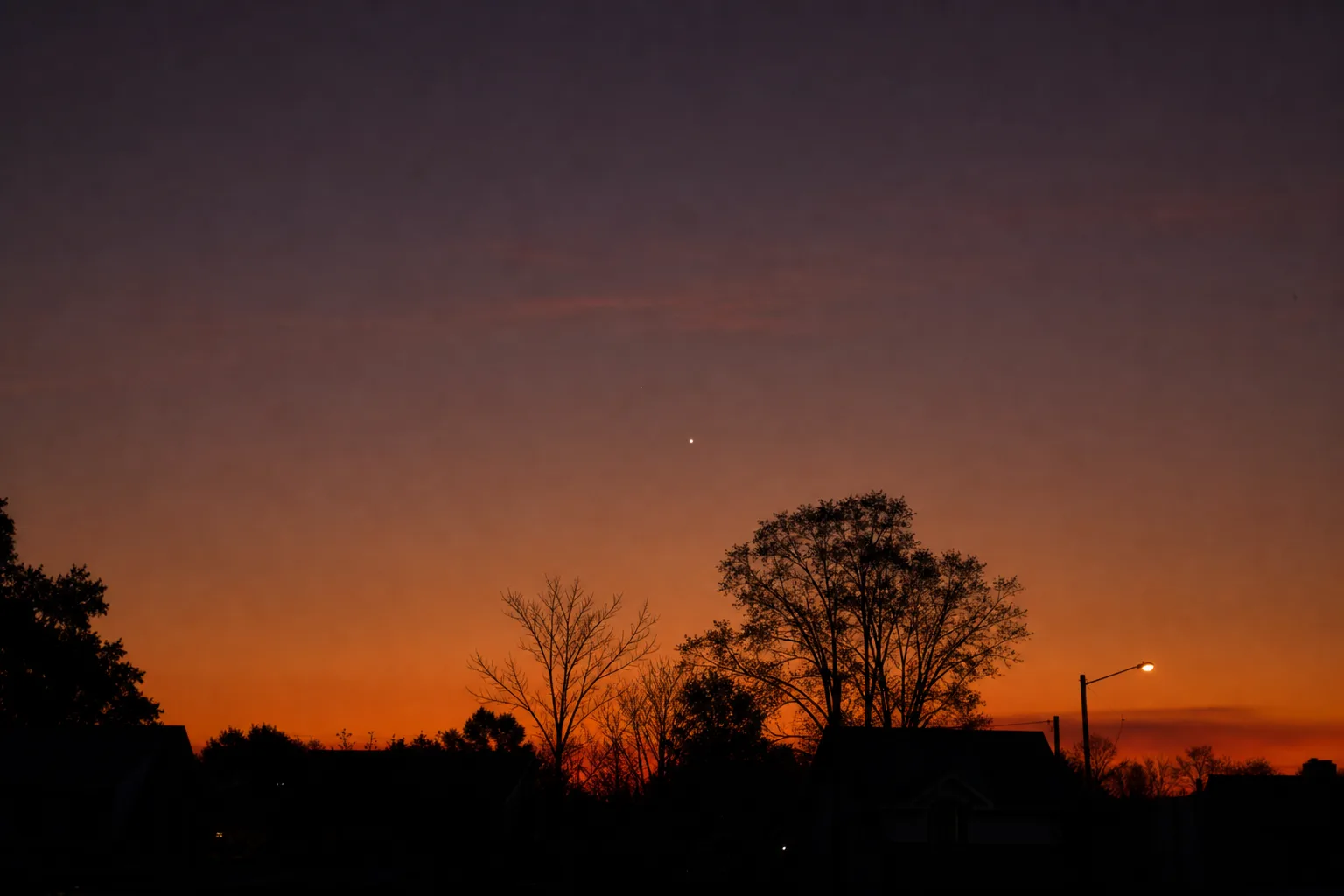
The Venus sky shows arriving this July are exactly the kind of celestial moments that remind you how good naked-eye astronomy can be — no equipment required, no dark-sky site needed, just a clear western horizon and a willingness to step outside after dinner. Between July 7 and July 17, Venus stages two distinct appearances: a tight pairing with Regulus, the lead star of Leo the Lion, followed by a rendezvous with a slender crescent moon. Both events are straightforward to find and genuinely worth your time.
- Venus sky shows this July include a close pass by Regulus on July 9 and a crescent moon pairing on July 17.
- Both Venus sky shows are visible to the naked eye low in the western sky around 9:45 p.m. local time.
- Venus outshines Regulus by roughly 158 times, making it the unmistakable anchor of the western twilight.
- After its August 15 peak elongation, Venus begins sinking toward an October inferior conjunction before rising in the morning sky.
Table of Contents
Venus Sky Shows: What’s Actually Happening Up There
To understand why these Venus sky shows look so dramatic, it helps to remember what Venus actually is right now. The planet entered the evening sky back in January after passing behind the sun on January 6 — what astronomers call a superior conjunction. For weeks it was buried in solar glare, but by March it had climbed clear of the twilight and established itself as the unmistakable brightest point in the post-sunset sky. By mid-June, Venus was standing nearly 30 degrees above the sunset horizon, setting a full 2.5 hours after the sun. That’s a long, productive evening window.
What’s changed since then is the geometry. Venus has been tracking increasingly south of the sun’s apparent path across the sky — the ecliptic — and while its angular distance from the sun is still growing, that southward drift is dragging it progressively lower each week. The result is that these July Venus sky shows, as beautiful as they are, represent something close to peak convenience for mid-northern latitude observers. Things get harder from here.
July 7–12: Venus Meets Regulus, Leo’s Brightest Star
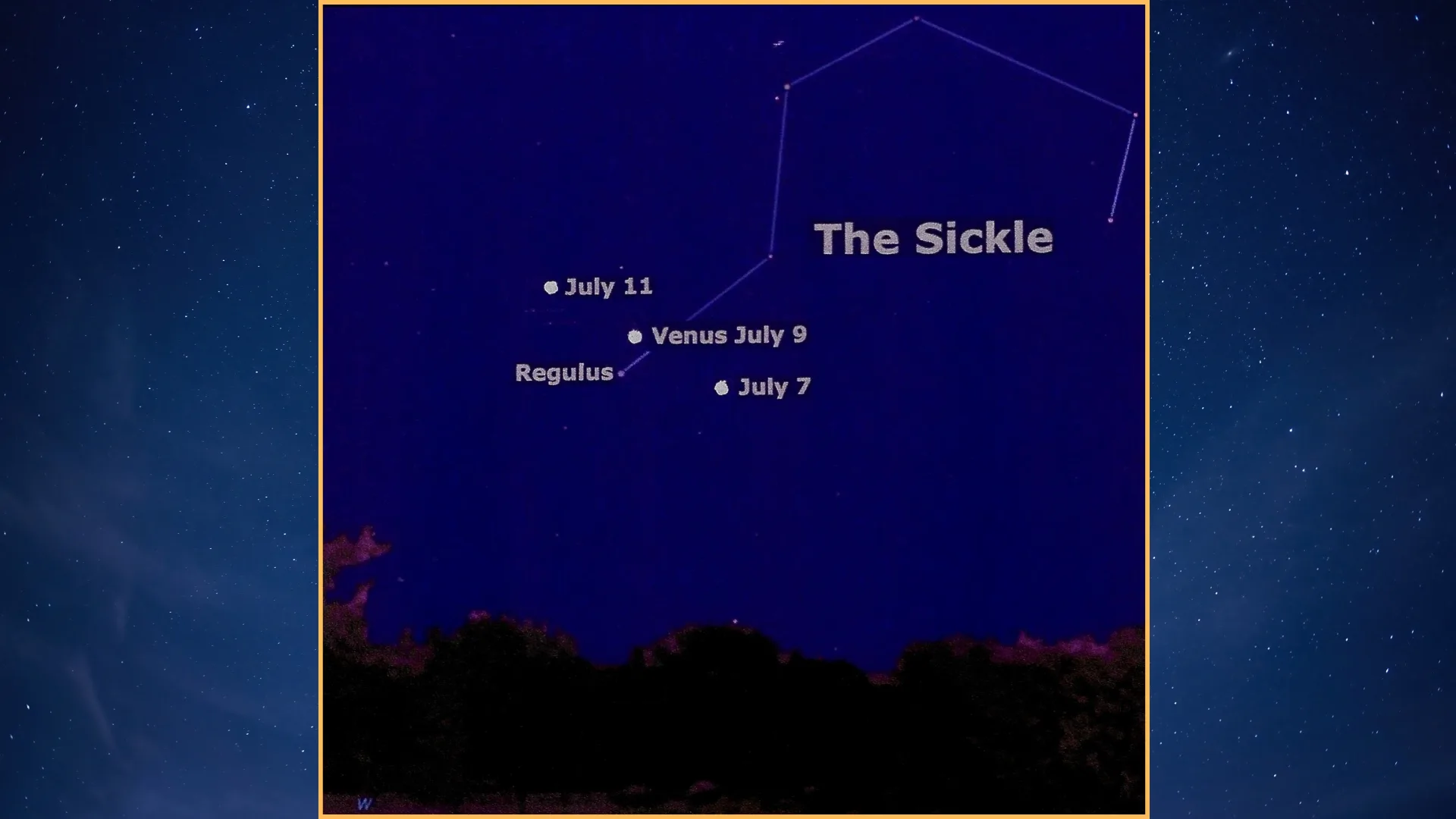
The first of the two Venus sky shows centres on Regulus, the 21st-brightest star in the sky and the anchor of the constellation Leo. Regulus is a blue-white star — noticeably different in colour from silvery Venus — and it sits at the bottom of an asterism called the Sickle, a backward question-mark shape formed by six of Leo’s stars. Historically, Regulus was one of the four ‘royal stars’ of ancient Persian astronomy, believed to govern one of the four quarters of the heavens. These days it’s better known as a reliable celestial landmark.
Venus and Regulus will be within three degrees of each other from July 7 through July 12, with the closest approach — just one degree of separation — occurring on July 9. To put that in perspective, your clenched fist held at arm’s length covers roughly ten degrees of sky; a single degree is about twice the apparent diameter of the full moon. They won’t be touching, but they’ll be close enough that a single binocular field of view captures both comfortably.
The viewing progression across those days is worth tracking night by night. On July 7, Venus sits to the right of Regulus as you face west. By July 9, it’s nudged to the upper right. By July 11, it has swung to the upper left and the gap is visibly wider. That apparent movement isn’t an illusion — Venus is genuinely moving along its orbit fast enough that you can track the shift across a handful of evenings without any equipment at all. These Venus sky shows reward patience and repeat visits.
One number tells you everything about the brightness contrast: Venus outshines Regulus by approximately 158 times. Regulus is no dim object — it made the list of the 21 brightest stars, just barely, at number 21 — but next to Venus it simply disappears into second billing. Binoculars will pull both objects into sharp relief and make the colour difference between the two more apparent.
July 17: Venus and the Crescent Moon
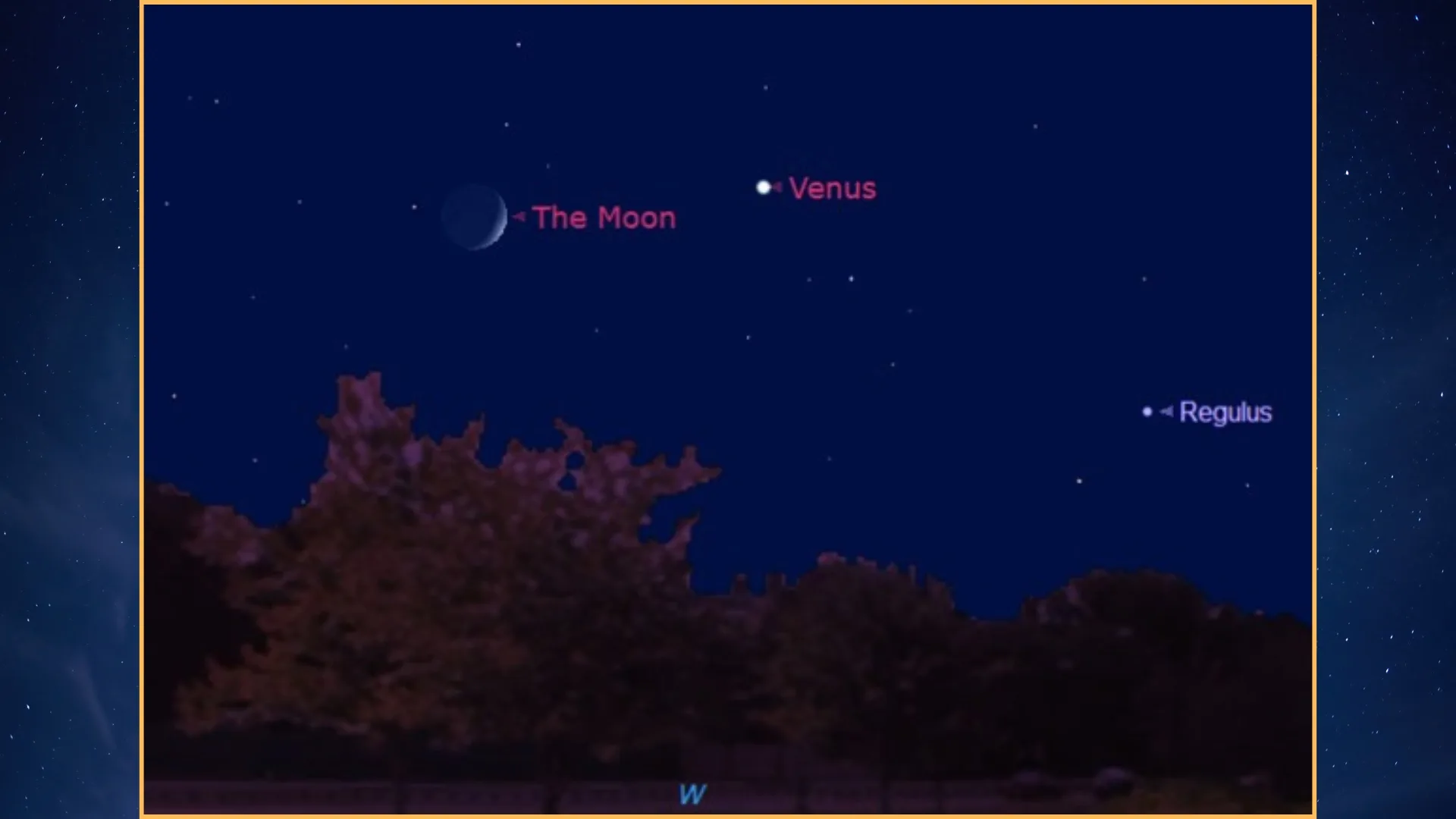
Ten days after peak Venus-Regulus proximity, the second of July’s Venus sky shows arrives in the form of a crescent moon pairing. On the evening of July 17, the moon will be 3.5 days past new phase, showing a slender crescent with just 17% of its face illuminated. It’ll sit roughly six degrees to the left of Venus as you face west-northwest — a wider separation than the Regulus event, but not one that makes the view any less compelling.
The pairing is less about precision alignment and more about spectacle. Two of the three brightest objects in Earth’s sky — Venus and the moon — descending together toward the horizon is the kind of sight that stops people on the street. Both should be setting around 10:30 p.m., giving you a reasonable window after sunset to find them. Again, binoculars help, but they’re genuinely not necessary.
What binoculars do reveal, and what’s worth looking for, is earthshine on the moon’s dark limb. When the crescent is thin like this, the portion of the lunar surface not lit by direct sunlight isn’t completely dark — it’s faintly illuminated by sunlight that has bounced off Earth’s oceans and clouds and then reflected back onto the moon. The effect is a ghostly greyish-blue glow on the dark part of the crescent, giving the whole disc an almost three-dimensional quality. It’s one of those subtle details that makes you appreciate just how much is going on even in these Venus sky shows that appear simple at first glance.
What Happens to Venus After July
These two Venus sky shows are, in a sense, a last hurrah for convenient evening viewing in 2025. The planet reaches its greatest elongation — 46 degrees from the sun — on August 15, which sounds like it should mean peak visibility. But because of its southward track relative to the ecliptic, Venus will actually appear lower in the western sky at greatest elongation than it does right now. That’s a counterintuitive result of orbital geometry, not a mistake in the ephemeris.
By late September the situation becomes genuinely difficult at mid-northern latitudes. Venus will be sinking rapidly, appearing as an increasingly large but thinning crescent through telescopes and steadily held binoculars — a beautiful sight, but one that requires a flat western horizon and precise timing to catch. The planet passes inferior conjunction on October 24, swinging 6 degrees south of the sun. That far south puts any transit attempt firmly in Southern Hemisphere territory only.
But the story doesn’t end there. Come November, Venus makes a dramatic entrance into the pre-dawn sky, climbing quickly enough that by December it’ll be the ‘star in the east’ greeting early risers before sunrise. If you miss the July Venus sky shows, that morning apparition will more than compensate — just set your alarm for an hour before dawn around Christmas and look east.
For now, though, the western twilight is where the action is. You’ve got a genuine multi-week window of easy, naked-eye planetary viewing — the kind of thing that professional educators at institutions like the Hayden Planetarium point to when they want to demonstrate that serious astronomy doesn’t require serious equipment. Step outside around 9:45 p.m. this week, face west, and Venus will find you.
Frequently Asked Questions
Where exactly should I look to see the Venus sky shows in July 2025?
Look low in the western sky around 9:45 p.m. local daylight time for the Venus-Regulus pairing, and west-northwest for the Venus-moon event on July 17. Both are visible to the naked eye, though binoculars sharpen the view considerably.
How close will Venus and Regulus actually appear on July 9?
On July 9, Venus and Regulus will be separated by just one degree. They’re within three degrees of each other from July 7 through July 12, giving skywatchers a nearly week-long window.
What is earthshine and will I be able to see it on July 17?
Earthshine is sunlight reflected off Earth back onto the moon’s dark side, producing a faint greyish-blue glow. On July 17, the moon will be only 17% illuminated, making the dark limb visible and earthshine a notable feature of the view.
When will Venus be at its brightest and highest in 2025?
Venus reaches its greatest elongation — 46 degrees from the sun — on August 15, 2025. Paradoxically, it will actually appear lower in the sky than it does now because its orbit has taken it south of the sun’s path across the sky.