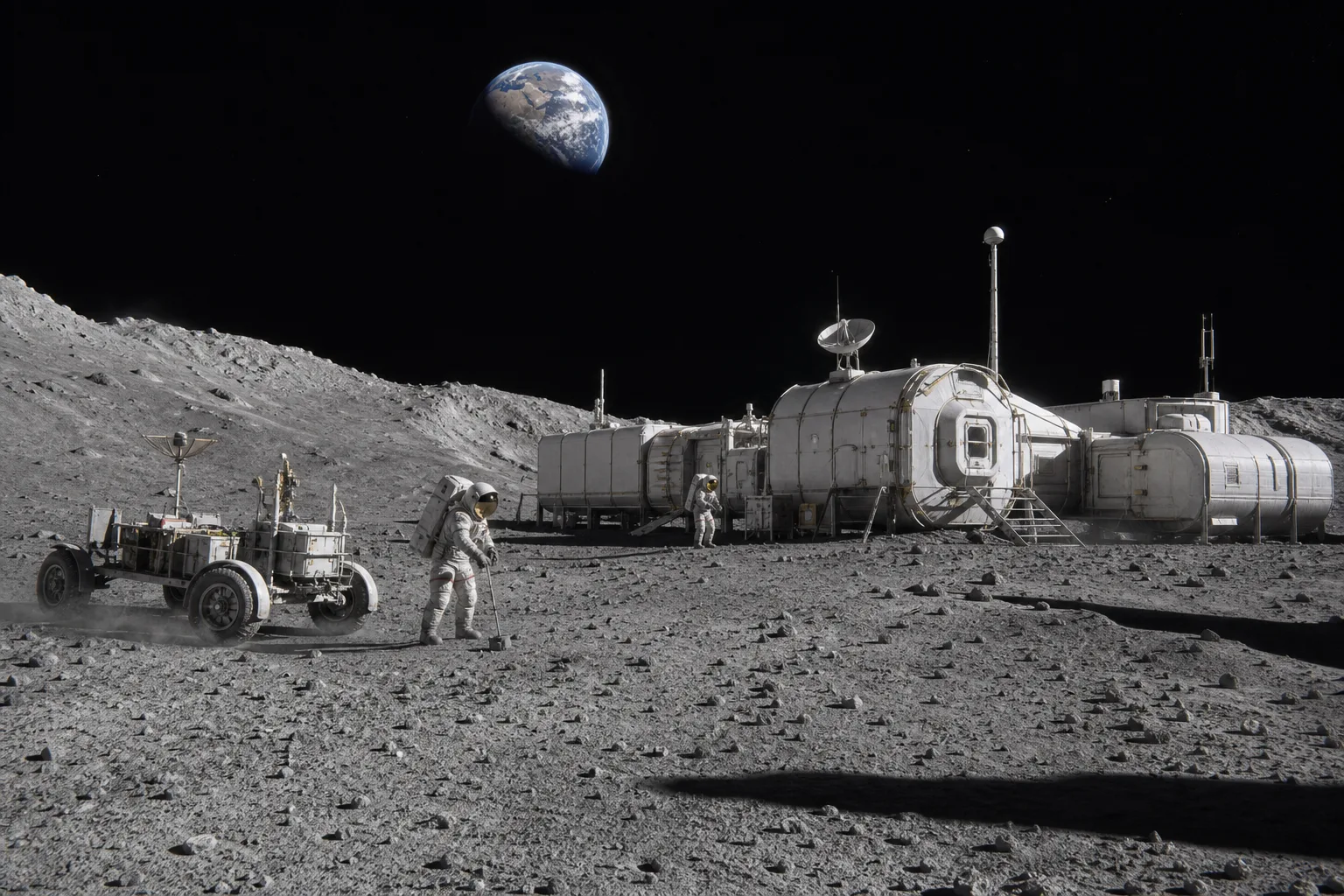
Building a NASA moon base is one of the most complex engineering and human-factors challenges the agency has ever attempted — and a new study suggests the biggest variable might not be rocket propulsion or habitat design. It might be how the crew is structured in the first place.
- A new PLOS ONE study finds NASA moon base mission design shapes crew productivity more than psychological training alone.
- The NASA moon base model showed only a 20% task completion rate under initial scenarios, highlighting significant operational challenges.
- Agent-based modeling — typically used for disease spread and bird flocks — was applied to simulate lunar crew dynamics.
- ISS data shows crew utilization topped 120 hours per week in late 2019, offering a benchmark for future lunar operations.
Table of Contents
Mission Design Over Mindset
A study published in PLOS ONE, led by Anamaria Berea, a computational social scientist at George Mason University, set out to identify the specific conditions that would make a permanent NASA moon base succeed — and the red flags that could quietly undermine it. The first author was GMU’s Raymond Vera, and their core argument is pointed: mission architecture itself, not just the psychological resilience of individual astronauts, will determine whether a lunar crew functions effectively.
That’s a meaningful reframe. For decades, astronaut selection has leaned heavily on the idea that the right people — mentally tough, emotionally stable, highly trained — will figure it out. Berea’s team is pushing back on that assumption, at least partially. Even a well-selected crew operating under a poorly designed NASA moon base structure will struggle. The environment shapes the behavior as much as the individual does.
How They Ran the Simulation
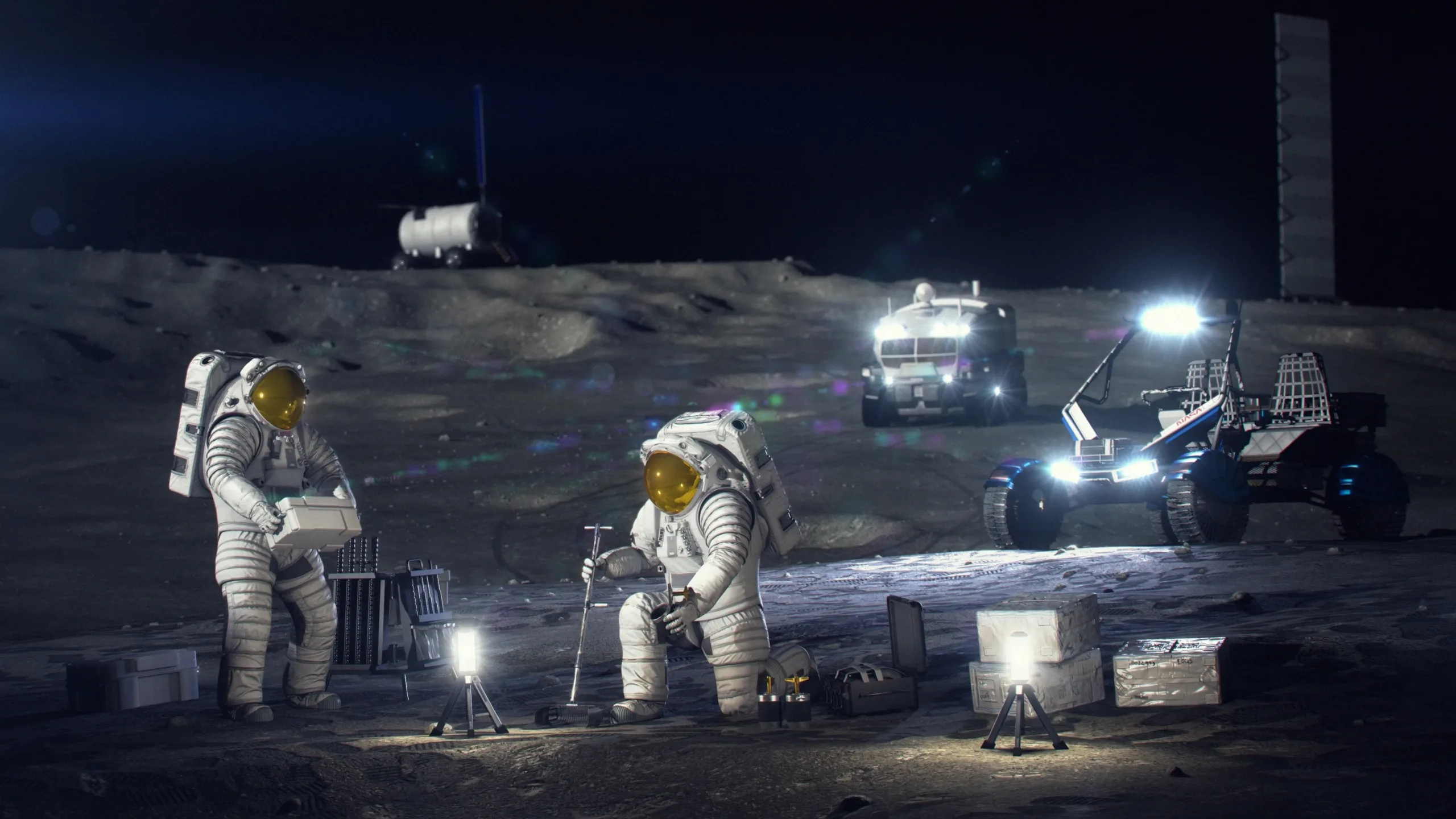
The team used agent-based modeling, a computational approach more commonly associated with tracking how diseases spread through populations or how starlings coordinate in murmurations. It’s distinct from the kind of machine learning driving most AI hype right now. Rather than training a model on historical data to predict future outcomes, agent-based modeling constructs a system of interacting ‘agents’ — in this case, simulated astronauts — and watches emergent group behaviors unfold under defined conditions.
The researchers layered in a Monte Carlo simulation, a probability tool that runs thousands of possible outcomes to identify the range of likely results. In their baseline scenario — a three-month NASA moon base mission with a single resupply at Month 2, delivering food, water, air, and a rotation of fresh crew members — the simulated astronauts achieved a productivity rate of roughly 20% against their assigned tasks. The authors describe this as acceptable by manufacturing process standards, but they’re candid about what it implies: teams are consistently struggling to push through psychological stressors and environmental disruptions, even under relatively controlled conditions.
That 20% figure doesn’t account for the unexpected. A meteorite strike, a suit malfunction, a medical emergency — none of those scenarios are baked in. Add real-world chaos and the number almost certainly drops further.
What the ISS Tells Us About Crew Utilization
The International Space Station offers the closest real-world data we have for benchmarking any future NASA moon base. NASA tracks productivity aboard the ISS using a metric called ‘utilization’ — essentially how many crew hours per week go toward scientific research and investigation, separate from maintenance, sleep, meals, and general housekeeping.
As of 2014, the ISS program set targets of 35 hours per crew per week with three people working on the U.S. segment, and 68.5 hours with four or more. Those targets have been consistently met and often surpassed. According to a September 2024 report from NASA’s Office of the Inspector General, the station hit a high of 120 average hours per week devoted to research between October 2019 and April 2020 — a remarkable output for an orbiting laboratory operating roughly 250 miles above Earth. From March 2022 through March 2023, the most recent period with published data, utilization held near 90 hours per week.
There’s a telling trend in that OIG report: both crew time and the number of scientific investigations have been climbing steadily from 2000 through 2023. Even accounting for documented disruptions — emergency ammonia leaks that required unplanned spacewalks, the operational pause following September 11, sheltering in place during debris-avoidance maneuvers — the trajectory is upward. Larger crews help explain part of that growth. With more people aboard, the burden of routine maintenance is shared more broadly, freeing up capacity for actual science.
But the OIG was also explicit about a structural vulnerability: lack of redundancy in crew and cargo transport. Right now, getting people to and from the ISS runs entirely on SpaceX Crew Dragon and Roscosmos Soyuz. Two vehicles. That’s a thin margin, and the agency knows it. The OIG flagged this directly: limited transportation options increase the risk to NASA’s ability to maintain safe operations and full utilization of the station. For a NASA moon base, which would sit roughly 240,000 miles further away and face far longer resupply timelines, that vulnerability would be exponentially greater.
The Isolated, Confined Environment Problem
Researchers use the term ‘isolated, confined environment,’ or ICE, to describe the conditions humans face in places like submarines, Antarctic research stations, and spacecraft. It’s a clinical phrase for something most of us understand intuitively — think of a long road trip crammed into a car with people you can’t escape, or the months many spent locked down with family or roommates during the pandemic. Resources are limited, personal space shrinks, and connections to the outside world become fragile.
A NASA moon base would be one of the most extreme ICE scenarios ever attempted. Unlike the ISS, which maintains near-real-time communication with mission control on Earth, a lunar outpost would face signal delays and, eventually for deeper missions, genuine communication blackouts. The crew wouldn’t just be isolated from Earth socially — they’d periodically be operationally on their own.
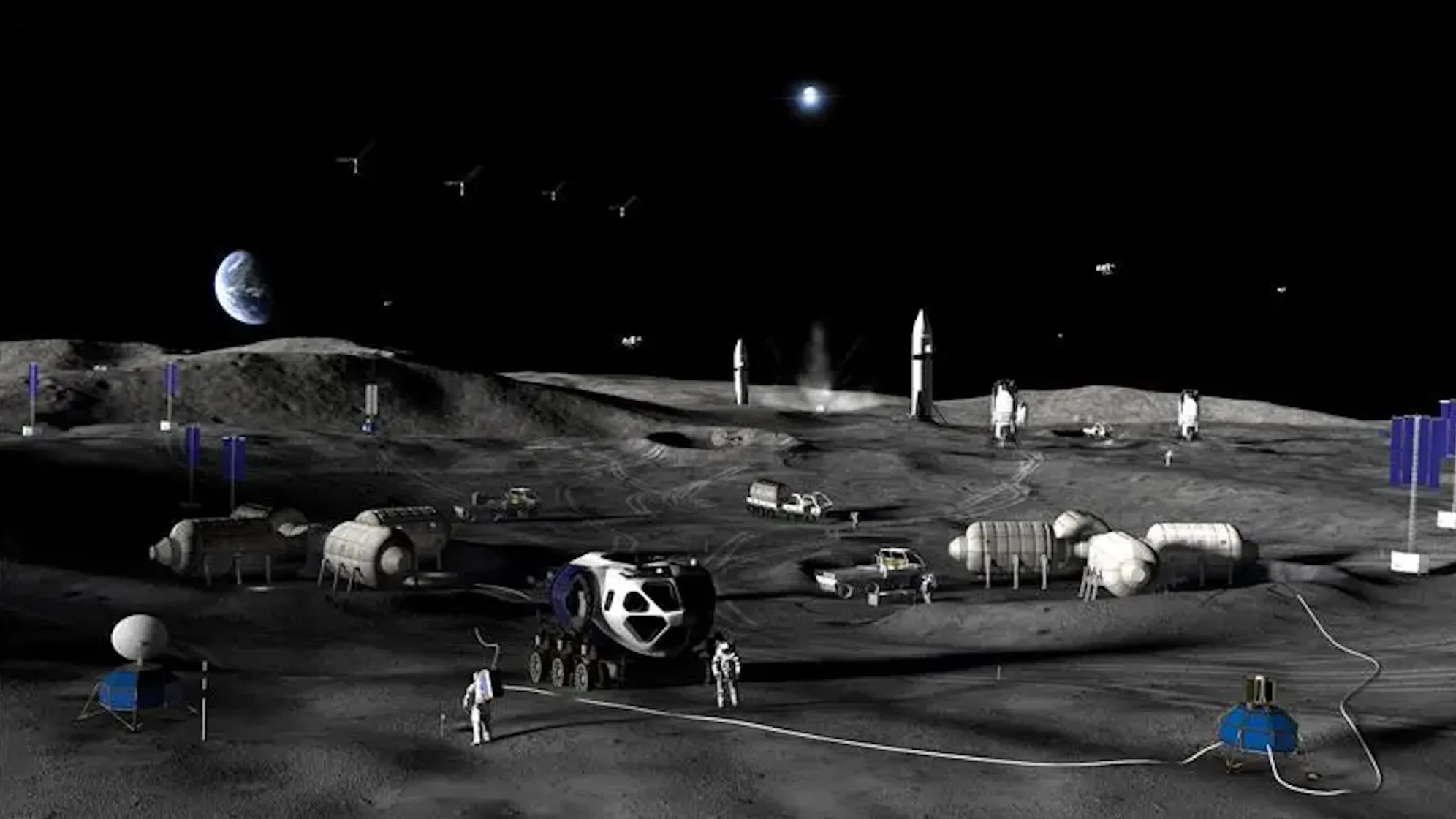
Berea’s team notes that a NASA moon base would add further complexity: not just human crew members, but rovers, robotic systems, and occasional visiting crews all interacting within the same confined operational space. Coordinating humans with semi-autonomous machines, under stress, with limited supplies, and without immediate outside support is a problem that existing research barely begins to address. As Berea put it, the team was ‘trying to understand better the human factors involved in crewed space missions, particularly the deep-space ones, for which we don’t have a lot of historical data.’

Why This Research Matters Now
NASA’s Artemis program is pushing toward a permanent presence near the lunar south pole, an area of intense interest because of confirmed water ice deposits in permanently shadowed craters. The scientific and strategic value of establishing a NASA moon base in this region is obvious. The logistical and human factors challenge is enormous.
The kind of agent-based modeling Berea’s team is applying isn’t just an academic exercise. It’s exactly the sort of tool mission planners need before committing to a crew structure, a resupply cadence, or a rotation schedule. Getting those decisions wrong won’t just reduce productivity — it could strand people in a genuinely dangerous situation with few options for rapid intervention from Earth.
The ISS experience proves that productivity in space can be high, and that it tends to improve as crew size grows and operational systems mature. But the ISS also shows how fragile that performance is when supply chains thin out or transport options collapse. A NASA moon base will have fewer safety valves, longer resupply windows, and far less room for error. The 20% task completion rate in Berea’s baseline model isn’t a prediction of failure — it’s a starting point for asking harder questions about how to design missions that push that number significantly higher before any astronaut sets foot in a permanent lunar habitat.
Frequently Asked Questions
How many astronauts should live in a NASA moon base?
The research doesn’t prescribe one fixed number, but it models different crew sizes and resupply frequencies. The study suggests mission design — including how often new crews rotate in — matters as much as how many people are present at any given time.
What is agent-based modeling and why is it used for space missions?
Agent-based modeling uses computational simulations to study emergent group behaviors that don’t have a single direct cause. Unlike machine learning, it doesn’t extrapolate from patterns — it models how individual agents interact under specific conditions, making it useful for novel environments like a lunar outpost.
How does ISS crew productivity compare to what’s projected for a moon base?
The ISS reached over 120 hours per week of research utilization between October 2019 and April 2020, according to NASA’s Office of the Inspector General. The moon base model, by contrast, showed only around 20% task completion — though the two metrics aren’t directly comparable.
What are the biggest risks to productivity in an isolated space environment?
Psychological stress, supply chain vulnerability, and lack of transportation redundancy are the main threats. The ISS has faced disruptions from ammonia leaks and space debris events, and NASA’s OIG flagged limited crew and cargo vehicle options as a critical risk to sustained operations.