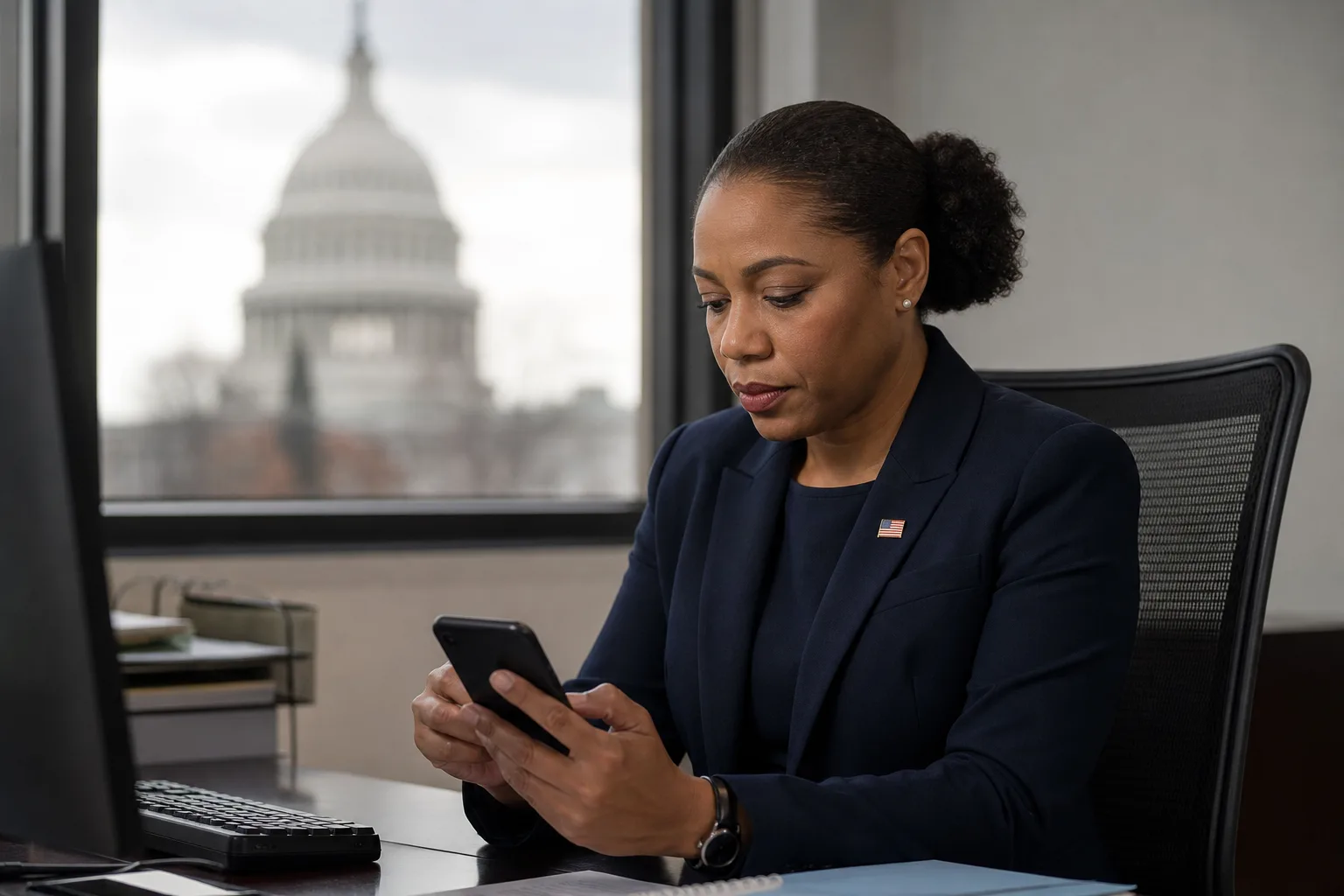
- TikTok government devices may again run the app after the Justice Department said a 2022 federal restriction no longer applies.
- The TikTok government devices reversal follows a US ownership arrangement involving Oracle, Silver Lake, MGX, and a reduced ByteDance stake.
- Federal agencies retain discretion over employee access and can still impose their own workplace security policies.
- The decision shifts TikTok’s Washington debate from a blanket ban toward oversight of the company’s new US structure.
Table of Contents
TikTok government devices are back, with an asterisk
The federal government’s TikTok policy has taken another sharp turn. TikTok government devices can once again carry the short-video app, according to a Justice Department memo reported by Reuters, ending a restriction that had been in place since 2022.
That does not mean every federal worker should expect to scroll dance clips between meetings. The DOJ reportedly told executive-branch agencies that employees may download TikTok to official devices only at an agency’s discretion and in line with workplace rules. In plain English: the legal barricade has moved, but the IT department may still keep the gate locked.
The change rests on TikTok’s reworked US ownership arrangement. Oracle, Silver Lake and Abu Dhabi-based MGX are backing the new US joint venture, while ByteDance retains a 19.9% stake. Oracle, which has spent years orbiting TikTok’s US operations, is positioned as the security partner. That structure appears to be the legal distinction the administration needed to say the old prohibition no longer fits.
It’s an oddly consequential moment for an app that has spent much of the past four years as a geopolitical football. Washington first framed TikTok as a national-security concern, then passed a law aimed at forcing a divestiture or banning the service. Now, after a deal and a series of delayed enforcement deadlines, the government is effectively telling its own workforce that TikTok government devices are no longer automatically off-limits.
Why the original ban existed
The 2022 law barring TikTok from federal devices was not a consumer ban. It was a narrow risk-management measure based on the possibility that a China-based parent company could access sensitive user data or influence content recommendations. Federal phones can hold contact lists, location information, agency communications and work calendars. Even a relatively ordinary handset can become a useful piece of a much larger intelligence puzzle.
That concern did not emerge from nowhere. ByteDance’s corporate ties and Chinese national-security laws raised concerns. But government security policy is rarely built around taking a company at its word.
The federal-device restriction also became a template. States, universities and public agencies adopted similar rules. For a time, TikTok government devices were a clean political signal: officials could look tough on China without requiring millions of ordinary Americans to give up an extremely popular app.
Then Congress went much further. The divest-or-ban law pushed TikTok toward a national shutdown, and the app briefly went dark in the US as the deadline arrived last year. President Donald Trump repeatedly delayed enforcement and pressed service providers to restore access while a deal was worked out. Remember when the industry spent years wondering whether TikTok would vanish overnight? The answer, apparently, was that it would disappear just long enough to prove the threat was real.
The deal changes the legal argument, not every security question
The new arrangement is designed to put meaningful US-based ownership and oversight between ByteDance and American TikTok users. Oracle’s role is as the new venture’s security partner. The pitch is familiar, even if the corporate paperwork has changed — isolate American information, monitor the systems handling it and reduce Beijing’s potential influence.
My read is that the DOJ’s position is a legal and political judgment, not a declaration that all concerns about TikTok have evaporated. ByteDance retaining 19.9% matters. Minority ownership can be economically limited while still leaving difficult questions about software development, recommendation systems, intellectual property and practical operational control. Those are not questions answered by simply relocating a server rack.
For TikTok government devices, agencies will likely make different calls based on mission and risk tolerance. A public-affairs office that uses TikTok to reach younger audiences may see a clear reason to install it on a managed phone. A defense, intelligence or law-enforcement office may see no upside whatsoever. Both outcomes would fit the DOJ’s reported guidance.
There is a practical point here, too. Government cybersecurity policies already distinguish between devices used for public outreach and devices that touch sensitive systems. The sensible approach for TikTok government devices is not pretending all phones are equal; it is setting rules around accounts, permissions, data access and device management. That is mundane IT work, frankly, but mundane IT work is what prevents avoidable breaches.
What Washington’s TikTok reversal actually changes
The immediate effect for most Americans is close to zero. This does not change whether consumers can download TikTok, nor does it erase the broader political fight around Chinese technology. It does, however, give TikTok an important symbolic win. TikTok government devices were once treated as an obvious security red line. The administration is now saying that line can be crossed under the right ownership and policy conditions.
For Oracle, the decision is a validation of its long-running bet that it could become the acceptable American custodian for TikTok. The company gets a high-profile security role, and potentially a durable cloud and compliance relationship, without having to become TikTok’s outright owner. Silver Lake and MGX, meanwhile, get an investment tied to one of the world’s most culturally powerful consumer platforms.
The real test will be transparency. Congress, agency security teams and outside researchers will want to know what the US venture actually controls, how Oracle audits its systems, and whether ByteDance’s remaining role is genuinely constrained. TikTok government devices may be permitted again, but the trust question has merely become more technical — and far more difficult to settle with a press release.
If the ownership structure holds up under scrutiny, TikTok may have found a model for surviving the next wave of tech nationalism. If it does not, this reversal will look less like a policy resolution and more like another temporary extension in a saga Washington still has not finished writing.
For background on the original federal restriction, readers can review the No TikTok on Government Devices Act on Congress.gov.