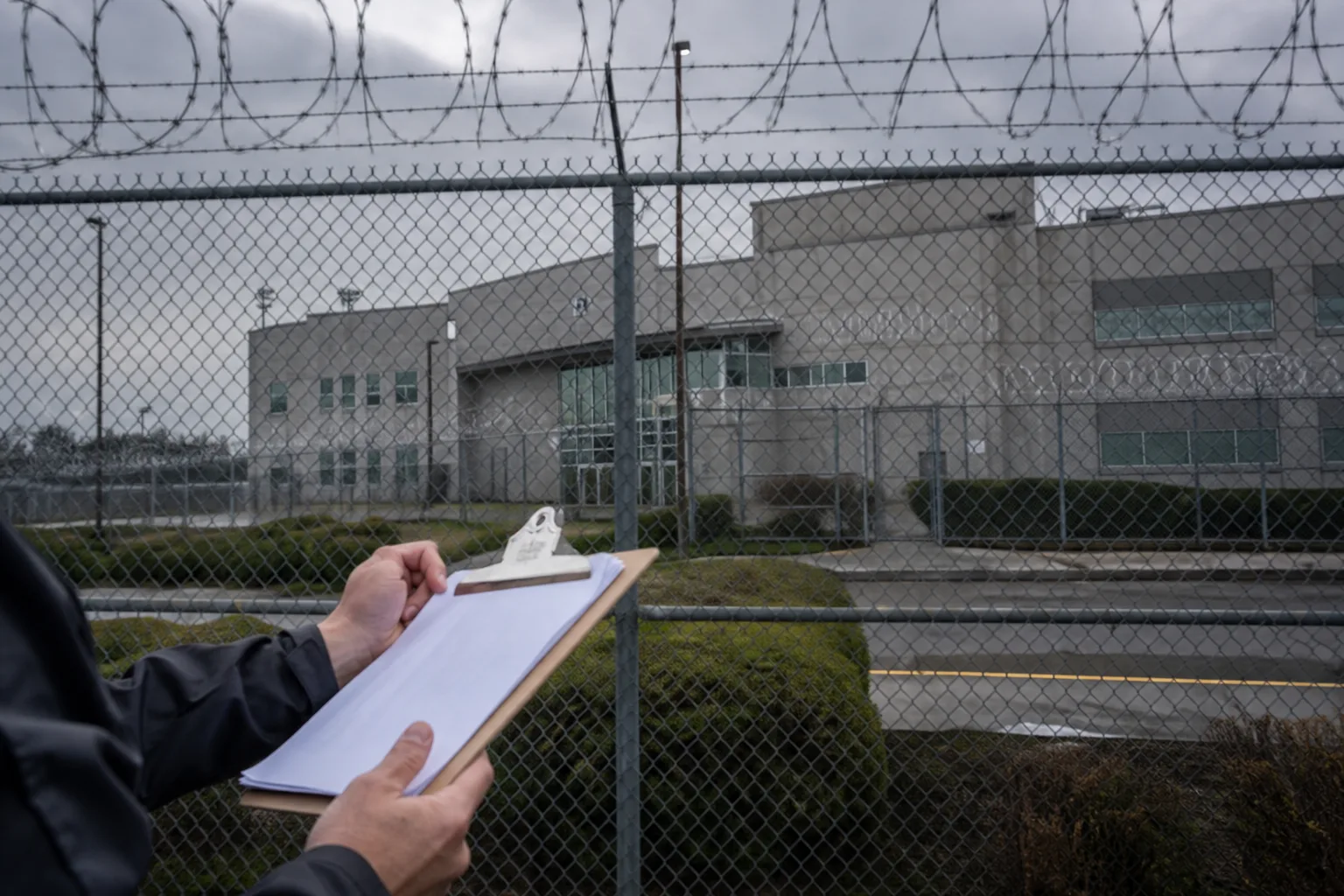
- Draft ICE detention contracts say state and local laws shall not apply at four privately operated immigration detention facilities.
- The ICE detention contracts surfaced one day after a federal judge rejected nearly identical language in Washington state.
- The proposed awards appear tailored to existing GEO Group facilities, with a 30-day timeline that leaves little room for new competitors.
- New detention standards could limit outside oversight while allowing facilities to operate at 85 percent staffing, including medical personnel.
Table of Contents
ICE detention contracts are trying to redraw the line
A contract clause can look like dry procurement boilerplate right up until it tries to tell a state government it cannot enforce its own laws. That is the unusually blunt move embedded in draft ICE detention contracts published in July: state and local laws “shall not apply” to the operation of the facilities covered by the agreements.
On its face, the language concerns four immigration detention sites and roughly 5,500 beds. In practice, these ICE detention contracts look like an attempt to move a large slice of America’s private detention system outside the reach of state health, labor, and safety regulators. I’d argue that is the real story here. The immediate legal question is whether ICE can write such a clause. The larger question is what happens when federal agencies use contracting terms as a shortcut around public oversight.
The timing is hard to miss. On July 9, US District Judge Benjamin Settle ordered the operator of the Northwest ICE Processing Center in Tacoma, Washington, to allow state health officials into the facility. The next day, ICE posted its draft procurement materials containing language that mirrors the disputed Tacoma contract.

Settle’s reading of the law was refreshingly direct: “Preemption requires Congressional intent, not a contract.” In other words, a federal agreement cannot simply erase Washington law because the parties would prefer it did. That sounds obvious to anyone outside a federal procurement office. Yet Washington reportedly spent three years litigating for access, after 10 rejected inspection attempts and roughly 3,500 complaints from detainees.
The picture is messier for now. A Ninth Circuit judge paused Settle’s access order on July 21 while GEO Group pursues an appeal. But a pause is not a legal endorsement of the clause. It does, however, demonstrate why this strategy may appeal to ICE and its contractors: even a weak legal position can buy time when each inspection requires a lengthy court fight.
Why these ICE detention contracts look built for incumbents
The draft solicitation is presented as a competition, but the details point in a different direction. Operators would have to begin housing people within 30 days of an award. That is not enough time to build a facility, secure permits, hire hundreds of staff, and stand up medical operations. It is enough time if you already own the building, the beds, and much of the workforce. The compressed schedule makes the ICE detention contracts especially difficult for new competitors to pursue.
The specified locations and capacity line up with detention centers already run by GEO Group: Tacoma; Aurora, Colorado; Pompano Beach, Florida; and Philipsburg, Pennsylvania. The Florida request calls for 700 beds, matching the existing guaranteed bed count at GEO’s Pompano Beach facility. Contracts or local operating arrangements at these sites are due to expire in the coming months, making the procurement look less like an open invitation than a renewal process wearing a competitive-bidding costume.
That matters because ICE detention contracts are not ordinary government purchases. These agreements determine who controls access to facilities holding people who often have limited ability to report medical problems, unsafe conditions, or mistreatment. A contract structure that makes incumbency the practical entry ticket also concentrates power in the hands of a small private-prison industry.
GEO’s role in the Tacoma dispute is especially revealing. Judge Settle said the company signed a new ICE agreement during the lawsuit and then argued that ICE, rather than GEO, controlled entry to the building. He also faulted GEO’s court presentation for leaving out a provision under which ICE would ask the Justice Department to seek GEO’s dismissal from litigation related to its performance, or substitute ICE as the defendant.
That arrangement has a familiar flavor: private operator runs the facility, federal agency claims ultimate authority, and accountability becomes a relay race between two entities. If you’ve ever tried to get a cable company and an internet provider to agree on who owns a service outage, you know the basic frustration. Now imagine the stakes are health inspections inside a detention center.
A weaker rulebook could make oversight harder
The proposed ICE detention contracts may also move facilities onto ICE’s newer National Detention Standards, issued in June. ICE says the standards will “reduce the burden” on contractors. That phrasing should make readers sit up. Reducing burden can mean eliminating paperwork; it can also mean lowering the friction that forces an operator to answer uncomfortable questions.
ICE records indicate that three of the four facilities were previously inspected under the agency’s 2011 performance-based standards, which are generally viewed as more demanding. Tacoma was inspected under the newer National Detention Standards after its revised agreement took effect. The agency’s detention management materials describe its framework, but the practical issue is who gets to verify compliance when state officials are excluded.
The newer standards allow facilities to run indefinitely at 85 percent staffing, including medical staffing. They say detained people performing “voluntary work” are not employees entitled to wages or benefits, while capping payments at $1 per day. They also permit AI translation tools for communications deemed non-critical. That last distinction is doing a lot of work. In a detention environment, a conversation that begins as routine can quickly become medically or legally consequential.
Under the draft terms, outside inspections would be confined to ICE, ICE-approved third parties, and other federal officials. Internal oversight has value, obviously, but it is not a replacement for independent state scrutiny. Regulators with different mandates tend to catch different problems. That is not ideological; it is how inspection systems work in every other high-risk industry, from nursing homes to chemical plants.

The California precedent shows where this can lead
Washington is not alone in confronting this issue. San Diego County officials were blocked from inspecting CoreCivic’s Otay Mesa Detention Center, then sued and won a federal court order for access in June. Soon after, CoreCivic announced it had sold Otay Mesa and the California City Detention Facility to the Department of Homeland Security for $1.5 billion.
DHS spokesperson Lauren Bis linked the purchase to California’s “sanctuary politicians,” saying they were trying to outlaw private prisons or make them financially unworkable. CoreCivic said independent appraisers set the facilities’ valuations through the government’s required process. Still, the broader pattern is plain: if private ownership triggers state regulation, direct federal ownership can change the legal terrain.
That is why the new ICE detention contracts deserve attention beyond the four named locations. Buying facilities is one route around state pressure. Writing federal supremacy into vendor contracts is another. Neither approach automatically settles the constitutional question, but both can force states into expensive, years-long litigation before an inspector gets through the front gate.
A contract cannot settle the constitutional fight
Federal law can preempt state law, but courts generally look for Congress to make that choice. An agency procurement document is not an act of Congress. The Tacoma ruling may be preliminary and geographically limited, yet it identifies the central weakness in ICE’s approach: the government appears to be asserting a power it has not clearly been granted.
For people inside these centers, that distinction is hardly academic. Washington says two people have died at the Tacoma facility since 2024, while state officials were attempting to investigate thousands of complaints. The system should not require a three-year lawsuit just to establish whether public health inspectors can enter a building.
My read is that ICE may be betting on delay rather than a decisive courtroom win. If the agency puts the same disputed wording into ICE detention contracts across Colorado, Florida, Pennsylvania, and Washington, every state may have to fight its own version of the Tacoma case. The question is whether courts will keep treating that as four isolated disputes—or recognize a national policy designed to make outside accountability optional. The outcome could determine how broadly ICE detention contracts can be used to limit state oversight.